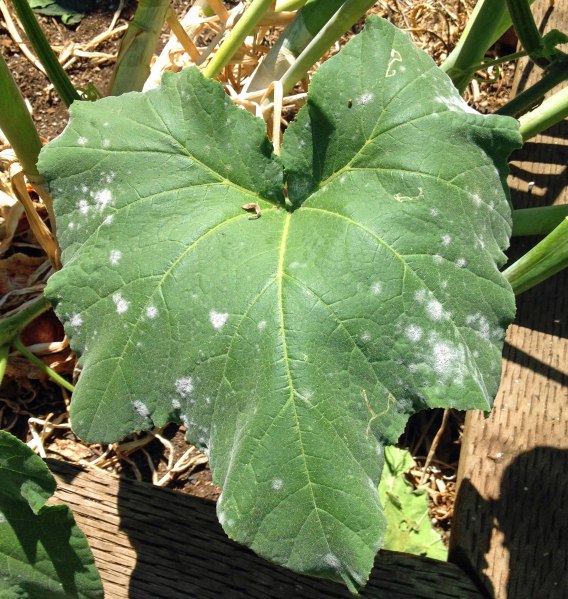
It must be August, because my squash leaves are starting to look pretty sad in places. I noticed the beginnings of a whitefly problem a few nights ago and tested a new do-it-yourself spray on a group of leaves. Two days later, the test leaves looked great, but the rest of the squash patch was starting to show more serious signs of infestation. Today I sprayed the top and bottom surface of every leaf I could find with evidence of whiteflies and then some. I’ll track the results in a few more days and update things here.
The varieties of squash in the patch are:
‘Vegetable Spaghetti’ (C. pepo)
‘Candy Roaster Melon’ squash (C. maxima)
‘Upper Ground Sweet Potato’ (C. moschata)
and ‘Jim’s Butternut’ (C. moschata)
This last one was saved from ‘Waltham Butternut’ many years ago and kept going by a neighbor. It grew 25 foot vines with 10 fruit on a single vine in 2012. If some of that productivity crosses into my ‘Upper Ground Sweet Potato’ seeds for next year, maybe it will be a good thing!
The ‘Spaghetti’ squash is suffering the most from the whiteflies, though I first noticed it on the ‘Upper Ground Sweet Potato’ leaves. Maybe I didn’t notice it on the ‘Spaghetti’ squash because it’s harder to get to their part of the patch? The ‘Candy Roaster Melon’ is clearly the least affected. It’s much slower growing than the other varieties and is just now, in August, starting to flower. I have yet to find any research on differing vulnerability to whitefly across squash species, so the differences I see may have other causes. It is certainly too early to say that C. pepo is more likely to suffer whitefly infestation and C. maxim is more likely to fend it off—but that’s a theory that might turn out to be worth testing.
 The spray that I made started with 1 Tsp of Dawn Advanced Power liquid dishwashing soap mixed into 1 cup of vegetable oil. This makes a concentrate that you then mix with water in your sprayer. Add 1 1/2 tsp of the concentrate for each cup of water you add into the sprayer. I mixed 3 cups worth at a time in my regular household spray bottle. Next time I will seriously consider a backpack sprayer. In order to control whitefly everything I have read emphasizes the need to spray both the tops and the underside of the leaves. This can quickly become a tedious and finger-numbing project with your average spray bottle.
Next year I will plan ahead. The U.C. Davis Integrated Pest Management site says, “Several wasps, including species in the Encarsia and Eretmocerus genera, parasitize whiteflies. Whitefly nymphs are also preyed upon by bigeyed bugs, lacewing larvae, and lady beetles.” Buglogical has additional suggestions to try. If I manage to establish populations of these good bugs in my garden before August next year, maybe we won’t see the whiteflies at all.
Do you have a whitefly cure that works well in your garden? Please share it in the comments. And if you have tried something that didn’t work, I’d like to hear about that as well.
Updated August 31, 2013
The spray has had mixed results. The plants are still going, and new fruit is even being set, but there is noticeable damage from this pest on a number of leaves. Below is an example from the ‘Butternut’ patch.

Butternut Squash leaves treated with homemade whitefly deterrent.
The growing tips look healthy and you can see at least one young squash has been set during the Whitefly/Mildew invasion. But a number of leaves may have been too damaged to recover. And the nastiness is clearly spreading again.

Both sets of leaves you see here are from the same Spaghetti Squash, one clearly much more affected than the other.
Only the few five-fingered leaves you see here are not from this plant. Seeing these leaves so close together, clearly growing in the same conditions, makes me wonder about the variability for disease resistance in these squash.



 From Dirt to Dinner