Potting Up

1 Comment

The tomato seeds start out in little pellets, and the irony is not lost on me that I am growing “local” food by starting seeds in a product that has come all the way from Vietnam.

Starting Local Food in Fiber Grow from Vietnam

Starting Local Food in Fiber Grow from Vietnam

Digging up peat bogs to dry them and ship them to gardeners everywhere contributes to global warming, so I thought I was doing a good thing by getting Fiber Grow pellets. But once I got home and turned the package over and read the Made in Vietnam sticker, I wasn’t so sure anymore. It takes a lot of resources to ship not-peat moss around the world too.

Tomato Sprouts

Tomato Sprouts

Anyway, the tomatoes, for better or worse, begin their lives on the top of the refrigerator in their Vietnamese fiber homes. It takes a week or two sometimes at the right temperature for them to germinate. They like to be warm. The first batch I started, only about half of them ever sprouted at all.

Once they have “true” leaves, the tomatoes and their Vietnamese pots go into the regular 6-packs you might see at the garden store.

First Potting

First Potting

They will stay in the 6-packs for several weeks until they begin to fill out, develop stronger stems, make more leaves and start to be recognizable as tomato plants.

The next time the plants are potted up, they will be set deep into individual containers with potting soil
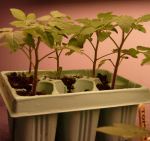
Tomato Starts in 6-pack

Tomato Starts in 6-pack

and a little mature compost to help them grow strong. This may sound nasty, but you bury them deep enough in the new pots that some of the early leaves will be under the soil, so you carefully tear these leaves off. Where the leaves were on the stems, roots will grow in the soil making the plant sturdier when it finally sees the garden soil.

The tomato seeds that I started in early January are just now moving into their own pots for the first time, so this process has taken about 6 weeks. It takes a long time to grow tomatoes from seed but I am really looking forward to all the pasta sauce and sundried tomatoes, salads, catsup…
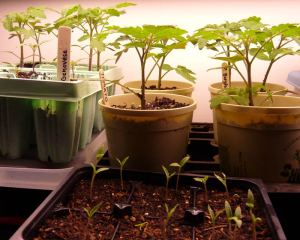
Tomatoes in Four Sizes

Tomatoes in Four Sizes

When’s the Last Date of Expected Rain?

Leave a comment

We made it past the last date of expected frost, February 19th, without much fanfare but I am hoping for at least a break in the rain for our first garden session of the project this coming Saturday.

Fresh Produce

Fresh Produce

We have also scheduled our first extra field trip, to the grand opening of the Full Circle Farm produce stand on Wednesday, March 4th from 4:00 to 6:00. This is a great place for us to visit because the kids will have a working day on the farm at Full Circle coming up on the 28th. That ought to make it abundantly clear how the produce gets to the farmstand.  ;-)

The garden is starting to take shape. There is lots to do and to build and some small garden beds ready for planting. We got a very generous donation of seed from the National Gardening Association. We’ll make a Thank You card for that when we’re together.

We’ve created a Ning for the kids to use to share their ideas, photos, videos, blogs and comments as the project progresses. Now all we need is a four or five hour break in the Spring rain, and we’re all set!

The Last Winter Carrots

Leave a comment


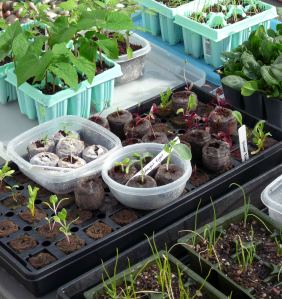
Starts hardening off

Starts hardening off

This morning some of the starts that have been growing under lights in the garage are having a field trip out into the partially cloudy day. We still have at least five days until the last date of expected frost, so I’m going to give them a few hours a day up to all day over the next week or so as they get ready for possible planting on the 28th.

We have beets, two different kinds of tomato plants, three types of onions, Swiss chard, spinach, bush beans, cabbage, cucumbers and some flower starts pictured here.


Last night *something* went through the carrot patch and perfectly munched the Winter carrots, leaving the separated tops undisturbed on the soil. At least our raiders left us everything we need to make nice compost to grow more carrots!

The Last of the Winter Carrots

The Last of the Winter Carrots

I got out a digging fork and gently dug around to find the last of the remaining carrots that have wintered over.  Next year I will do lots more of them. These were delicious and very welcome in stews and soups. There are a few small patches of carrots coming up and there are three or four varieties ready for the Dirt to Dinner kids to arrive on the 28th. My favorite way to plant them is using carrot tape, which I have just found out how to make oursevles, so I’ll be adding that to the project list.


Here’s what we ended up with when it was time to make lunch:

Romeos Ready to Cook

Romeos Ready to Cook


We have two different varieties of potatoes started and will be able to plant them in bags or various containers for the kids to experiment with. I can’t wait to see how they do. We should be able to start eating new potatoes about half way through our program.

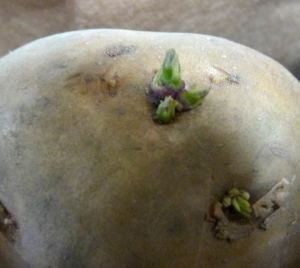
Potatoes Growing Eyes

Potatoes Growing Eyes


Eye See You

Eye See You

Dirt to Dinner Reading List

Leave a comment

We have enjoyed many of the resources we are pouring through as we plan the Dirt to Dinner program and want to share our top-picks-so-far list with you. Let us know if you have a don’t miss title of your own to share.

Gardening

Golden Gate Gardening by Pam Peirce who also blogs at Golden Gate Gardener

The Garden Primer by Barbara Damrosh, who also writes a regular gardening column for the Washington Post


Cooking

The Art of Simple Food by Alice Waters

Simply in Season Children’s Cookbook by Julie Kauffman


Learning More

Math in the Garden by White, Barrett and Kopp

Botany on Your Plate: Investigating the Plants We Eat by Barrett, White and Manoux

The Growing Classroom by Jaffee and Appel

“How’d That Get on My Plate?” on the Food Network

“Food Detectives” on the Food Network


Good Background for Older Kids/Adults 

Animal Vegetable Miracle by Barbara Kingsolver

The Omnivore’s Dilemma by Michael Pollan

Fast Food Nation by Eric Schlosser

King Corn documentary by Aaron Woolf

Super Size Me documentary by Morgan Spurlock

Six Arguments for a Greener Diet by the Center for Science in the Public Interest


The Great Raised Bed Debate

6 Comments

I was clearly naive about the number of options for raised beds there were to consider. Long gone are the days when my mother tossed a couple of railroad ties against the hillside and called it a garden. And the cost has changed too!

These gorgeous beds from Naturalyards would have cost well over a

Natrualyards Cedar

Naturalyards Cedar

$1000 to hold the Dirt to Dinner growing plots for each of the kids.  Not quite what we had budgeted for! But if money were no object, these would be the beds for me. They are beautiful, easy to assemble, available in lots of size choices and look like they would last a generation.

Link-A-BOrd

Link-A-Bord

I also like the idea of Link-a-Bord bins that would have snapped together.  They are made of all recycled materials.  They are light and easy to construct.  They come with two different depths, both a little shallower than I like for vegetable gardening, but reasonably priced. They still have the nice, neat look that any realtors scanning the neighborhood would approve of.

There were also quite an array of sizes and shapes to choose from. Want a good geometry exercise for the kids?  How many square feet of space do you get with this?

Traingle Raised Beds

Traingle Raised Beds

It’s an equilateral triangle with 7’ sides. Then it has another equilateral triangle on top so you can have that section be twice the planning depth of the large triangle ends, so now you really need to look at the cubic feet,…

When the calculator cooled off, it didn’t make sense to go with the funky shapes, much as I wanted to.

Paver Raised Beds

Paver Raised Beds

Lee Valley had some great kits where you use 16” pavers and their hardware to build beds. These things probably would have survived the next Big One, but somehow concrete and kids and all those nuts and bolts didn’t work for me for this project.  Though I love Lee Valley and the excuse to get some fun tools would have been worth it.

I was hoping to get back to the more natural “wild” look of at least the Natruayards design, if not something onto the other side of that when I came across a post on a gardening chat site that referred to the 600 year-old technology of raised bed design used in English gardens. That’s when I found mastergardenproducts.com.

Historic Willow Raised Beds

Historic Willow Raised Beds

willowraisedbedmodern

Modern Willow Raised Beds

Oh yeah. That’s as granola-y as they come.  It’s perfect. Sadly, it’s nearly impossible to find enough Willow that size to make similar boxes today, but the ones we’ll be using in the Dirt to Dinner garden will look something like the modern ones before we seal them with linseed oil, line them and fill them with our garden planting mix.

I’m a little worried that the sticks will need some kind of covering on the top to keep from sticking us, but I’m sure we’ll figure something out.  And we may even weave some of our own versions to see how they compare.