Carrots From Root to Flower

Leave a comment
Carrot tops sticking out of the soil

No Crowding the Carrots

I can often be found in the garden munching a carrot I couldn’t resist pulling out of the soil and hosing off while I worked. All in the name of proper thinning, of course. Unlike the peas you might consider serving them with, carrots do not like to be too crowded.

It took me several years to get the hang of how to encourage decent carrot seed germination, but lately my carrot luck has extended all the way to the final stage of seed saving. Last fall was the first time I attempted to plant carrot seed I had “saved” by way of forgetting to harvest a couple of carrots that later went to see among the bean poles where I couldn’t see them. I hoped they were purple carrots, the part still sticking up out of the ground certainly didn’t look orange anymore, but when the seeds came up this spring, the roots were mostly a very pale and not especially tasty yellow. Carrots  are an insect pollinated biennial, so chances are that either pollen from another carrot variety was introduced to my purple carrots, or the purple carrots I hoped I was letting go to seed were hybrids that wouldn’t breed true for the purple characteristic that I wanted.

Carrot FlowersThis winter I set aside a much more carefully protected carrot patch in the back garden where a known variety of carrots was grouped together and no other carrots, or other umbels at all, were allowed to flower. I’m just now starting to see flower heads drying enough to save seed and can’t wait to try planting them once the rains start this fall.

The problem is that by the time you save enough carrots to get good cross-pollination, you have just made sure you will have enough carrot seed for an entire army of urban farmers, and their friends. For home use, I just save the seed from the best, largest, and usually first flowers, the Primary Umbels. They make the highest quality seed. If you care to nerd out on such things, the way I do, here’s seven pages worth of research on the facts. And, if you want to see a great picture of the actual carrot seeds, don’t miss this one from the Carrot Museum, yes, seriously, that shows a group of carrot seeds under a microscope. Check out all those tiny hooks!

And leave me a comment if you want to know where you can send an SASE for some free carrot seed!
2013 Garden Dreams (and Some Actual Planning Ahead)

Leave a comment

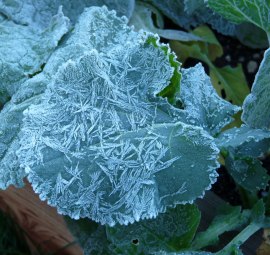
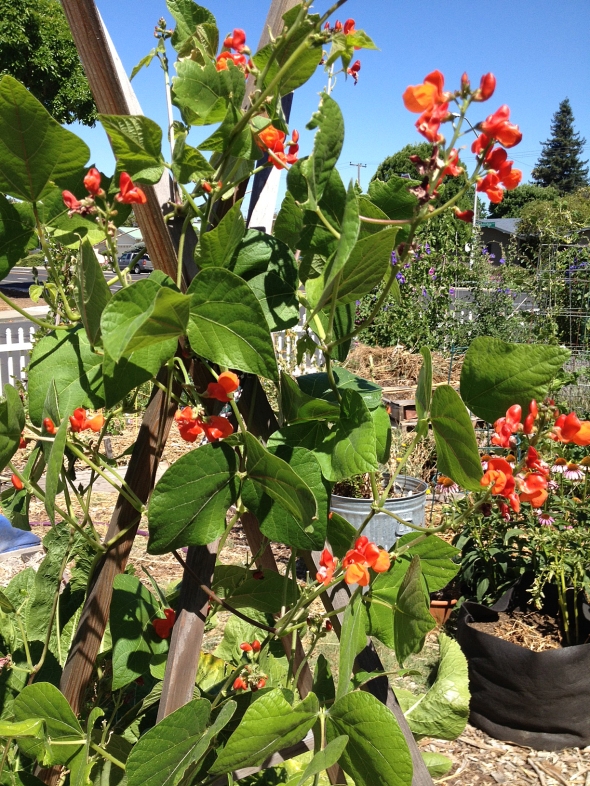
frosted-broccoliMy Northern California garden doesn’t sleep for the winter under a blanket of snow, or ever experience much of a frost, but parts of it are “resting” right now in cover crops of peas, fava beans, clover and fenugreek. (Seriously,  Fenugreek (Trigonella foenum-graecum) is well known as a spice, but is also useful as a nitrogen-fixer (it’s in the Fabacae or bean family), soil-cleanser, and source of forage (for both pollinators and livestock). Just ask the folks at TheModernHomestead.) All but two of the summer’s tomato plants have hit the compost pile, and all the perennial runner beans have been mounded with compost of their own. While the kale, spinach, onions, and garlic are slowly consuming the short day’s sunlight, it’s a very good time to dream of the next gardening year.

My favorite gardening catalogs help. Orders from Victory Seeds and Adaptive Seeds will round out what I haven’t saved myself or traded with other seed savers. I already have a tantalizing stash of seeds courtesy of a friend’s visit to Baker Creek Heirloom Seeds. They have wonderful names like ‘Amsterdam Prickly Seeded Spinach’ and ‘Glory of Enkhuizen Cabbage’ and ‘Monkey Tail Cowpeas.’  And the chayote fruit the neighbors brought me has not only sprouted, but it has a 5-foot long vine growing leaves as wide as my hand.

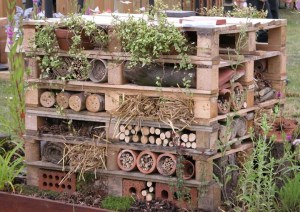
wildlife-trust-insect-hotelThe biggest structural change in the garden this year is that we are building a Beneficial Insect Hotel out of pallets salvaged by a good friend. The center section of the front garden is dedicated to an insectary with a small, rock-filled bug  bath, annual and perennial natives to attract and feed beneficial garden insects, and the new hotel. This beauty from Inspiration Green is what we are using for inspiration. So far we have added tree cuttings, hollow bamboo poles, a pottery toad house, and straw batting for nesting material. I’ll share pictures as it fills. If you have a secret for attracting toads, please share it!

In the 2013 garden I hope to focus on growing more onions and garlic, getting back to basic and reliable potato varieties, and adding two more stands of runner beans, one for the big white ‘Cannellini’ runner beans and the other for the relatively rare ‘Ayocote Morado’ runner bean.  Both this summer’s ‘Blenheim Orange’ and ‘Amish’ melons were wonderful, so I’m sure I will have requests from the family to grow more of those along with the standing request to grow watermelons. This year I plan to finally break down and grow the watermelons on Solar Mulch to warm the soil. I already have to put the mulch in to get sweet potatoes to crop in less than 200 days, so I might as well add some for the melons.

This year we’ll test seven different varieties of tomatoes for canning. I planted four seeds of each variety on January 12th and set them on the seed heating mat. I’m comparing their germination with the ‘Principe Borghese’ tomatoes that I grow every year for drying. The test varieties for this year are:

  • ‘Rutgers’
  • ‘Scatolone’
  • ‘Tsungshigo Chinese’
  • ‘Raspberry Lyanna’
  • ‘Roma VF’
  • ‘Santa Clara Canner’–A “local” variety which is actually from Italy!
  • ‘Marglobe’

Because taste-testing those tomatoes is so far away, for now I will be working on the rutabaga trials. I have ‘Nadmorska’ rutabaga seed from two different sources, ‘American Purple Top,’ ‘Marian,’ and ‘Joan’ all going in the garden.

What’s happening in your garden? Have big plans for 2013?

Five Fiery Fall Favorites for Pepper Perfection

6 Comments

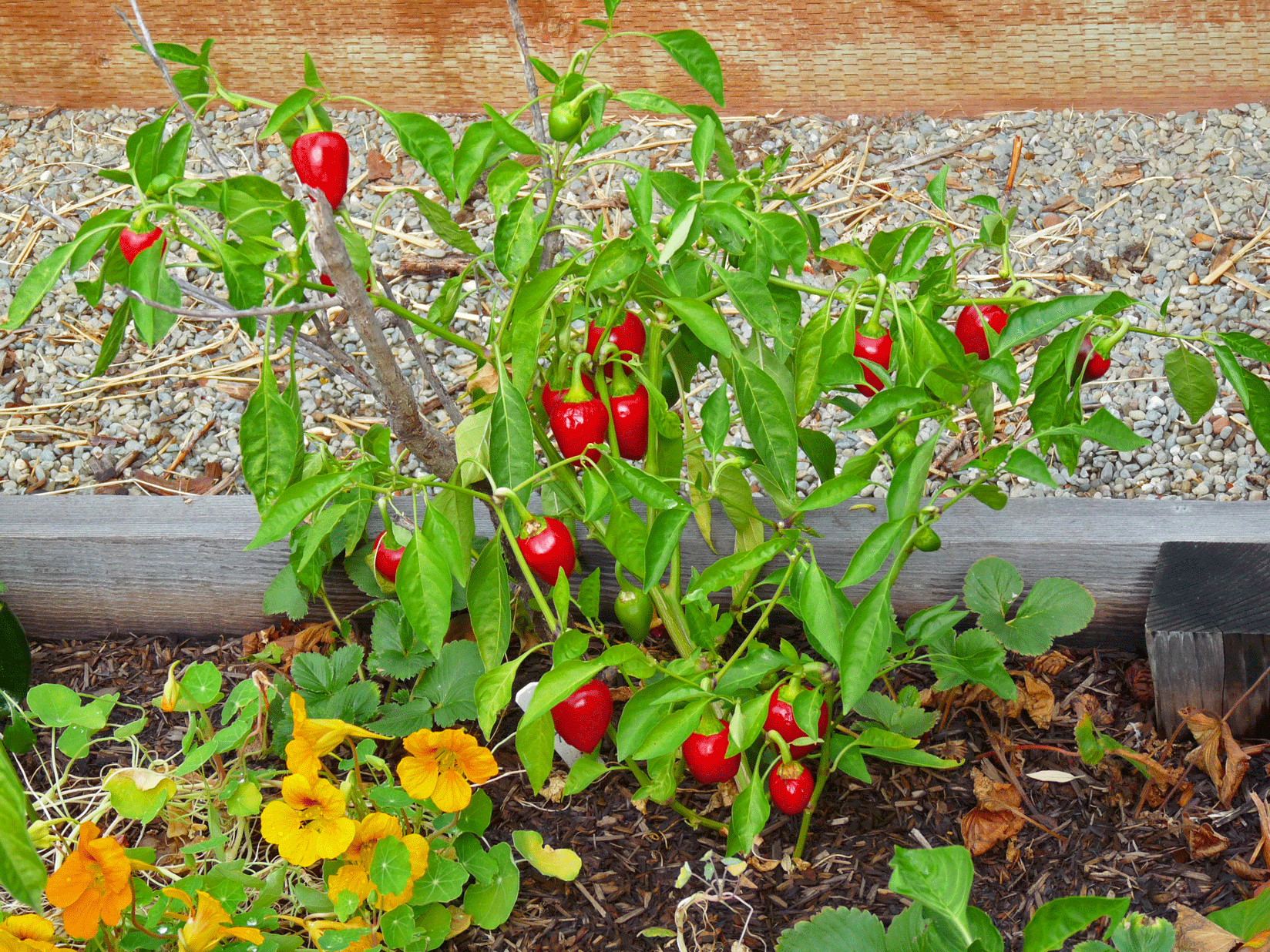
Heirloom ‘Matchbox’ Peppers Grown from Hudson Valley Seed Library Seeds

It’s almost the end of October, so that must mean I finally have peppers! And this year has been extremely satisfying in the pepper department. I’ll be the first to admit I don’t actually know how to measure a “peck of peppers” but I am willing to bet I have a least one.

Along with the several sweet peppers that were kind enough to perennial-ize themselves from last year, and our usual ‘Ancho-Poblano’ and ‘Spanish Spice’ varieties, this year we added several new additions to the pepper patch. This ‘Matchbox’ pepper was started from Hudson Valley Seed Library seed on Valentine’s Day. I didn’t notice fruit setting until seven months later in September. Today, October 23rd, the first pepper is finally ripe. I was so happy to see it that only its Scoville Unit rating of over 30,000 saved me from popping it straight into my mouth. It may not be a Habanero, but I’ll still be wearing gloves when I pick and cook with these little beauties.

Ethiopian Brown Berbere Pepper

I’m also looking forward to the ‘Ethiopian Brown Berbere’ peppers. I plan to start drying them in the next few days to make the Ethiopian spice paste called “Berbere” for a nut and seed mix recipe that I like. These peppers are a beautiful chocolaty brown, though I have heard their final ripened coloring is a brighter red. Since the plant has been prolific, I plan to harvest some of the peppers brown and dry them now, then if the rest ripen to red, I will dry those and we’ll be able to compare the flavor. I expect these peppers to be pretty hot, in the 30,000 to 50,000 Scoville Unit range.

These Berbere peppers are also said to have a rich, smokey flavor that’s good for making chili powder as well as rubs and BBQ sauces. I may have to fight my husband for them to get enough for the nut mix.

‘Red Cherry Bomb’ Pepper

One pepper we will certainly have plenty of is the ‘Red Cherry Bomb.’ This was the first of our hot peppers to produce fruit and here in late October it is still covered in deliciously bite-size bright red peppers. It’s on the milder side, good for fresh salsa, diced on pizza, or tossed into omelettes to get you going for the day.

This variety is definitely a keeper–maybe. It was sold to me as an open-pollinated heirloom. But I have seen other posts around the garden blogs saying that it does not grow true-to-type. If you have more information on this pepper, please share in the Comments!

‘Manzano Orange’ Pepper

Another mystery for us this year is the ‘Manzano Orange’ Pepper. Still no fruit set, but look carefully. I am pretty sure we’re about to see what it will make.

This pepper is intended as a perennial. Trade Winds Fruit calls this pepper, “a rocoto tree pepper relative” and says it, “is noted for its cold hardiness, as it naturally grows on Andean mountain slopes, this pepper will survive several degrees below freezing. Plants grow to 2-6ft, can live for many years.” At the end of next month I plan to surround the roots with a layer of compost and then mulch heavily with rice straw and hope for the best. It’s very unusual for us to have freezing temperatures but anything can happen with the weather these days!

Heirloom ‘Fish’ Pepper Plant
Click image for larger view

No post on our favorite peppers would be complete without the African-American heirloom ‘Fish’ pepper. Great for seafood and gumbo, I also dry the light-colored peppers to make “white” pepper for added heat in cream dishes where I don’t want the red coloring that usually accompanies this spiciness. (Think Chicken a la King, for instance.) The red and mixed-color peppers that aren’t eaten fresh are dried for pepper flakes and get added to everything from pasta sauce to bacon frittata.

Color Variation in ‘Fish’ Pepper Fruits

The colorful variety on this plant is also a fun surprise in the garden. I have gotten ‘Fish’ peppers in green, yellow, white, red and even some with stripes. And the plant itself has beautiful two-toned leaves with bold white splashes across whole sections of the plant.

How did your peppers do this year? If you have a favorite, please share it with us in the Comments.

Don’t Read This – Go Read “The Seed Underground”

2 Comments

To say that I was inspired by Janisse Ray’s The Seed Underground: A Growing Revolution to Save Food, would exceed my understatement limit for the week. Before I even finished it, I purchased three more copies to increase my chances of still having one after I start giving it to friends who are on the verge of grasping where our food system is currently heading. I told my husband that when he was finished reading this book, he would better understand his wife, his yard, and his dinner.

Ray weaves her own story of coming to understand food in a deep and fundamental way with many stories of seed savers around the United States and the why, if not so much the exact details of how, they do what they do. It’s not an instruction manual. It’s more a “This I Believe” manifesto of seed saving.

If I could have put the book down, I would have done it in order to plant, collect, or share seeds of the nearest vegetable at hand. The book makes you want to DO something. It lifts you past the doom and gloom of species and varieties disappearing or being forever fouled by the poison of corporate gene manipulation to the beautiful simplicity of action you can take right now to be part of the solution.

You finish the book with the knowledge that seed savers are out there. Seed savers are messy and neat, healthy and sick, on small lots and vast acreage, saving a single variety or dozens at once. Seed savers are people saving food. And maybe seed savers are just like you.

So, don’t read this. Get out there and save some seeds. And take The Seed Underground with you to keep you in good company along the way.