First Journalist Report

4 Comments

Saturday in the Garden
by Talya Klinger

Saturday, September 26, was a big day for Dirt to Dinner and for a particular Green June Beetle (Cotinis Nitida), who was the day’s initially Unidentifiable Bug Talking Object.
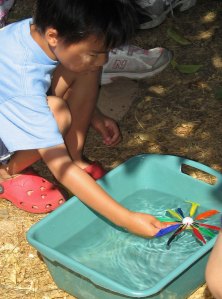
Seed_FloatThe pea seed carrier competition was on. Everyone worked hard to make seed carriers that could float on water for 5 minutes, move 2 feet horizontally on their own, and fly from the top of the play structure.  A popular creation idea for floating seeds was to press peas into Styrofoam balls, and then release them into the competition buckets.  Movement and flight were typically accomplished simultaneously with one creation serving two purposes. Many participants’ creations were balloons filled with air , but left untied, so the seeds could easily release. To disperse the peas, people let their creations fly from the top of the play structure.  Others let their balloons explode, enabling their seeds to disperse with a blast.

Seedy_GranolaIn the kitchen, kids were making seedy granola.  Nuts, seeds, dried fruit (but not raisins fortunately enough!), and maple syrup were combined and baked. As a result, many of us are enjoying delicious homemade granola for breakfast and snacks this week.
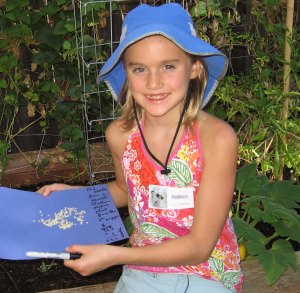
PepperSeedsJuli was also cooking up a storm, along with some other parents. Lunch was a spicy pasta with veggies in it and cheese  on top. Tomatoes and peppers had to be harvested to make the sauce. Fortunately, we had learned a whole lot about pepper seeds earlier in the morning, thanks to S. Almost as soon as she arrived, she began  counting pepper seeds. She estimated that the pepper plant in the backyard has 852 seeds on it, using the seeds of one pepper and some multiplication. However many seeds it has, it sure made for a delicious lunch!
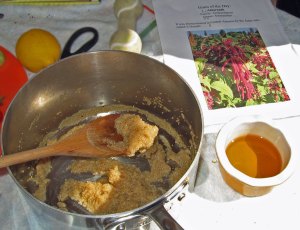
AmaranthPasta wasn’t the only grain product to rule the day. Actually, the official grain of the day was amaranth, a grain domesticated in Central America. The Aztecs called it Huautli. Mackenzie boiled some up, giving us honey to drizzle over it.
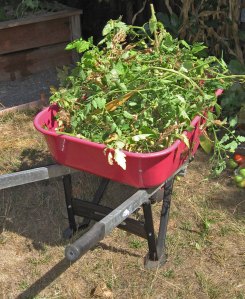
RecycledTomatoPlantsAnd if you think the day was just about seeds and grains, then you didn’t notice the dead tomato plant removal going on at the back of the garden just after lunch. Because of a lot of cutting, pulling, and hauling, the big pink wheelbarrow was filled with the stalks of summer’s tomato crop. The bed is now ready for winter’s spinach. If anybody has any spinach salad recipes, we should be ready to sample them in a couple of months.

Our first Dirt to Dinner of Fall 2009 was the perfect recipe of sunshine, friends, songs, bugs, dirt, worms, seeds, plants, and food!

Peas and Potatoes

Leave a comment
Potatoes Looking Done

Potatoes Looking Done

Last weekend at our Open House the kids harvested the last of the All Blue potatoes. The plants were looking pretty sad by the time we got to them. Which is fine. That’s what potato plants do. When the vines die down then you have an easy way to tell that they aren’t doing anything more to grow the potatoes and you can take them out of the ground now. The ones I hadn’t already stolen ‘new’ for potato salads, that is.

This week during our Open Garden time, we pulled the spent vines and tossed them into the compost. Then we added a layer of finished compost and the worm castings we saved when we added a new level to the worm farm and mixed those in well with the existing soil.

Split Bamboo to Keep the Dew and Mold Off the Plants

Split Bamboo to Keep the Dew and Mold Off the Plants

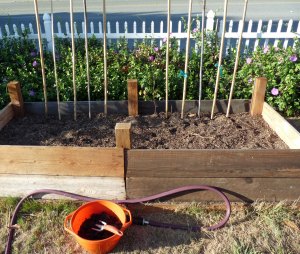
Peas like to have something to climb on, even if they aren’t the pole varieties that grow very tall. On one side we put in Cascadia Snap peas and the seed packet says they climb to 32″. Our poles extend well beyond that, but we figured there was no harm and that way the poles stay a good size to use with our determinant tomato plants in the Spring.

The other side of the bin holds Oregon Sugar Pod Snow Peas, the ones that you pick and eat flat. We are only expecting those vines to grow to 28″ or so, but it still helps to keep pea vines off the ground when you are growing them in the Fall. We don’t know if the weather will be wet or the slugs will be hungry so climbing gives the vines a little bit of an edge against both bugs and disease. Peas also don’t like to be touched and having them staked will make it easier for us to harvest the peas without messing too much with the sensitive vines or possibly spreading disease from one plant to another.

Spacing Out the Pea Seeds

Spacing Out the Pea Seeds

The Cascadia peas are planted ~1″ to 1 1/2″ apart and the Oregon Sugar Pod packet insists that they need 2″. The packet actually says “Seed Spacing: 2″ (Yes. 2″)” which made me feel like they knew me and maybe had seen how closely we had packed in the peas last year during the Winter Pea Trial. I think for one of those varieites we calculated almost 100 peas planted in a single square foot. We gave the Oregon Sugar Pods each their 2″. If they don’t all sprout we can always fill in next week when we see what we’ve got coming up.

The middle section of the bed on the Oregon Sugar Pod side we planted some Golden Beets. Next week during Open Garden we can keep filling in the bed. It might be nice to try some greens along the front of the bed where they will get a bit of shade and we have a seed donation package coming from Territorial Seed Company that might have some interesting things in it we’ll want to add. We also still have kale, broccoli, spinach, cauliflower and celery plants we have started that are all getting ready to look for more permanent homes. There’s always plenty to do in the Dirt to Dinner garden!

Fall Starts

2 Comments

I started some new seedlings for the Dirt to Dinner participants to plant in their home gardens, if they are doing them this Fall. I started a mix of three different varieties of Broccoli and had a heck of a time getting any Early Dell Celery or Snowball Cauliflower to come up. But we went through a heat wave right after I planted, so that may have been the problem. It’s worth trying agin.

Tonight I started:

KaleA Japanese spinach called “Oriental Giant,”
“Bloomsdale” spinach,
Orange Fantasia” chard, which came up beautifully in the Spring and was promptly devoured down to it’s last root by squirrels,
A specialty salad green called “Gala” mache (never tried this one, let me know if it does well for you),
Something the kids would call ‘Dinosaur’ kale that says “Covolo Laciniato Nero Di Toscana Precoce” which I think means “Curly black kale from Tuscany,” but that’s just a guess,
Some more standard looking kale called “True Siberian,”
More Snowball cauliflower,
And the rest of the seed I had for the “Early Dell” celery.

It was luxurious having fresh celery available all Winter long last year and I actually saved seed from the plants we grew. I tried starting some of that along with the Early Dell. I have no idea if it will do well. I found the plant label from last year and it just says “Celery” so no idea if it is a hybrid that might not breed true. Put that one under the category of Experiment! :-)

In the garden we have:

some carrots tucked here and there trying to hide from the creatures that come in the night and dig them up,
some peas just starting,
turnips that could really stand to be thinned,
drying beans for soups this Winter,
sunflowers waiting for us to dry and husk the heads,
onions that still need to be pulled,
blue potatoes that are about ready to come out,
melons, pumpkins and gourds that have been growing all summer
and still more tomatoes!

End of the Season

Leave a comment

Ready-to-GrowThe garden is quiet now that the last session of the Spring 09 Dirt to Dinner project is done.
Real-World Wide Web

Real-World Wide Web

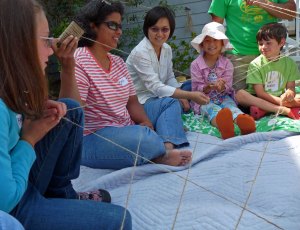
We explored the interconnectedness of the food webs we participate in every day. Latecomers spent part of the afternoon asking why we all had on nametages that said things like “Flowers,” “Oak Tree,” “Earthworms” and “Cougar.”

We also dug the potatoes that have been growing in the black nursery cloth circles since the start of the program. The plants had long ago bloomed and were mostly ready for us.

Washing the Dirt Off Dinner

Washing the Dirt Off Dinner

There were lots of the red-skinned potatoes with a blush color inside. I hope the folks at Common Ground know what they were because we liked them and they might work for next year’s Red White and Blue Potato Salad. They kept their color and held up nicely when we cooked them for the Balsamic Green Beans and Potatoes.

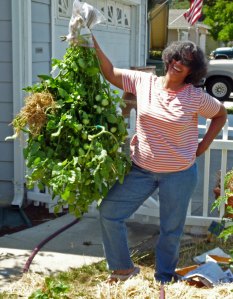
Some of the kids chose to pull the plants with their *many* green tomatoes and take them home to hang for ripening.

Roma Tomato Prepped for Dry Hanging

Roma Tomato Prepped for Dry Hanging

We are experimenting with three or four different ways to ripen green tomatoes and I’m curious to see what works best. Right now my favorite is to put them into a paper bag with a ripe apple or tomato and to let them redden that way. We are testing the plant hanging method, sunny window sills, newspaper wrapping and apple-in-a-bag. We’ll let you know how it comes out!

We also stabilized the gourd trellis and planted the gourds, picked the Principe Borghese and Costaluto Genovese tomatoes that were ready and explored the Ice Box watermelon ripening that has happened so far. (Not there yet, but close and already quite tasty!)

Everyone Loves the Eating Part!

Everyone Loves the Eating Part!

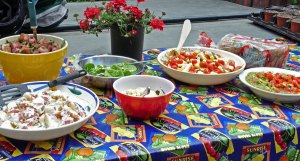
Today’s lunch included Balsamic Green Beans and Potaotes, Red White and Blue Potato Salad, Spinach Salad with Goat Cheese, Egg Salad, Tomato Basil Mozzarella, Roasted Tomatillo and Avocado Salsa.

Thank you to everyone who made this year’s program possible, including our generous donors at Seeds of Change, The National Gardening Association Seed Donation Program, the generous and helpful folks at Bauer Lumber and Mark Lassen at Lassen Construction.

Finishing Our First Program Season

Leave a comment
As Dirt to Dinner Begins

As Dirt to Dinner Begins

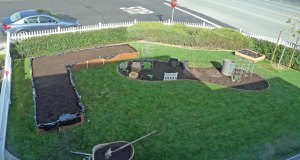
I’m cleaning things up around the garden for our final Dirt to Dinner lunch of the Spring session. A lot has changed around here since we started. Here’s what it looked like when all we had growing was the Spring Pea Trial vs. where the kids growing box and the rest of the front garden area are today.

Lots of Growing Changes!

Lots of Growing Changes!

We’ve added additional beds, trellis, arbors and teepee support structures, and, of course, lots of plants. We’ve let the lawn dry up and the mulch and straw take over to the point where I’m starting to wonder if I have 50 feet of defensible space around the house in case the suburb is consumed by wildfire. ;-)

Gourd_corsican_lgTomorrow we are going to put in several different varieties of gourds on an arbor we’ve constructed over the bench. It’s a tad late for gourds since they like such a long season, but we could still get lucky, and we could always try covering them with season extenders. Could be a good challenge for the new crew starting in September. One of the neighbors gets tomatoes until November, so I’m hopeful.

Eternal optimism is very helpful when it comes to experimenting with agriculture.

We’re also going to experiment with various ways of ripening green tomatoes, clean up around the garden a bit to see what we have to add to the compost bins, and we’ll probably tuck in some surprises for the folks who are coming back in the Fall.

Lunch is a Summer picnic theme so we are making tomato basil salad, potato salad, green beans, chopped green salad with veggies and some folks are also bringing a bit of potluck to spice things up. Should be a wonderful time to celebrate what we have accomplished and review the kids suggestions for what to do differently next year.