The Three Sisters

3 Comments
Native American Three Sisters from Renees Garden

This week at Dirt to Dinner each group of kids got to learn about and planted their own Three Sisters garden. We are using seeds from Renee’s Garden that include Earth Tones Indian Dent Corn which we will later grind into cornmeal, Scarlet Runner Beans, which the kids–and the pollinators around the garen–will like, and Sugar Pie Pumpkins.

The pattern for our garden also comes from traditional sources. This week when we were all together, the kids dug compost into the bed and formed the first set of mounds we’ll use, the corn mounds. Next time we are together, in about two weeks, they will form a second series of ammended mounds, this time for the squash. (The beans get planted in the corn mounds.)

Here’s the wonderful diagram from Renee’s that demonstrates the process so much better than I could write it out.

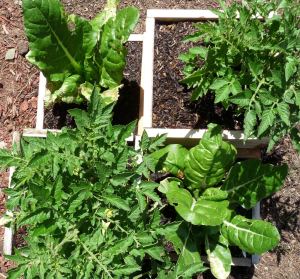
We actually have two patches because we are testing a way to get more light into the garden with one of the planting beds and using the other as a control, so we also have a tomato patch worked into the mix to separate the two Three Sisters beds. There is a demonstration bed of six different tomato varieties that divides the light augmented plot from the control plot. This already looks so different from the endless acres of monoculture corn rows I grew up with in Ohio. I can’t wait to see how it grows!

corn-pouchTo celebrate the corn planting the kids also made corn pouches which will sprout a sample of the Indian Dent Corn and a sample of the monoculture corn plated across those fields in Ohio and allow us to talk about genetic variation and why it’s important to have plant diversity.

Then they prepared a beautiful lunch that included mini corn muffins and an artful display of finger foods with yogurt dip and hummus.

All in all, a very satisfying day!
The Difference Two Weeks Can Make

1 Comment

Sprouting and Growing

Sprouting and Growing


Right now we are pretty happy that we decided to space the in-garden Dirt to Dinner sessions two weeks apart. The kids are going to be able to see an optimal change in their individual garden beds when they arrive tomorrow. Enough that they can see that things have changed and grown, but hopefully not enough that they feel they have ‘missed out’ on any of the fun.

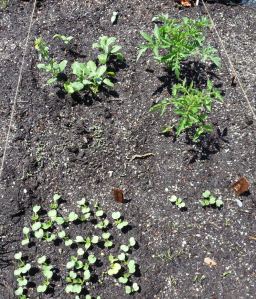
The beds were planted April 11th and have managed to survive unprecedented wind storms and record heat with only a few losses of some leggy starts. Most of the starts and seedlings are  intact and doing well. Some of the flowers that were planted take longer than two weeks to sprout but for the most part there are bits of green appearing in all the squares of the planter.

Maximum Use of Eight Square Feet

Maximum Use of Eight Square Feet


So much so, in some cases, that we are going to need to review the space needs of various vegetables and maybe do a little transplanting as well tomorrow. ;-)

I learned this the hard way this year. I tend to plant on the intensive side of biointensive practices, and I left the broccol raab in my own seed bed crammed together too close for long enough that it appears to have leaped straight from sprouting to going to seed, without the intervening step of making broccoli! Ugh!

Chalk another one up to lessons learned in the garden and be glad there’s extra space for one of the Summer crops it’s now time to plant.

plentifulpeasAt least we will have peas that the kids can pick and eat while they are in the garden, and some broccoli shoots, baby lettuces, radishes, baby beets and baby green beans if they want them. The peas were a long time coming. They were planted January 3rd, to be precise, and that makes 111 days by my count from seeding to eating. About double what they print on the package, though it is written in Italian so I could easily have missed something where I thought it said 55-60 days.
Still, the January planted pea patch is bearing and the February planted patch is flowering and setting a few peas, but nowhere close to eating at this point, so it feels like we’re ahead of the game by several weeks at least doing it this way. I’m planning to try a December, January and February planting next year so we can compare the results.

One man's trash is another woman's potato patch

One man's trash is another woman's potato patch

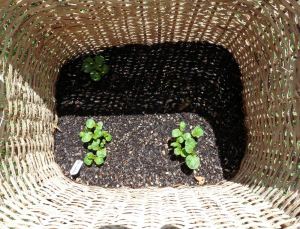
In other exciting garden news, the La Ratte fingerling seed potatoes I planted in a trash basket I found in the neighbors’ Clean-Up Week pile have finally sprouted! I was starting to worry about them. I planted them shortly after our Full Circle Farm field trip March 28th and it seems to me that the seed potatoes we had from Common Ground started showing green tops in more like two weeks than four. Now I’m keeping an eye on the All Blue potato patch watching to see how long they take to sprout. They did not have many well developed eyes when they went into the ground, so if they turn out to be on the four week side, that would make sense.

foursquare 

 P. Borghese First Fruits


chivesprouts              Planting Bed at Two Weeks


April Garden Tour

Leave a comment
Teacher's Growing Bed

Teacher’s Growing Bed


For a tour of some of the Dirt to Dinner garden highlights, you can check out the April Voicethread. You can see the garden’s development so far this Spring, all the individual growing beds the kids have planted, our experiments with four different varieties of potatoes and how all the various pea growing trials are turning out.

Here are some of the thing we are able to eat from the garden right now:
peas, broccoli, celery, parsley, spinach, chard, scallions, bok choi and radishes.

The next crop we expect to come in should be our early green beans, the Yellow Wax beans. They are looking good, but are still small and green. No sign yet of the yellow color that will let us know they are ready for picking. And we are looking forward to snap peas, carrots and planting our corn.

One for Wind, One for Crow

Leave a comment
Edamame-cide   

Edamame-cide

…One to die and one to grow.

Have I ever mentioned that gardening can be a very frustrating hobby? Just look at this poor Edamame soy bean sprout! I forgot to put their little plastic covers back over them last night after I watered and every last beautiful soy bean sprout was slaughtered in the night. Or, most likely, in the very early morning by the crows.

Why do they do this? They don’t eat the sprouts. They just tear them out of the ground and bite them so they can’t grow! Don’t they know the rule in the Dirt to Dinner garden is, “You kill it–you eat it?” (Let me know if you have any good recipes that call for crow. We’ll talk.)

Heart of the Artichoke

Heart of the Artichoke

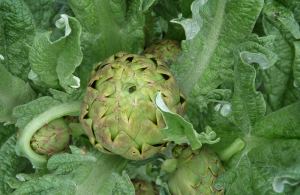
Not only that, but some time after I took this picture this morning, the artichoke plant these blooms are on fell over, for no apparent reason, into the pea patch next door! I am about to go out there and prop it up with some bamboo poles and a trellis net.

Let me assure you, the plants do not look this way in the gardening catalog! Maybe this is the real reason that people don’t generally grow their vegetable gardens in the front yard. At least when you put the garden in the back and the plants are strung up with bailing wire, no one sees them but you!

Four-Foot Snap Peas?

Four-Foot Snap Peas?

I would just clip off the artichokes and cut the whole plant back to the ground and let it start over next year, but this is a picture of the last plants I ‘gave up’ on.

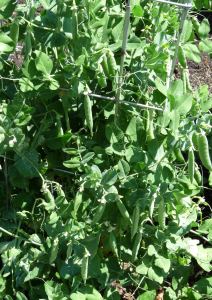
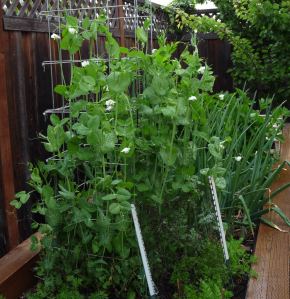
This is a patch of Sugar Snap peas I planted during a warm spell on January 18th from starts I picked up when I bought the broccoli.

They immediately had all their tops snipped off by some pestilent critter and I thought they were all goners. But they fooled me. They grew back from the roots again! Each plant sent up a new shoot from underground and now they are happily climbing the supports we set out for them.

I’m sure they could have grown a lot faster, had they not had their heads chopped off a week after I planted them, but they are flowering and getting ready to make peas at the same time as the February planting of the Picolo Provenzale peas in the front.

Do April Tomatoes Bring May Potatoes?

2 Comments

I read the other day that wind exposure can activate plant genes for sturdiness. If that happens in peas, tomatoes and potatoes we are about to have the stockiest plantings of vegetables between here and the Pacific. Yesterday’s wind storm was crazy, and today is calmer, but we’re still have gusts of over 30 mph!

First Fruits

First Fruits

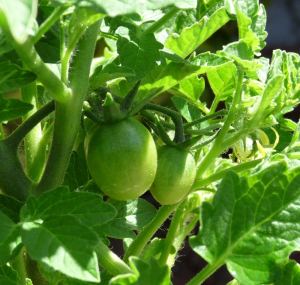
I was just starting to wonder if the Principe Borghese tomatoes were setting fruit while the plants were still way too small and thinking that maybe I should pinch off the first few fruits to let the plant get bigger before energy was going into fruit production. Who ever heard of tomatoes in April? The plants aren’t even two feet tall!

But I’ve never tried this variety. It’s my first time trying tomatoes for drying and my mother-in-law and some long-time gardening neighbors thought it best to leave the fruits on the plants. Hopefully they will still be there when the wind settles down again.

Most of the neighbors are keeping an eye on the Dirt to Dinner garden and like to stop by to see what all we’ve got growing. I’ve learned a lot from them about what grows well in the neighborhood, when they plant things and how various varieties have wintered over in their yards. I’m enjoying chatting over the fence with folks as they ask what’s growing where and share what works in their gardens.

Nursery Cloth Growing Bag for Potatoes

Nursery Cloth Growing Bag for Potatoes

Everyone asks about the potato bags. I can’t wait until they are rolled all the way up and full of soil. They will be about 18″ tall and hold a total of 15 gallons of soil and potato plants. They’re not as tall as the new potato bed we’re going to start putting in tomorrow, but they are fun and should be a lot easier to harvest than the wooden planter will be. 

Right now we are trying three varieties of potato in the Dirt to Dinner garden. The kids all got La Ratte fingerling seed potatoes when we visited Full Circle Farm a few weeks ago. The ones we planted here haven’t sprouted yet, but the four I am saving to give our teacher, Mackenzie, have started to form eyes, so I’m still hopeful. The other two are an early yellow much like Yukon Gold and a mid-season variety with a redish purple exterior that we also picked up at Common Ground.

In addition to those three test varieites, we just got word that the 2 1/2 pounds of All Blue seed potatoes we ordered  have been shipped from the Seed Savers Exchange. Here’s a link to what they might look like at You Grow Girl.

The New Bed Takes Shape

The New Bed Takes Shape


These guys will get a large (for us anyway!) 4′ x 8′ foot bed that we plan to raise at least two feet tall as we hill the potatoes. We’re starting with a redwood frame, held together by nailing the framing boards to 4″x4″ post pieces cut into 2′ sections. It’s going to take a fair amount of sawing, since most of our wood is lumber yard castoffs or otherwise donated scraps, but there’s something very satisfying for the kids that seems to come out of building something out of “nothing.”