Saturday in the Garden
by Talya Klinger
Saturday, September 26, was a big day for Dirt to Dinner and for a particular Green June Beetle (Cotinis Nitida), who was the day’s initially Unidentifiable Bug Talking Object.
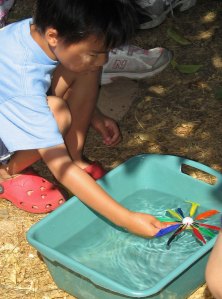 The pea seed carrier competition was on. Everyone worked hard to make seed carriers that could float on water for 5 minutes, move 2 feet horizontally on their own, and fly from the top of the play structure. A popular creation idea for floating seeds was to press peas into Styrofoam balls, and then release them into the competition buckets. Movement and flight were typically accomplished simultaneously with one creation serving two purposes. Many participants’ creations were balloons filled with air , but left untied, so the seeds could easily release. To disperse the peas, people let their creations fly from the top of the play structure. Others let their balloons explode, enabling their seeds to disperse with a blast.
 In the kitchen, kids were making seedy granola. Nuts, seeds, dried fruit (but not raisins fortunately enough!), and maple syrup were combined and baked. As a result, many of us are enjoying delicious homemade granola for breakfast and snacks this week.
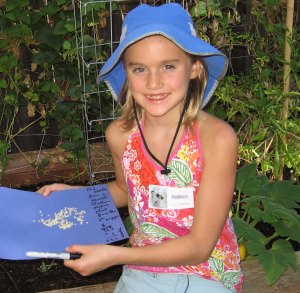 Juli was also cooking up a storm, along with some other parents. Lunch was a spicy pasta with veggies in it and cheese on top. Tomatoes and peppers had to be harvested to make the sauce. Fortunately, we had learned a whole lot about pepper seeds earlier in the morning, thanks to S. Almost as soon as she arrived, she began counting pepper seeds. She estimated that the pepper plant in the backyard has 852 seeds on it, using the seeds of one pepper and some multiplication. However many seeds it has, it sure made for a delicious lunch!
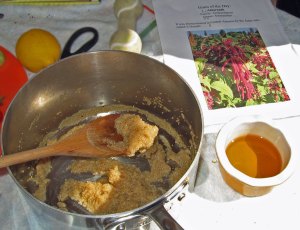 Pasta wasn’t the only grain product to rule the day. Actually, the official grain of the day was amaranth, a grain domesticated in Central America. The Aztecs called it Huautli. Mackenzie boiled some up, giving us honey to drizzle over it.
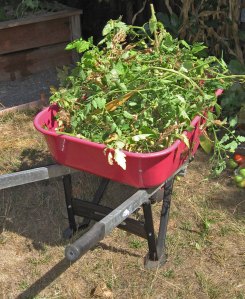 And if you think the day was just about seeds and grains, then you didn’t notice the dead tomato plant removal going on at the back of the garden just after lunch. Because of a lot of cutting, pulling, and hauling, the big pink wheelbarrow was filled with the stalks of summer’s tomato crop. The bed is now ready for winter’s spinach. If anybody has any spinach salad recipes, we should be ready to sample them in a couple of months.
Our first Dirt to Dinner of Fall 2009 was the perfect recipe of sunshine, friends, songs, bugs, dirt, worms, seeds, plants, and food!


 This weekend, to get warmed up, I took a few small liberties with Alice Water’s “Winter Minestrone with Turnips, Potatoes, and Cabbage” recipe from The Art of Simple Food. But I like to think that Alice would approve. It was fresh, organic and as local as the front yard after all. Some friends came down from San Francisco, and the enthusiastic audience set the tone.

 From Dirt to Dinner