The Tomatoes Are Coming!

3 Comments
From Sun Ripened to Sun Dried

From Sun Ripened to Sun Dried

I’m trying to remember this moment as the calm before the tomato storm. I have a feeling this nice hot weather is about to inundate us with tomato bounty. I have the drying screen, dehydrator and oven drying recipes ready to go. I’m still looking for the perfect catsup. Let us know if you have a recipe you like!

We will have quite a few of the Principe Borghese tomatoes ready to go first. They have been ripening one at a time here and there, but now there are suddenly *lots* of orange ones on the vines and the vines seem less robust, as if all their energy is going into the fruits now.

Shades of Genoa

Shades of Genoa

I am really looking forward to tasting the Costaluto Genovese tomatoes. They look wonderful on the vine with their deep creases and funky shapes.

I tried to count the other day and I think there are at least a dozen varieties of tomatoes growing in the Dirt to Dinner garden; Principe Borghese for drying, Roma for sauce and cooking, three varieties of grape tomato for eating, the Orange German Strawberry tomato my mother-in-law sent over for fun, the Big Beef for burgers and other slicing needs. And the there are what I think must be  the Crimson Carmellos, which grow like monsters! Green-GloryThey are the most robust tomato vines I have ever seen. If you are out late in the evening watering too close to this thing, I swear it might toss one brawny arm over your shoulders and keep you there all night telling you its garden tales as the moon rises.
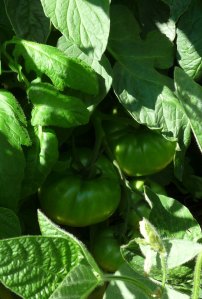
The fruits are a shiny deep green and I know the label for the plant is hidden down there somewhere, behind the lost shallots that I foolishly thought might actually enjoy a little shade provided by the tomato. Ha! They better be nocturnal to be surviving under there. At least the Edamame beans still get some light from the side.

I am also enjoying the dry farmed tomatoes planted outside the fence in the squash garden. The squash aren’t big enough yet to be much help shading the ground, but the tomato plants still seem happy.

Romas Getting Ready

Romas Getting Ready

Between drying, making pizza sauce, making catsup, whatever the kids will eat in salads and on sandwhiches, I think we’re pretty much set for tomatoes!

And the really interesting thing is the way the tomatillos have taken off! There are both verde and whatever purple is in Spanish varieties out there and they have taken over the corner growing bed to a slightly unhealthy extreme. Yesterday I found some kind of mold growing on one of their leaves. I may need to get out there and pick off the affected parts of the plant. It’s so dense in this patch that the air circulation can’t be good.

Not sure why I didn’t figure out that tomatillo plants got so big and spready when we planted them. They all seem so small and helpless in the beginning! :-)

Tomatillo-Twins

Test Potatoes Are Up

2 Comments


Test Potato

Test Potato

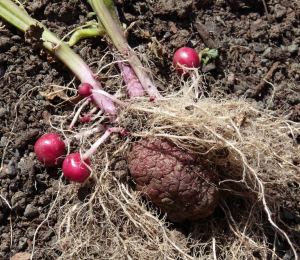
Growing potatoes is kind of mysterious, so we grew one test potato on it’s own so that we could pull it part-way through the season and all the kids (and the rest of us!) could see what was going on under there. We planted all the potatoes right around Saint Patrick’s Day, except for the Blues because their seed potatoes didn’t arrive from Seed Savers until later. 

Forming New Potatoes

Forming New Potatoes

It’s easy to see that the potatoes–and the roots–all form *above* the seed potato that you plant in the ground. You almost have to think about these guys upside down. It’s the soil that you put in on top of them that they care most about, not so much the soil that they are sitting on when they get planted. I was amazed to see how many potatoes were forming on this one plant that hadn’t even been hilled. 

Basket of Rattes

Basket of Rattes

Now I am curious to see how many potatoes we will be able to raise in the small spaces we have used. The La Ratte seed potatoes from Full Circle Farm are growing in an old trash basket that might hold five gallons, if we’re lucky. There are four plants in there and they have been hilled nearly to the top.

Big-BagI think I remember that the potato sacks we used each hold fifteen gallons, and they are nearly full of soil at this point as well. Each sack is planted with four or five potatoes, the same amount we used in the much smaller basket of La Rattes. So maybe we’ll find out the consequences of crowding when we compare the harvests, but it will be hard to interpret, since we used different varieties.

The real test of how many potatoes we can produce in garden this size will be the All Blue’s.

On Blue Hill

On Blue Hill

When I asked at the nursery the other day what they would recommend we use to supplement our own compost when we hill our 4′ x 8′ potato patch they started doing the math for how many cubic feet we would need and some eyebrows went up. “How many potatoes are you growing?!” was asked more than once.

But that’s OK. It’s only 32 plants. Kids love potatoes, right? And these potatoes will be nearly purple. That’s got some fun appeal, doesn’t it? Not to mention all the antioxidants from the phytochemicals that cause the color in the first place. 

I better go find out what you need to do to store potatoes for the winter…

May Dirt to Dinner Update

Leave a comment
Sprouting and Growing    Sprouting and Growing

There’s no doubt that the garden is starting to fill out nicely. If I hadn’t noticed it myself, the evening parade of dog walkers would have been happy to remind me.

We continue to receive attention and even gifts from neighborhood well-wishers. We now have two new lavender plants, starts from lavender bushes up the road that attract several different types of bees. We have a new moisture meter, which is addicting to use and is a huge help in watering. The small horseradish we were given has turned into an enormous pot of lush leaves and roots. And the seed donation from Seeds of Change has arrived with many interesting varieties we may want to try.

Bauer Lumber in Mountain View has also been very generous with donations of scrap wood that has come in handy several times already and which will be used to complete the potato bed as the hills get higher.

Thanks everybody! It’s wonderful to have your support.

Easter Egg Radishes make delicious pickles

Easter Egg Radishes make delicious pickles

In the kitchen, I have finally perfected my radish pickling brine recipe and can’t wait for everyone to try it out the next time we meet. It’s a mix of mostly sea salt, apple cider vinegar and tamari and it tames the stronger radishes in a way I hope the kids will like. Oh, and did I mention that recipe also uses a pinch or two of suagar and a swirl of honey? That could be part of what’s helping smooth it out. Delicious!

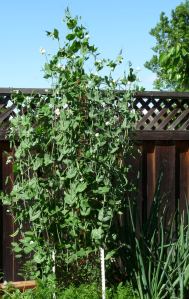
The January planting of shelling peas is just about done producing and we are moving on to pick the February shell peas and the snap peas. I’m sure people walking past the other side of the fence think we are growing the world’s tallest Snap Peas. Little do they know the peas are started in raised beds that are three feet tall. I won’t tell if you won’t.

Eight Foot Tall Snap Peas

Eight Foot Tall Snap Peas

The broccoli is also still producing nice side shoots, but will flower if given half a chance. The Broccoli Raab the kids planted in their individual beds is also prone to flowering. I’m keeping the flowers trimmed to see if it will go back to making more broccoli or not.

Intensive Planting to the Max

Intensive Planting to the Max

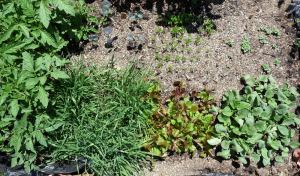
Some of the individual planting beds are small jungles at this point. Remind me to go over plant spacing with the kids again. :-)

This one has carrots, radishes, beets and tomato plants–and that’s just in the first two square feet!

Square Foot Patchwork

Square Foot Patchwork

These will be a wonderful experiment since they are all planted differently with more or less attention to the spacing ‘suggestions’ we used at planting time. Here’s one bed that was planted with careful attention to the square foot measures that gives it a visual patchwork look that many of our visitors find appealing.

I wish I could keep the rest of the garden looking that nice and neat!


Circle of Pollinator Attractors

Circle of Pollinator Attractors

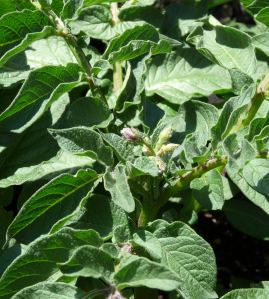
We have added a few more flowers to our pollinator collection, a blue basil, some coreopsis and others. And we have our first potato plant flower bud! I wonder what it will look like? I’m actually not sure at this point which sack of potatoes is which, so I’m not sure which kind of bud this will be. I hope Mackenzie remembers or we may not know until it’s time to pick the potatoes.

The blue potatoes sent up blue sprouts, which I would never have expected.  I didn’t even recognize them as sprouts when they first came up because they looked so dark against the soil and compost. Who knows? Maybe it will have blue flowers as well!

First Spud Bud

First Spud Bud

Hints of Things to Come

2 Comments
Our First Picolo Provencal Peas    

Our First Picolo Provenzale Peas

Friday morning–early–I was sitting in downtown Palo Alto in a Board meeting, in clean clothes with no visible dirt on me. But when someone there asked me what was good with me, I excitedly blurted out to the entire room, “We have peas!” Evidently, you can take the girl out of the garden, but…

These are the only peas that have survived from this year’s Pea Trial, the Pisello Nano Picolo Provenzale. I’ve been hunting for more seed for this variety and finally found it from Seeds from Italy. They are the U.S. distributor for Franchi Sementi spa of Bergamo, Italy, seedsmen since 1783. 1783, wow, I like the sound of that.

My mother-in-law comes from an Italian family and has liked other varieties of their seeds. I got some of the small Picolo Provenzale peas and also some of the Telefono variety which grow to 5-6′. 

Italian Winter Squash Sampler

Italian Winter Squash Sampler

I couldn’t help also ordering their collection of Winter Squash. They send you ten different varieties–and a bottle gourd–so we will be trying Padana, Marina di Chioggia, Quintale, Piena di Napoli, Tromba d’Albenga, Serpente di Sicilia, and four or five others. Just listen to the description for the Marina di Chioggia, “Very old variety from near Venice. 4-5 pound round fruit, grey/green knobby skin with sweet orange flesh. Essential for great soup, gnocci, roasting. Excellent keeper. 105 days.” Ahhh, those Italians!

The Pea Index

The Pea Index

But right now the garden is starting to show us a few more hints of things to come. The peas that got me all excited in the first place are growing pretty much flat until they are about the size of my index finger and then they start to round out some as the peas inside develop.

The January planting is roughly a square foot of pea plants that are flowering and developing peas at a rapid pace now that the weather has warmed some. They still have plenty of cool nights, which they supposedly like. I hope so, last night it got down to 39 and there was actually a light frost on the grass this morning when I went out. At this point, before a single pea has been eaten, I have to say that our January planting plan really has ended up getting us ahead of things, even if the peas got eaten by everything and developed very slowly. There are no flowers yet on the February planted patch yet.

Bush Beans Emerging from Flowers

Bush Beans Emerging from Flowers

We do have tiny beans growing though. The Bush Beans Roc D’Or Yellow Wax that are growing in a container on the back patio, where it is protected and warm, are flowering and slender beans have started to form.

I had expected two beans to form from each of the flowers but these are forming a single bean, which is still green but will turn a bright yellow as they mature. I love the way they look with the remains of the flower they formed from still stuck to their tips. These plants were also an early test that has turned out to be a good idea. These Bush Beans were sprouted inside under lights and planted as starts alongside seeds of the same variety that were put in at the same time these plants were hardened off. The beans growing from seed are doing well, but they don’t have flowers yet and are clearly behind the beans started indoors.

Even with starting things early, there isn’t much to eat in the garden right now. For lunch I made Pickled Radish salad with some of our delicious celery thrown in for good measure. I sliced the celery as thinly as possible, just like the radish, and pickled them together in the sea salt and sugar. Then I combined the radish tops and celery leaves, chopped them loosely and wilted them with a bit of water before tossing the radish and celery pickles with the dressing and the greens.

Maybe by next week I’ll be able to serve it with some fresh peas!

Full Circle Farm Visit

Leave a comment
Working on the Farm   Working on the Farm

This morning was our field trip to visit Full Circle Farm, the educational farm in the Santa Clara Unified School District in Sunnyvale.

The volunteer Garden Manager, Melissa, introduced us to the garden and showed the kids the large worm box that supplies part of the nutrients needed by the vegetables growing on the farm.

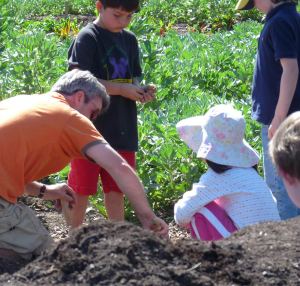
The farm hopes to soon be able to make all of it’s own compost and to use that as the only soil additives for the produce grown on Full Circle Farm. Part of our group helped turn compost piles that will contribute to this process.

Other members of our class sifted garden soil to make it into potting soil for new plants that are beginning life in the Full Cirlce Farm greenhouse. We need to make some screens like the ones they use at the farm for the Dirt to Dinner garden. They are wonderful for sifting compost and getting the lumpy “uncooked” bits back into the pile for some further decomposing. I’ll check our books for a sample design and take it with me to the hardware store this week.

Planting Fingerling Potatoes

Planting Fingerling Potatoes

Our class planted some small fingerling potatoes on the farm this week. They weren’t cut and developing big ‘eyes’ like the ones we started two weeks ago in the Dirt to Dinner garden, these were very small and planted whole in the soil. Melissa gave us some of these “seed” potatoes so the kids could start their own potato patches at home or in the Dirt to Dinner garden. There are also extra Yukon Gold and Purple potato “seeds” here in case they want to try several varieties and compare the plants and their growth, production or taste.

Wearing a Little Soil

Wearing a Little Soil

It was fun to see what you can do with a garden that covers over half an acre. By comparision, the whole lot that holds the Dirt to Dinner garden is about 1/8th of an acre. The size of the garden beds we currently have under cultivation is ~300 square feet. Because we are using raised beds and biointensive planting and growing techniques along with vertical supports, we can grow a lot more in a small space than if we did that same space in traditional rows the way much of the Full Circle Farm produce is planted, but it was still great to see what’s possible when you really have the room to spread out. I can dream, can’t I?


eyeing-the-fields