The December Garden

Leave a comment
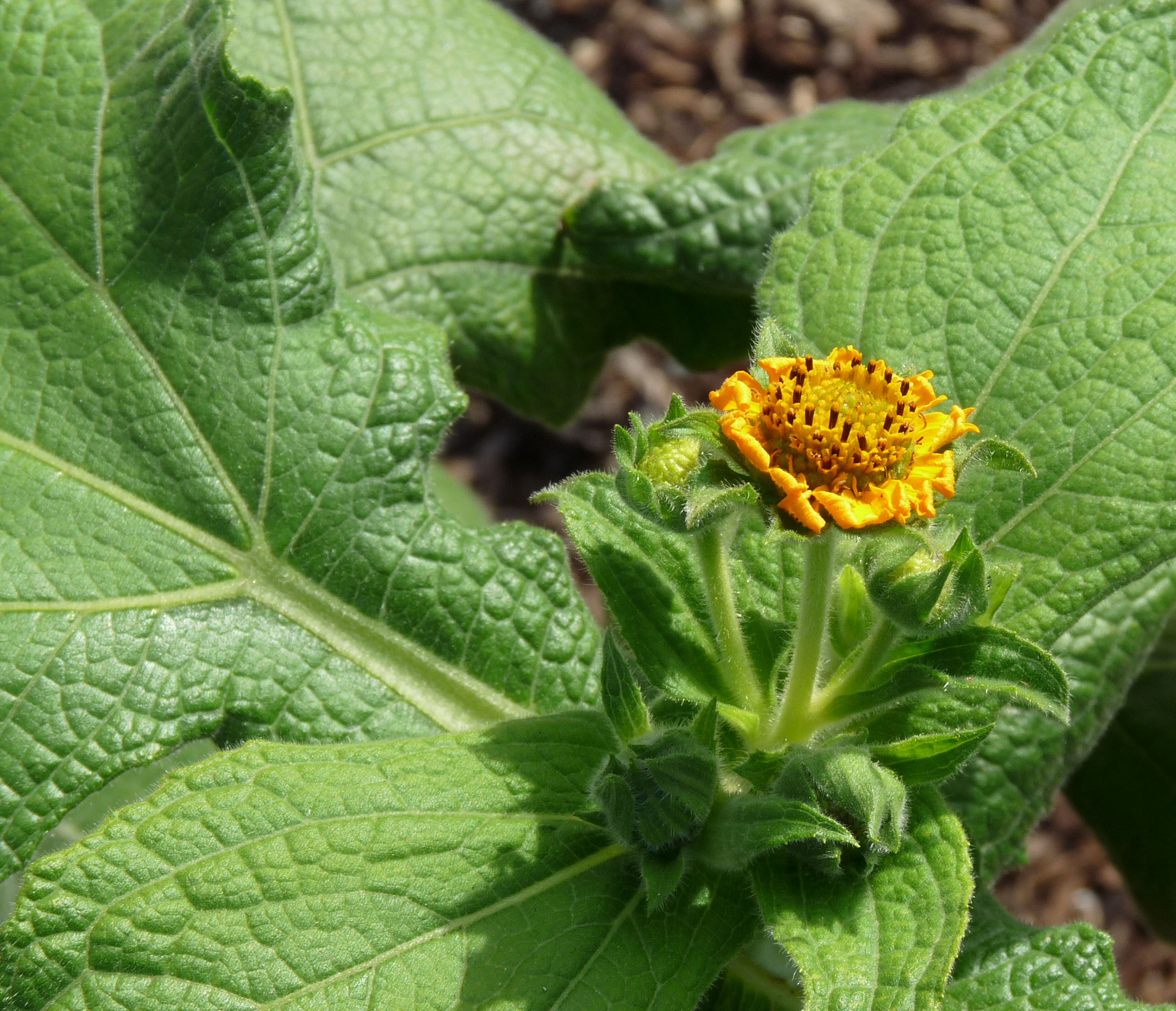
Yacon Flowers

The tasty tubers are much bigger than the bright flowers

I apologize if it sounds a little sad to say that the yacon plant’s reward for making these sweet little flowers was that we ripped it out of the ground, ate it’s tubers and cut it’s roots into five separate sections before replanting them.  I couldn’t help it. It was delicious. Yacon, also called “Bolivian Sunroot,” has a crisp, fruity tuber that ads a satisfying crunch to salads and can be prepared a number of different ways. I bought this one on a lark from Pam Peirce when she was visiting Common Ground. Now that I have tasted them, I hope to have a stand of five plants next year. They can get as tall as 6′ and should make a nice visual break between the front garden beds and the street.
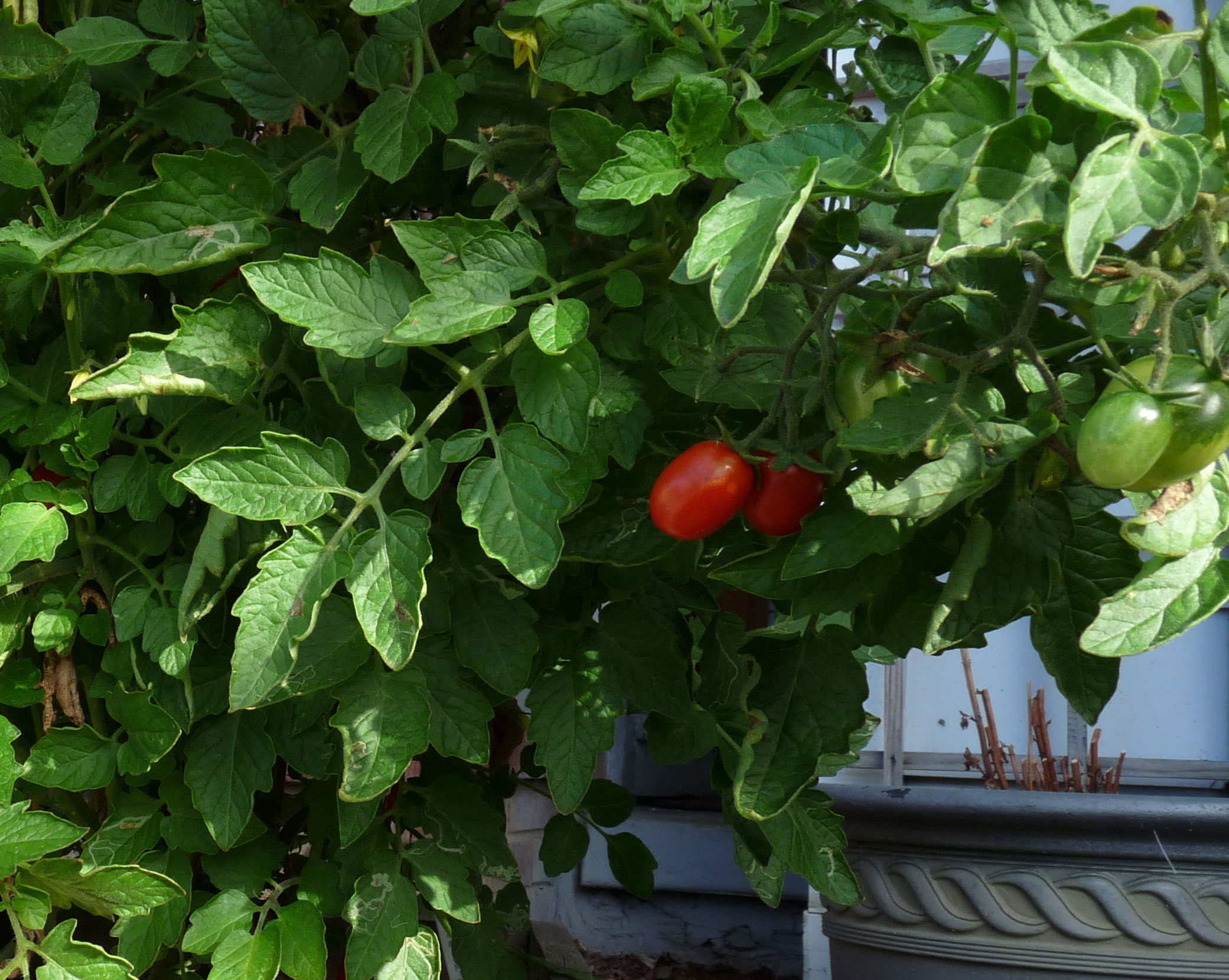
Red and green tomatoes in December

Glacier Tomatoes ripening in December

I brought in the last of the peppers, eggplant and Armenian cucumbers right after Thanksgiving. If you had to eat out of the garden right now in mid-December, you could have spinach, kale, chard, arugula, lettuce, green onions, a couple snap or snow peas, mustard greens, broccoli, cabbage (the loose leaf kinds anyway), rutabagas, turnip greens, chicory, sorrel, radishes, rosemary or thyme, and tomatoes. Seriously. I have tomato plants flowering and setting fruit, in December. I put the ‘Glacier‘ tomatoes my mother-in-law sent over in large pots, uncovered so pollinators could get to them, on the patio set against a south-facing wall. It’s a cozy spot, sure, but we had frost for days running a week or two ago. These tomato plants do not care. And who am I to argue?

Seed flat

Keep 'em coming

This week the plan is to set out transplants we have grown of more arugula, chard, kale, Osaka Purple mustard, Chinese asparagus, winter leeks and mesclun mix. And to seed new flats of rutabagas and spinach. If I get to it before the rains come back, I’m going to try a stand of Alderman shelling peas near where I put in the Green Beauty snow peas. They aren’t in a well protected spot, but last year I had both snow and snap peas grow right through the winter. Frost got some of the pods, but the plants survived and flowered again.

All the weather folks keep telling me to expect an unusually wet and cold winter, which sounds an awful lot like the summer we just had, but I’ll believe it when I see it. Yesterday it was 65 degrees. Those tomatoes were probably sweating. ;-)

What I’m Doing Differently Since Taking “Edible Gardening”

2 Comments

This year I was lucky enough to be part of “The Edible Garden Series: From Design to Harvest” through Common Ground in Palo Alto taught by Drew Harwell. And there are a lot of things that I’ll be doing differently now that I have completed this class.

First, and perhaps most revealing, I’ll be growing–am already growing–a lot more food in the same garden space that I started with. Not only do I understand inter-cropping and plant rotations better, but plant spacing makes a lot more sense to me and I’ll be using a lot less of it in between my plants, especially my winter crops, than I have in the past. Column H of the Master Charts in “How to Grow More Vegetables” is finally useful to me! Yay!

Seed Flat KitAnd I’ll be starting those plants in flats. I used to start seeds in old yogurt containers, left-over six-packs from the garden center, old plastic cups…pretty much anything that was handy and could be recycled into something that held dirt. But seed flats hold a *lot* more soil than a six-pack, and hold it deeper than a six-pack. It stays moist and at a more even temperature and your seedlings grow up much healthier. I have no idea why this never occurred to me before, but as soon as Drew talked about it in the first week of our class, it all made sense and my seedlings are certainly thankful for it. Now I just need one of those little scoop tools to help with transplanting.

Kangaroo Rat

California Kangaroo Rat

Those new flats will be filled with 50% “bed soil” and 50% compost that I am now making right here at home with confidence and success. I’ve tried a lot of different composting methods over the years.  Some of them ended up smelly, some of them ended up taking forever to break down and one of them had an entire family of kangaroo rats who leaped out of it right at us when we opened the container to turn it!

No more. One of the things that’s different around here is the compost piles are now open. No expensive bins or crazy spinning systems or awkward compost turning tools required. We are building 4′ x 4′ piles with alternating layers of ‘green’ material, ‘brown’ material and bed soil. And we are turning them once, after they have gotten up to or beyond 135 degrees. The first pile has already cooked up to this point and been turned. The second one is piled right over where I hope to dig a new bed in the spring to help prepare and improve the soil while it decomposes over the rainy season.

This is also my first season of cover cropping. I have ‘Medic Mix’ from Territorial Seed Company in three of the raised beds, cereal rye in one, the Common Ground ‘Cover Crop Mix’ in another and a healthy stand of fava beans already going. These are the first crops I have grown specifically “for the soil” and I am feeling good about the process. Cover cropping is another thing from this class that now really makes sense to me. Some of these crops will be chopped under as a green manure before the spring planting happens, and some of them will end up in a compost pile. Either way, I like the idea that there are crops for us to eat and crops to feed the soil that ultimately feeds us.

Asparagus SeedlingsMy garden is now more forward looking in other ways too. Not only do I understand where the prevailing winds come from and where the afternoon sun hits the garden. I have learned a lot about planning the garden as it moves through time. For instance, there are more perennial edibles now in place or in progress. We have started our first Pigeon Peas, experimented with Chayote squash, put in an asparagus patch for plants started at home from seed, added several kinds of berries and learned how to be better to the fruit trees. And this is only a fraction of what Drew covers in the series!

Keep an eye out for the Spring Edible Gardening Series. The class is a great investment of your time and easily pays for itself with the increased yields you’ll rapidly see in your garden.

A New Start for Fall

Leave a comment

Some New Favorites

We learned a lot from the Fall Greens Trial this year, including:

  • Mice like collard greens seedlings even more than they like yellow tomatoes
  • The humans around here do not like ‘Runway’ arugula, no matter how well it sprouts and grows
  • ‘Osaka Purple’ mustard is quite possibly the stuff wasabi is made from and should not be chomped in the garden by the unsuspecting. (How bad can drinking out of the hose really be? It was an emergency!)

Starting on August 12th, we tried two varieties each of chard, mustard, arugula, collards and kale. For each variety, we started half the seeds in pots and the other half were direct seeded.  Direct seeded ‘Italian’ arugula was the first to sprout, a full 24 hours ahead of the same variety in a six-pack and both the direct seeded and the potted ‘Runway’. During the course of the trail we have come to believe that seeding fall arugula in Northern California is not a challenging task, no matter where you put it. ;-)

Ready for Cinderella

In our trials, ‘Improved Dwarf Siberian’ kale beat out the ‘Nero di Toscana’ which barely sprouted at all in the heat.  The thing is that I like the lacinato kale, so I am trying ‘Nero di Toscana’ again right now, half a flat of it, in the cooler temperatures. The ‘Mangold Witerbi’ chard has done slightly better than ‘Orange Fantasia’ but both are strong and delicious now. The spoon mustard seed was disturbed in its six-pack and didn’t sprout at all in the ground, but the ‘Osaka Purple’ came up with nice wide leaves with a beautiful green and purple mottled color and plenty of taste!

The ‘Georgia Southern’ and ‘Green Glaze’ collards were not nearly as accommodating. Potted ‘Georgia Southern’ sprouted first, though germination was thin for both varieties, under both conditions. And once the sprouts began to fill out beyond their seed leaves, all the direct seeded ones were quickly munched to the ground by some vile rodent nesting in the nearby ‘Star’ Jasmine. Probably a relative of the same evil pest who turned my ‘Lady Govida’ pumpkin into Cinderella’s carriage.

A brazen infestation of diurnal rodents was certainly not in the summer gardening plan this year, but they came anyway, bringing their friends and relatives. My daughter saw as many as six individuals at once stealing yellow, red and even green tomatoes in broad daylight. I cut back the jasmine. I planted catnip. I put out peppermint plants, tea and oil. My daughter tested a number of different home-designed traps, all to no avail. Easily half of the tomato crop and a fair number of green beans were lost to them before the Iowa farmer living next door put an end to the “nonsense” with D-con bait and peanut butter. I’m not saying it’s my idea of a perfect solution, but I’m also not saying I’m not grateful to have the population culled a bit. Now maybe I can sprout a pea plant without having it ripped up and eaten before it even spreads it’s seed leaves!

Hubbard Squash

A Mother of a Hubbard

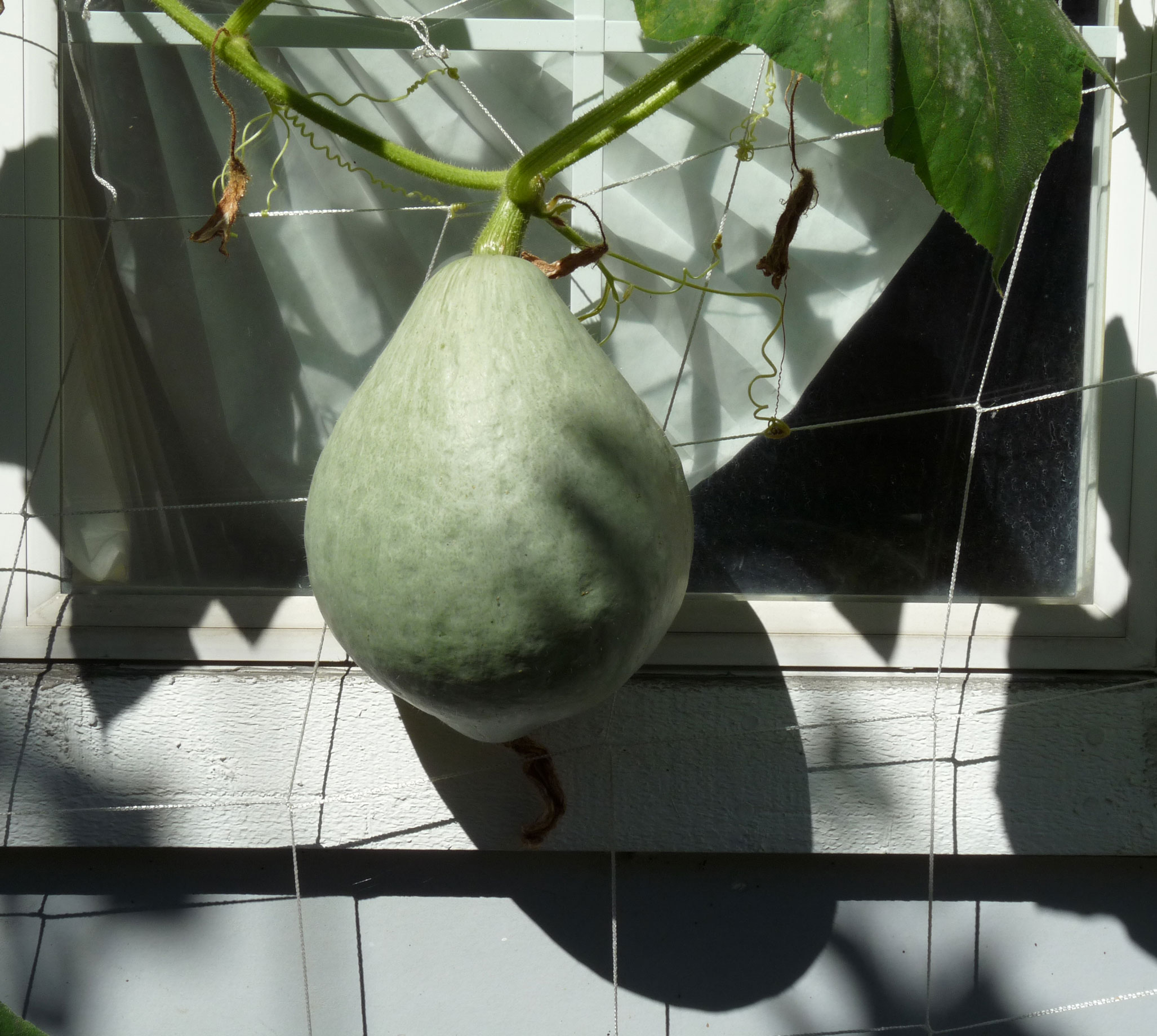
I know some of the neighbors were probably laughing when they realized I had trellised my ‘Sugar Hubbard’ squash. But, for the record, they held just fine. Because of slow growth in our unusually cool spring weather, I held each of the trial vines to one squash, 7 and a half pounds and just over 5 pounds, with no tearing in the netting and nice strong necks. I can’t wait to try them to see if we like Hubbard squash. Let me know if you have a favorite recipe.

I put one ‘Waltham Butternut’ under green mulch this afternoon to try to keep it going farther into the fall, but all the other squash are done for this year. If the green mulch works, I plan to start melons, cucumbers and squash under it next spring, just in case. I want to be more prepared if we find ourselves standing around next May wondering when it’s going to warm up so I am testing several different kinds of season extenders this fall.

Though it looks a bit like spring with the overgrown summer crops disappearing into the compost pile and bare ground showing again as the garden switches over to rutabagas and radishes, broccoli and beets, carrots, cauliflower and collards. Salad greens are in alongside Asian mixes and thin strips of onions and garlic separate patches of this from patches of that.

Working for the Underground

Leave a comment
No More Lawn

Food Not Lawn

What’s that old saying about good farmers growing food and great ones growing soil? Well, we make no claims to greatness here at Dirt to Dinner but we are trying to give the soil the great treatment it deserves. The space that now grows food started out as a lawn. If I had to guess, I would say that any original topsoil that remained from earlier days (the area was converted from farms to housing in the 50’s) was stripped off when the house was redone in 2000. We weren’t here yet, so we don’t really know. But the lawn and the adobe below seemed awful close together when we started digging it up.

In the spring of 2009, we removed large sections of the grass and added raised beds. In some places, we didn’t even remove the grass and the raised beds went right on top. Since then we have stopped watering the parts of the lawn that remained. The raised beds now all have well-tended and organically amended soil in them, but they are like tiny, well-provisioned rafts in a sea of wild, dry, mostly neglected ground.

Chipped Fruit Tree Shreds

Mulch Carpet

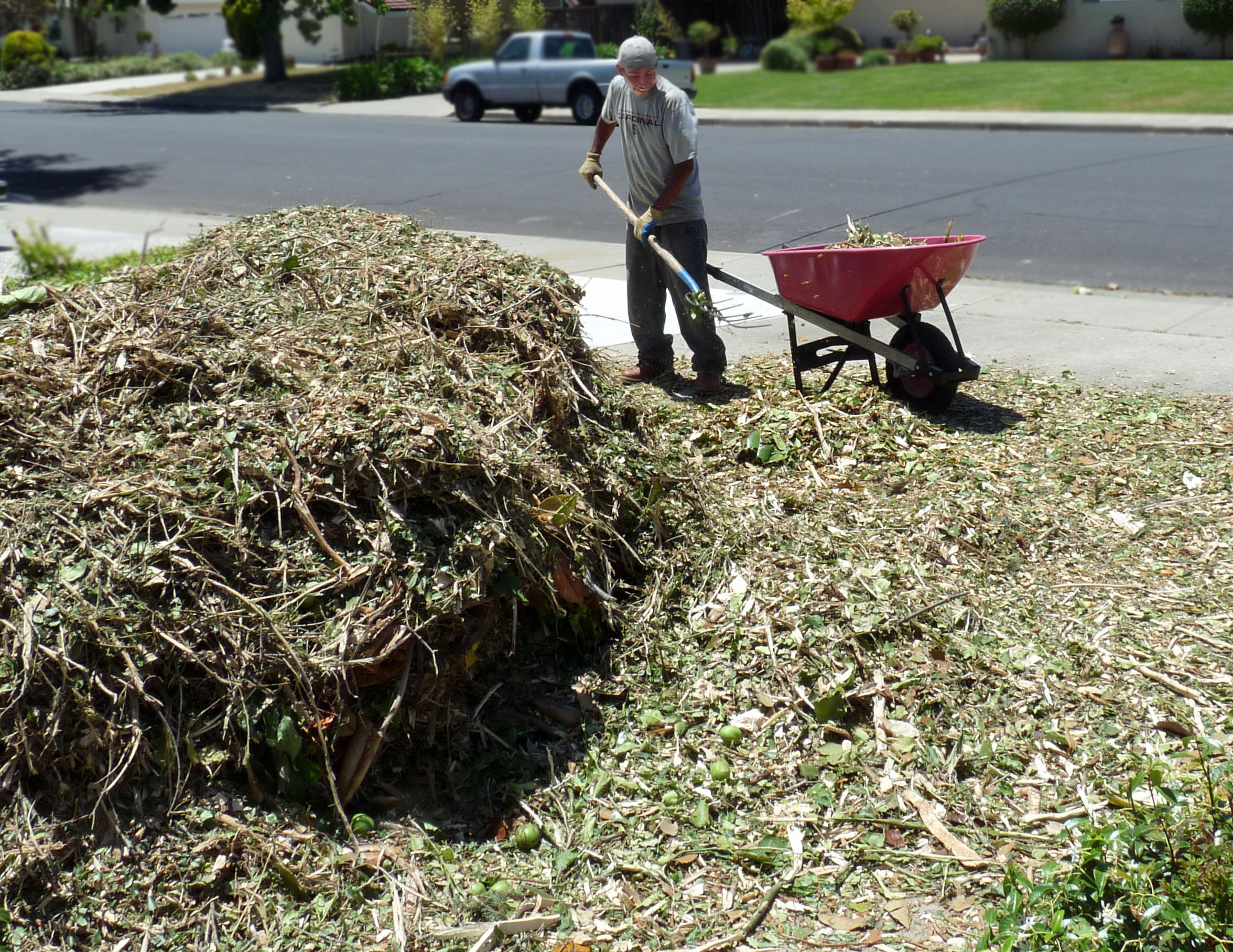
Or, I should say, they were, until the generous folks at A-1 Tree Service arrived on Thursday with a very large truckload of chipped and shredded summer-pruned fruit tree trimmings.  This is exactly what we needed to improve all the garden soil and connect the soil in the raised beds to a healthy, vibrant network of soil bacteria, underground critters and earthworms.

The chippings have fruit, green leaves, dry leaves and branches all mixed and shredded together, so they are already a combination of the ‘browns’ and ‘greens’ we need for composting. Spread in a layer about 10 inches thick, they will discourage the growth of grass and weeds, hold moisture in the soil around the beds, help moderate temperatures in the garden, and over time, they will break down into a rich layer of compost further encouraging the connections between all the beds and a healthy soil throughout the garden. In a year or two, when we want to add a new bed to the garden, underneath that compost layer will be rich soil just waiting for us to plant.

Dirt to Dinner is a project to help children and other community members get up close and personal with growing food. It wouldn’t be here without the volunteers and sponsors who make it possible to include so many in this nurturing activity. Thanks again to A-1 Tree Service, Bauer Lumber, Naturalyards, Victory Seeds and all of you who contribute time and energy to this project.

Special thanks to Oscar, from A-1 Tree Service for all his help moving the chippings into the garden!

Huge Pile of Chippings

Man vs. Mulch

One Potato, Three Potatoes

1 Comment
Sack-grown Potatoes

Potatoes Are Ready Droop

Have I ever mentioned how important it is to keep good records of your garden experiments? ‘Cuz I sure wish I had ’em right now. This spring, on some now-unknown date, I planted an unrecorded variety of potatoes, very carefully, in two identical Potato Grow Bags. In one container, I planted a single seed potato. In the other container I planted three seed potatoes of that same variety. Now, the directions call for five seed potatoes in each 15 gallon grow bag, but that seemed crazy based on what we saw with the spacing of the All Blue potato plants last year. If we grew them that way, the potatoes would probably be tiny. But, if we cut back to just three seed potatoes, would that give us a better yield of good sized potatoes, or did we really need to go all the way back to just one seed potato per pot to get the best potatoes? Only one way to find out, so we grew some.

Potato Spacing Yield Test

One Beats Three

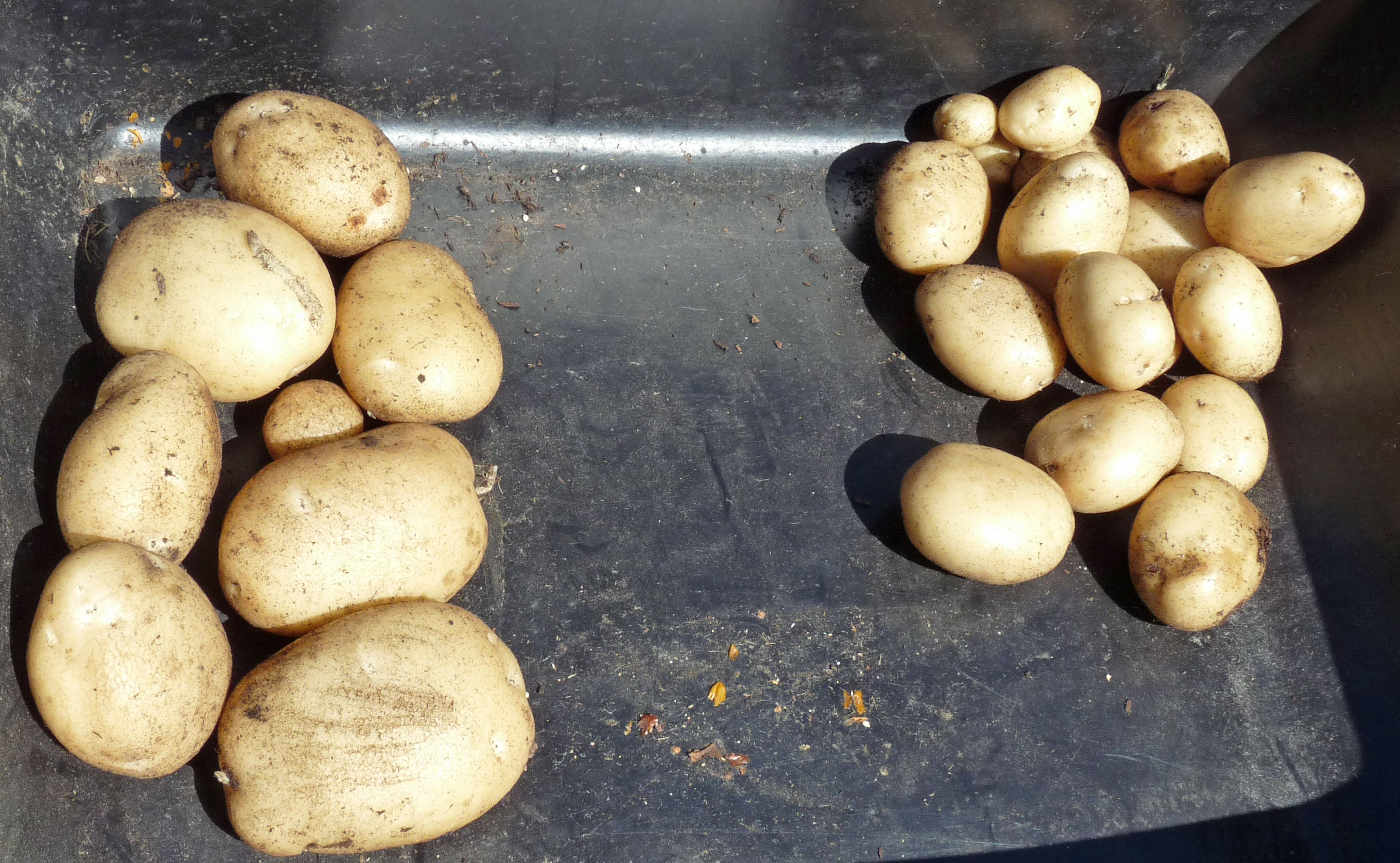
The bags were placed side by side and given the same amounts of compost and water. The two grow bags ended up with similar amounts of foliage, though the three-in-one bag flowered first and drooped earlier. I thought the potatoes were Rose Golds, and wanted to save some of them for seed, so I pulled the potatoes when the singleton had just started to droop in earnest.

The three-in-one bag had a dozen nice-sized potatoes and a handful of small ones, too small to save for seed, if I had been planning to save from that bag. This might be a fine harvest from this variety of potato, which I am now thinking is a California White. But I don’t honestly know. The label from the California Whites says, “Cal White is a long white-fleshed potato with brilliant white skin. Produces heavy yields of large potatoes.” Would you call this skin ‘brilliant white’? It’s certainly the whitest one we’ve pulled out of the ground here at Dirt to Dinner.

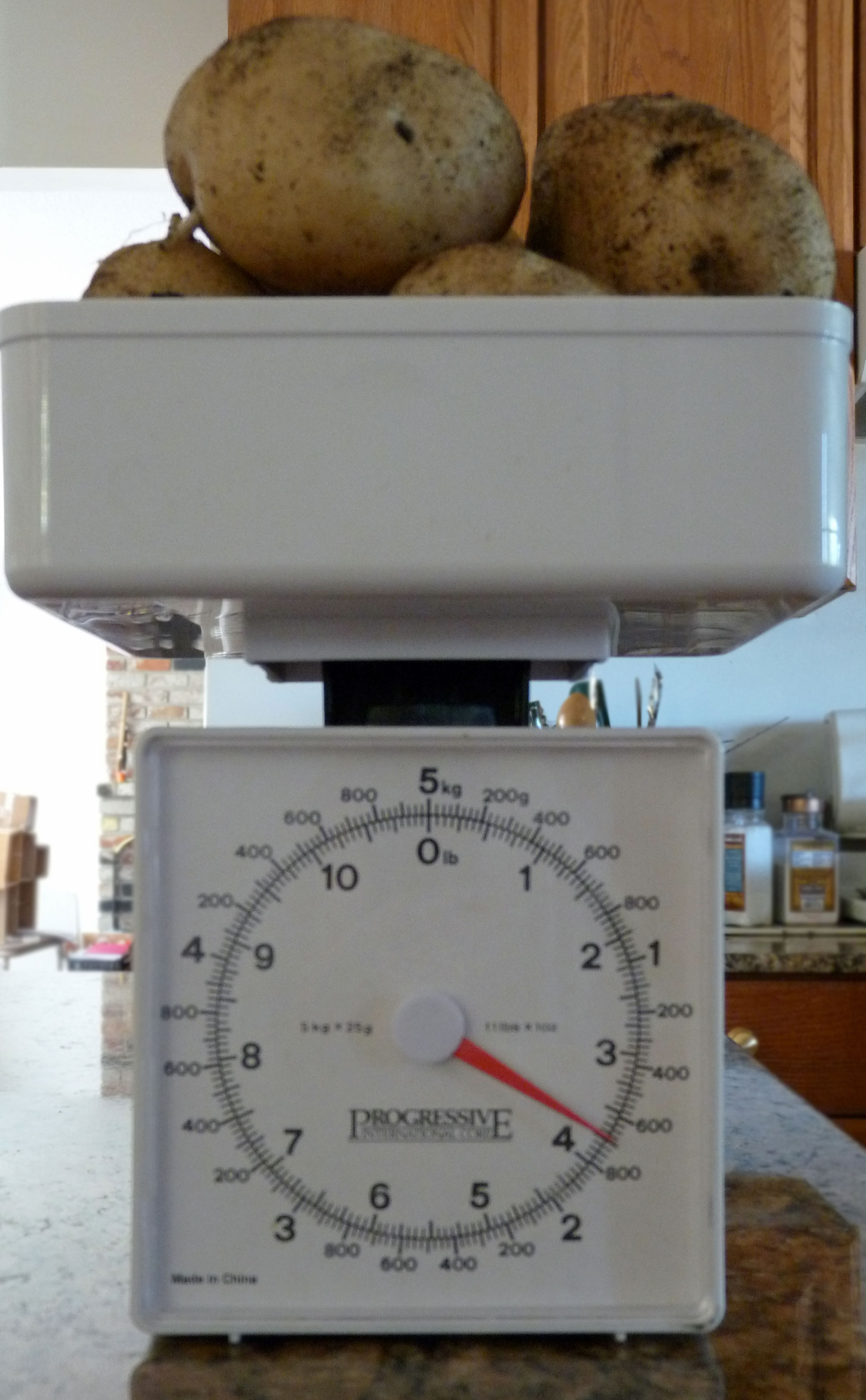
Potatoes on Scale

One Potato, Seven Potatoes

The singleton bag had seven big potatoes, and one tiny one,  which together weighted 3 and 3/4 pounds, almost a pound more than the dozen potatoes from the three-in-one bag. Now, how many square feet is 15 gallons? The over-wintered potatoes produced just under 1 and 1/4 pounds of potatoes per square foot. The 15-gallon bag has an 18″ diameter…any math geeks out there? Ah, what the heck, even if we call it two square feet, they are doing well. In fact, it should have taken us over 3 square feet to get those 3.75 pounds of potatoes over the winter so I’m calling that bag a success. And the other bag is good too. It all depends on what you want. If you want big fat baking potatoes, or even just all the potato you can get out of a square foot, you might want to give the potatoes more room. If you want lots of small potatoes, you might purposely crowd them into the bed even though it may reduce your yield slightly.

Either way, it’s time for me to make some potato salad.