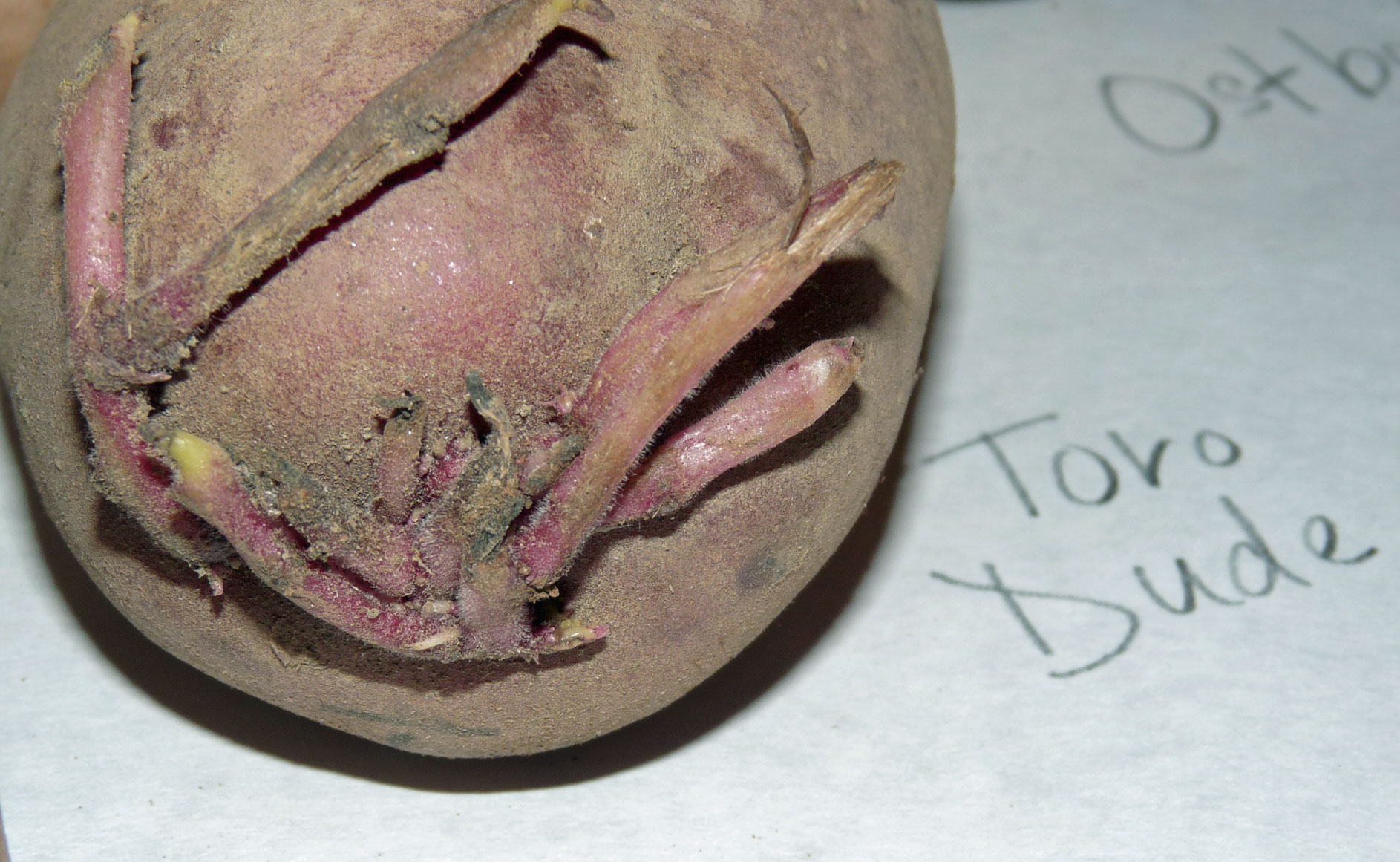
 It takes a special sort of person to see the beauty in a Potato Sampler box from New World Seeds and Tubers. My husband, for one, just didn’t get it. If he’s gonna look at a potato he wants to see it buttered and already on his plate. But I know beautiful when I see it and, to me, these guys all look gorgeous.
I chose the 8 pound sampler which promised 5 to 20 different varieties “from around the world, special breeding lines that are available only from us and a few classic varieties” of potatoes to try. I specifically asked for any they thought would do well growing vertically, since I wanted them for the 99 Pound Potato Challenge. I was also interested in trying some of the types Carol Deppe mentioned in her book, The Resilient Gardener.
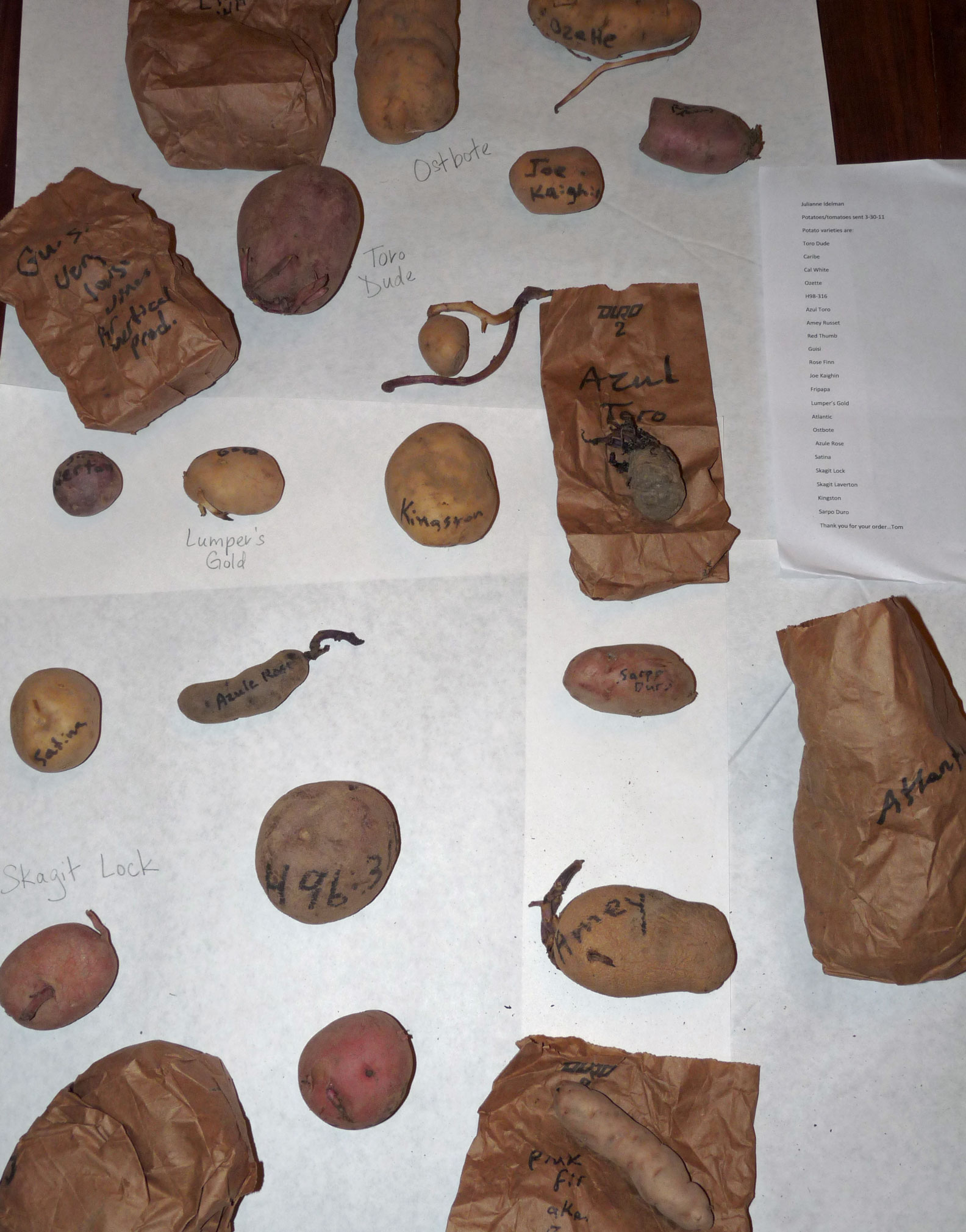 What arrived was a broad sampling of the possibilities of potatoes, twenty-one different clones and nearly forty individual potatoes, many I had never heard of before. In Heirloom Vegetable Gardening, William Woys Weaver says, “Growing heirloom potatoes presents special problems for the gardener because old varieties are not as resistant to disease as modern ones. Futhermore, potato varieties predating the advent of the blight in the 1840’s are to be found only in gene banks or in special botanical collections.”
I honestly don’t know where Tom Wagner finds all of his potatoes, but I am certainly glad that I found him. And I couldn’t wait to start getting these potatoes planted. One of the varieties specifically marked for the vertical growing project was Guisi, a potato I think is named for a Peruvian potato researcher killed tragically near one of his experimental fields.
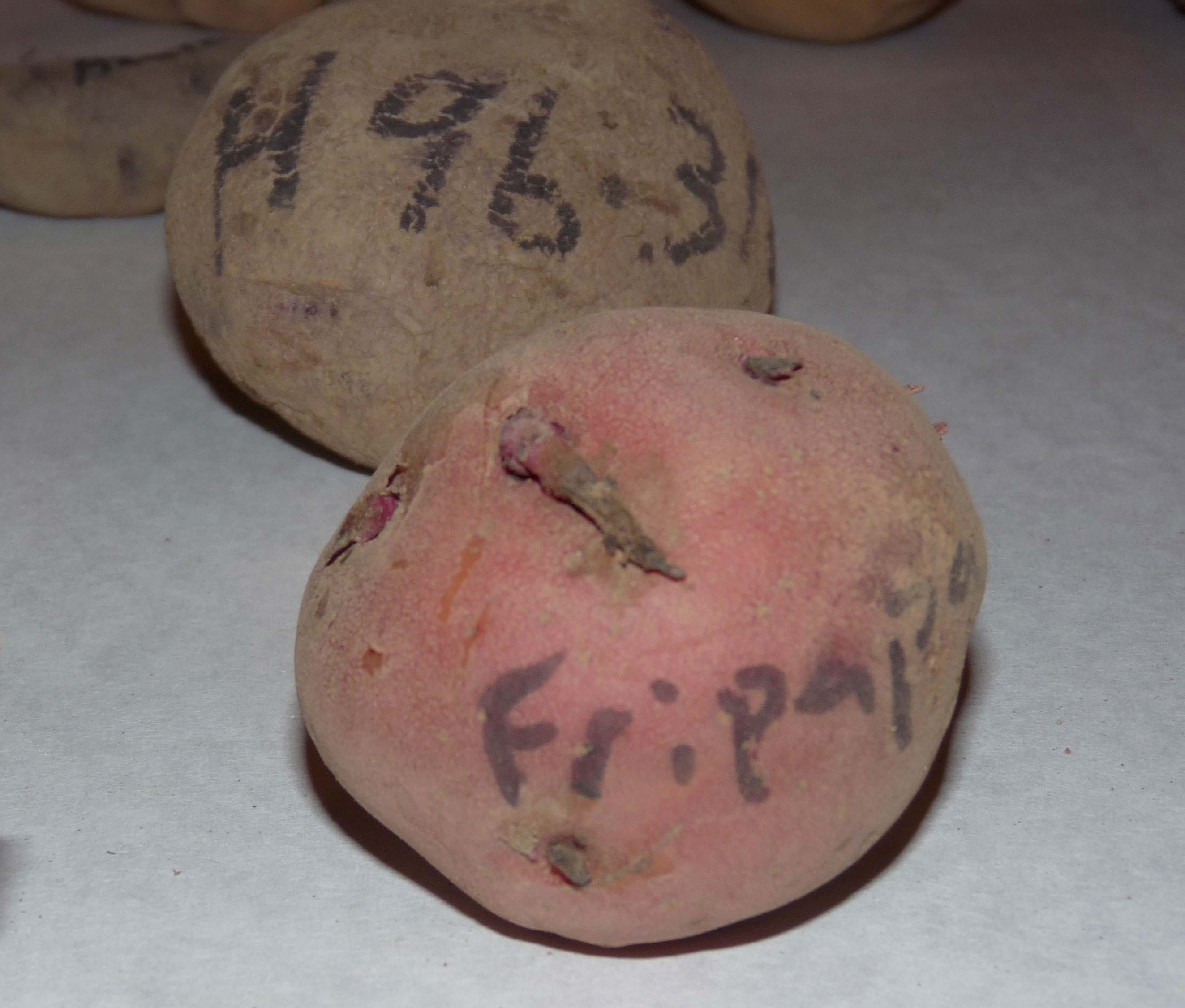 I got blues, reds and golds. I got fingerlings and smooth rounds, big bulbous blobs and delicate tiny tubers. But some of them don’t even have names! This hefty spud arrived with a number hand-written on its side. A quick Google search turned up an entry from the United States Potato Genebank that looks like H96.316 is an improved variety from the International Potato Center in Peru. Who knew there even was a United States Potato Genebank?
The Fripapa shown here had a hollow center, so I set it aside to research whether or not I should plant it. A potato with a hole in its heart would never pass the Carol Deppe rogue test. She cautions readers to eliminate peculiarities as something that might indicate a disease or a growing problem. Though none of the other potatoes I have cut for planting looked unusual.
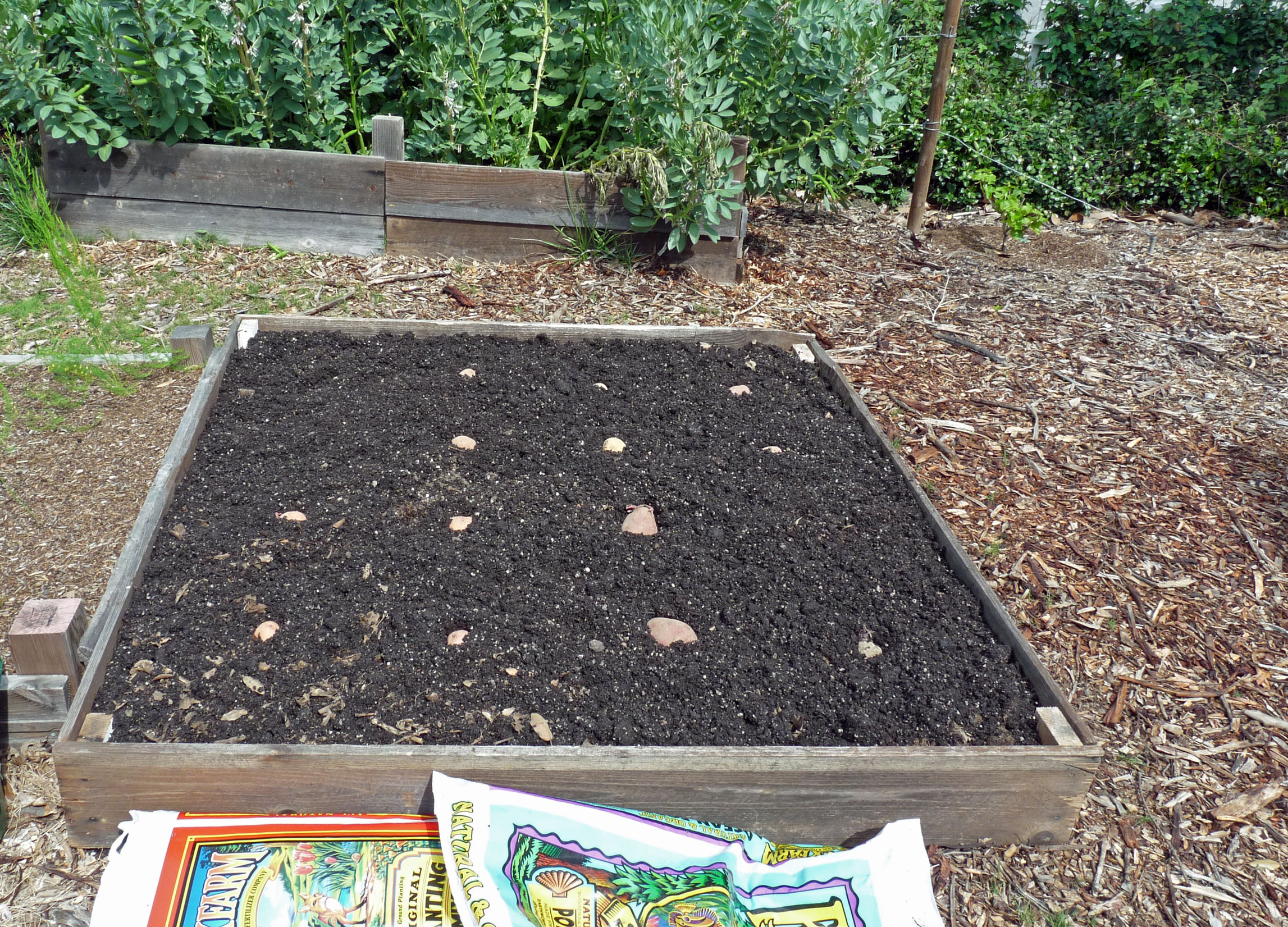 I set the potatoes 15″ apart, which gave me room to plant 16 potatoes in a 5’x5′ bed. This bed started out as a compost pile last year and grew favas through the winter. I amended it with my favorites from Happy Frog to deepen the soil level as much as anything else, since I anticipate soil fertility to be pretty good. Then I covered the seed potatoes with several inches of planting mix and watered the whole thing in. Depending on the weather, I hope to see at least some of the potatoes sprouting in the next week or two, though I understand it could take some of the varieties longer than that.
 The trick is, how do you keep track of which potatoes are which varieties when you are growing 16 plants of nine different varieties in one raised bed? To start with I got a stack of the really big plant markers from Common Ground so I can actually find them when I want to know who is who. I noted on the row marker how many plants of that variety are in the bed. For example, the ‘Guisi’ marker says (4) because the four plants closest to the marker should all be ‘Guisi’s’. I also drew myself a quick map, just in case something happens to the giant plant markers. Now I can refer back to this when the plants come up and remind myself that there should be two ‘Satinas’ and four ‘Guisi’s’ but only one of the ‘Skagit Lock’ and ‘Red Thumb’ plants.
Now, if I could grow a sour cream plant, I’d be all set!





 Yesterday I found a bee on the bright yellow flowers of a Chinese asparagus plant that had gone prematurely senile in it’s pot after our unexpected January heat wave. I whispered to the bee that we have lots more interesting delights coming for it this spring.
 OK, this whole companion thing gets complicated quickly, doesn’t it?
 From Dirt to Dinner