Hints of Things to Come

2 Comments
Our First Picolo Provencal Peas    

Our First Picolo Provenzale Peas

Friday morning–early–I was sitting in downtown Palo Alto in a Board meeting, in clean clothes with no visible dirt on me. But when someone there asked me what was good with me, I excitedly blurted out to the entire room, “We have peas!” Evidently, you can take the girl out of the garden, but…

These are the only peas that have survived from this year’s Pea Trial, the Pisello Nano Picolo Provenzale. I’ve been hunting for more seed for this variety and finally found it from Seeds from Italy. They are the U.S. distributor for Franchi Sementi spa of Bergamo, Italy, seedsmen since 1783. 1783, wow, I like the sound of that.

My mother-in-law comes from an Italian family and has liked other varieties of their seeds. I got some of the small Picolo Provenzale peas and also some of the Telefono variety which grow to 5-6′. 

Italian Winter Squash Sampler

Italian Winter Squash Sampler

I couldn’t help also ordering their collection of Winter Squash. They send you ten different varieties–and a bottle gourd–so we will be trying Padana, Marina di Chioggia, Quintale, Piena di Napoli, Tromba d’Albenga, Serpente di Sicilia, and four or five others. Just listen to the description for the Marina di Chioggia, “Very old variety from near Venice. 4-5 pound round fruit, grey/green knobby skin with sweet orange flesh. Essential for great soup, gnocci, roasting. Excellent keeper. 105 days.” Ahhh, those Italians!

The Pea Index

The Pea Index

But right now the garden is starting to show us a few more hints of things to come. The peas that got me all excited in the first place are growing pretty much flat until they are about the size of my index finger and then they start to round out some as the peas inside develop.

The January planting is roughly a square foot of pea plants that are flowering and developing peas at a rapid pace now that the weather has warmed some. They still have plenty of cool nights, which they supposedly like. I hope so, last night it got down to 39 and there was actually a light frost on the grass this morning when I went out. At this point, before a single pea has been eaten, I have to say that our January planting plan really has ended up getting us ahead of things, even if the peas got eaten by everything and developed very slowly. There are no flowers yet on the February planted patch yet.

Bush Beans Emerging from Flowers

Bush Beans Emerging from Flowers

We do have tiny beans growing though. The Bush Beans Roc D’Or Yellow Wax that are growing in a container on the back patio, where it is protected and warm, are flowering and slender beans have started to form.

I had expected two beans to form from each of the flowers but these are forming a single bean, which is still green but will turn a bright yellow as they mature. I love the way they look with the remains of the flower they formed from still stuck to their tips. These plants were also an early test that has turned out to be a good idea. These Bush Beans were sprouted inside under lights and planted as starts alongside seeds of the same variety that were put in at the same time these plants were hardened off. The beans growing from seed are doing well, but they don’t have flowers yet and are clearly behind the beans started indoors.

Even with starting things early, there isn’t much to eat in the garden right now. For lunch I made Pickled Radish salad with some of our delicious celery thrown in for good measure. I sliced the celery as thinly as possible, just like the radish, and pickled them together in the sea salt and sugar. Then I combined the radish tops and celery leaves, chopped them loosely and wilted them with a bit of water before tossing the radish and celery pickles with the dressing and the greens.

Maybe by next week I’ll be able to serve it with some fresh peas!
Raised Bed Trials

7 Comments
30" Potato and Tomato Raised Bed

24" Potato and Tomato Raised Bed

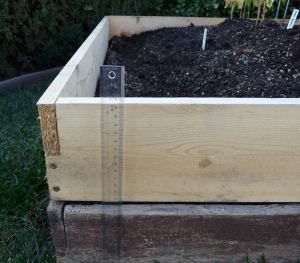
We are testing a wide variety of raised beds in the Dirt to Dinner garden. Just this week I added two new No Dig beds with tall trellising for cantaloupe and spaghetti squash. They are made of “found” lumber (it was Clean-Up Week in our neighborhood, so the finding part was easy) that 50 years ago was a backyard fence. I figure anything potentially unhealthy has surely leached out of it in all this time. Right?

The first bed we added to the front garden we took up the turf and dug the soil underneath, so it’s somewhere between 18″ and 24″ of new ammended soil mixed with the existing clay and topped with an inch of turkey farm compost. This bed holds potatoes and tomatoes, so I’m sure we’ll learn a lot about the quality of both the drainage and the new soil from the way the plants develop. It’s also in a windy corner, which the bush beans we tucked in there while the potatoes and tomatoes are getting started don’t seem too happy about. This also means the bed dries out more quickly than I would like and needs a thick mulching as soon as the plants are better established.

5" No Dig Squash Bed

5" No Dig Squash Bed

The shallowest of the raised beds is a No Dig 5″ deep bed with as close to Mel’s Mix as I could make with the materials at hand. And I do mean, No Dig with this one. It’s made out of found redwood timbers tacked together and laid straight onto the lawn. I am very curious to see how this bed does through the summer. I planted my spaghetti squash in this one, so I really hope it does well.

The idea is that the grass will die underneath the soil, turn into a natural compost and eventually become one with the dirt in the planting box. I imagine adding a lot of compost to this one through the Summer to keep the moisture content up. But will the grass grow up through 5″ of soil?

2'x2' of 6" and 12" Square Foot Sections

2'x2' of 6" and 12" Square Foot Sections

We also have a variety of Square Foot style beds in the Dirt to Dinner garden. My favorite ones, surprisingly, are the bi-levels. I thought I would want everything as deep as possible to hold all the soil and plants I could imagine, but I like the way this one looks in the garden and so far the occupants seem happy with their digs.

By far the largest raised bed in the Dirt to Dinner garden is the kids’ growing area which is over 18″ deep. The kids removed the turf and turned the soil underneath before the bed was constructed. At 112 square feet framed in traditional English willow hurdles, it is unique and also seems to be holding up well. willow-planter-almost-done1I have no doubt that the bed will provide ideal growing conditions and can’t wait to see what the kids do with it.

The original raised beds in this growing space are large plank board planters that stand 3′ high and are 4′ wide. They are great for keeping the dogs out and not having to bend over very far, and they are sturdy enough that you can even stand on the edge to adjust your cages or add to the trellis systems. But they are so deep that the soil compacts in them by a foot down and they are very ungainly to try to turn the soil in them because of their size. It’s tough to get a shovel into them and you end up breaking your back digging them out by hand every year or two to lighten the soil.

Full Circle Farm Visit

Leave a comment
Working on the Farm   Working on the Farm

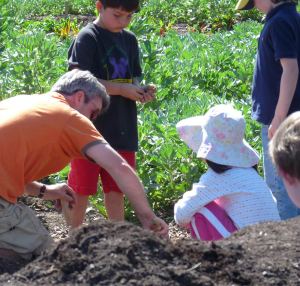
This morning was our field trip to visit Full Circle Farm, the educational farm in the Santa Clara Unified School District in Sunnyvale.

The volunteer Garden Manager, Melissa, introduced us to the garden and showed the kids the large worm box that supplies part of the nutrients needed by the vegetables growing on the farm.

The farm hopes to soon be able to make all of it’s own compost and to use that as the only soil additives for the produce grown on Full Circle Farm. Part of our group helped turn compost piles that will contribute to this process.

Other members of our class sifted garden soil to make it into potting soil for new plants that are beginning life in the Full Cirlce Farm greenhouse. We need to make some screens like the ones they use at the farm for the Dirt to Dinner garden. They are wonderful for sifting compost and getting the lumpy “uncooked” bits back into the pile for some further decomposing. I’ll check our books for a sample design and take it with me to the hardware store this week.

Planting Fingerling Potatoes

Planting Fingerling Potatoes

Our class planted some small fingerling potatoes on the farm this week. They weren’t cut and developing big ‘eyes’ like the ones we started two weeks ago in the Dirt to Dinner garden, these were very small and planted whole in the soil. Melissa gave us some of these “seed” potatoes so the kids could start their own potato patches at home or in the Dirt to Dinner garden. There are also extra Yukon Gold and Purple potato “seeds” here in case they want to try several varieties and compare the plants and their growth, production or taste.

Wearing a Little Soil

Wearing a Little Soil

It was fun to see what you can do with a garden that covers over half an acre. By comparision, the whole lot that holds the Dirt to Dinner garden is about 1/8th of an acre. The size of the garden beds we currently have under cultivation is ~300 square feet. Because we are using raised beds and biointensive planting and growing techniques along with vertical supports, we can grow a lot more in a small space than if we did that same space in traditional rows the way much of the Full Circle Farm produce is planted, but it was still great to see what’s possible when you really have the room to spread out. I can dream, can’t I?


eyeing-the-fields

We Will Have Peas

1 Comment
90 Days from Seed to Flower   90 Days from Seed to Flower

One way or another, we are determined that we *will* have peas from our garden. Two of the varieties from the Spring pea trial are all but forgotten, but the Picolo Provenzale  are growing in all three different plantings, and the January planting is starting to flower. OK, it’s what? Nearly 90 days out from planting, but hey, it’s flowers!

I’m also amazed that the Sugar Snaps in the back garden that each had their heads snapped off by some marauding varmint are starting to recover! They grew new vines from the roots up and around the bitten ends of the first ones and some of them are starting to put out tendrils like they mean to actually grow.

Sugar Sprints and Carrots

Sugar Sprints and Carrots

Nearby, in a 4′ x 4′ bed, there are Sugar Sprint peas growing, mostly under a burlap covered cage to protect them from everything. They don’t seem to mind the shade. The Picolo Provenzale starts in the front garden didn’t seem bothered by it while they were covered either. I take it off of them in the morning to allow them a few hours of direct sun and they seem fine.

buckets-of-tomatoesAnd we are getting to the stage where we have literally buckets of tomato plants. We have Roma Paste tomatoes for sauce and catsup, we have Principe Borghese for drying, we have Costaluto Genovese for fresh cooking, Big Beef and Crimson Carmello for slicing and eating, we even have a German Orange Strawberry tomato that I can’t wait to try! I’m afraid I may have even ordered some grape tomato plants in fun shapes and colors from Park Seed when it was still cold out and the garden was a limitless imaginary place.

Surviving the Spinach Monster--So Far!

Surviving the Spinach Monster--So Far!

And, happily, the evil Spinach Monster that devours my plants right down to the roots if I leave them outside after dark without a cover does not appear to like Bok Choi. What IS that thing? For a long time I thought it was ravenous snails or slugs because the plants that were up on the hottub cover at night weren’t bothered by it, but earlier this week several six-packs up there were creamed by whatever it is and the chard, tomatoes, peppers, etc. sitting right next to the spinach were fine. Maybe Popeye the Possum? I don’t know.

Square Foot by Square Foot

Leave a comment

Square Foot Tomatoes and Chard

Square Foot Tomatoes and Chard

The Dirt to Dinner garden is starting to really take shape and I’m loving the time I am able to spend out there. One of the fun things we are doing this year is practicing some French Intensive gardening, or “Square Foot” gardening, as it’s often called. I have several beds divided up more or less in this way. Today I put in a two-level 2′ x 2′ bed with my drying tomatoes in the deeper sections and Swiss Chard in the two lower sections that will probably get shaded by the tomato plants, even when I cage them. I hope the Chard doesn’t mind too much. It should have lots of time to establish itself before then–if the crows don’t eat it!

Another bed is divided into three sections with a test bed of beans that I started ahead indoors, beans I started in place a month later, and beets. I lined the edges of this bed with carrots also, so it will be crowded as things mature and I will need to keep it fed. The bush beans won’t mind all being together and the beet tops hopefully won’t shade the carrots too much. We’ll have to see how this one works out.

Square Foot Beans and Beets

Square Foot Beans and Beets

I’m also trying a 3′ x 3′ with two tomato plants, again, and sections of spinach and chard. So that will make a nice comparison bed to the 2′ x 2′. I wish I had grown this type of tomato before. They are a determinate heirloom variety called Principe Borghese but I can’t get any concensus on how tall they like to grow or how bushy they will be. I’ll let you know how they turn out!