Compost Resurrection

1 Comment
100 Years of Farming  

100 Years of Farming

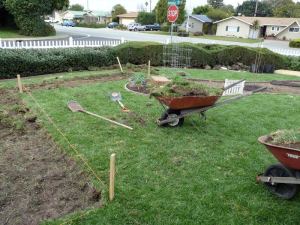
I spent part of Easter Sunday in the garden, pretty much like I do every day. I cleared the sod that we piled willy-nilly around the compost bins when the kids took the turf up for the Dirt to Dinner bed in the front garden. Once I made my way to the compost bin that’s done cooking, I dug underneath to see what the compost was like. The dog helped. Remind me not to get a digging breed next time. ;-)

The first thing that greeted me under there was a worm. Looked ready to me.

I got a large cement mixing tub and balanced the family heirloom across it to sift the compost. My husband’s family were Italian immigrants who farmed in Santa Cruz for several generations. This frame has come down to us from the family farm and I’m honored to use it. My mother-in-law briefly toyed with the idea of setting it out with the trash last Clean-Up Week, but even though the squirrels have done their worst, it survives as part of the Dirt to Dinner project here with us.

Tomato Variety

Tomato Variety

I sifted the compost through the frame, relocating the worms and adding whatever didn’t make it through the frame to the compost bin that we are currently building up. Then I took my tubfull of “black gold” over to the tomato bed. One of my recent don’t-know-how-I’d-survive-without-her phone calls to my mother-in-law went something like this, “Can I grow six varieties of tomatoes in the same bed?”

“They won’t mind but you can’t save the seed.”

“Why not?”

“They might not breed true into what you expect them to be next time.”

Just like kids, in other words. 

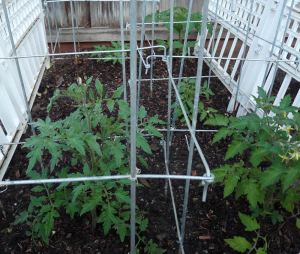
I carefully surrounded my six tomaotes with compost made from the scraps from the food we’ve already eaten, chewed by worms and other unseen helpers, sifted through more than a hundred years of family farming. It felt like a perfect moment in keeping with the resurrection theme of the day.

The best place to seek God is in a garden.  You can dig for him there. 
~George Bernard Shaw

The Planter is Planted!

Leave a comment
Dirt to Dinner Individual Raised Bed Planting Areas    Dirt to Dinner Individual Raised Bed
Planting Areas

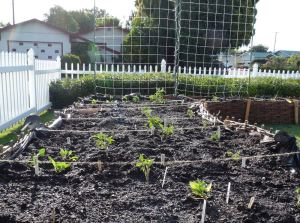
Hooray! The Dirt to Dinner willow raised bed planter is now home to 14 individual 2×4 planting sections, one for each of the families in the Spring program. And today, April 11th, was finally the day the beds were first planted. The 112′ “L” shaped bed created with willow hurdles from Master Garden Products in Oregon holds about 18″ of soil on disturbed adobe that has been lawn for the last ten+ years, with the sod removed. (We’re still trying to fit it all into the composter in layers–it could be a while!)

The planter now holds different combinations of tomatoes, tomatillos, peppers, chard, beets, carrots, a wide selection of radishes, including one patch with four varieties growing side by side for comparison, lettuce, watermelon, cantaloupe and cosmos, among others!

You'll Be Missed

You'll Be Missed

During the planting of starts and seeds, a square foot of Broccoli Raab starts were transported into the front garden, in hopes of being chosen as residents of the new planting bed. Sadly, one of the broccoli starts did not survive the move. The kids chose to honor the broccoli’s return to the soil with this memorial. ;-)

Not only did we get the planting beds planted today, but we also had lunch on time! (A process it has taken us a while to perfect.) In the kitchen, the kids prepared Strawberry Lemonade, Mashed Sweet Potatoes and Quinoa Confetti  Salad with beets, carrots, cabbage, red onion, radishes, celery, fennel and fresh herbs. The sweet potatoes were said to, “smell like a pie!”

Grate Help

Grate Help

The quinoa salad was not as popular with the kids as the kale salad we tried during Class 2 but it was tasty, fresh and welcomed by most of the adults. It made me wonder if there is some more fundamental reason kids tend not to like certain foods. I’ve been reading the new edition of Harold McGee’s classic On Food and Cooking: The Science and Lore of the Kitchen and in the vegetable section he talks about the chemistry of many of the vegetables we are encouraging the Dirt to Dinner kids to eat, a chemistry which is often a defense mechanism for plants designed to keep things from eating them! What if immature digestive systems are more sensitive to these chemical defenses and there’s a biological reason children turn up their noses at the foods grownups spend a lot of time trying to convince them are good for them? Certainly, feeding them fresh versions right out of the garden gets around any obvious taste or processing-into-tastelessness issues. Just a wild idea. Let me know if you have thoughts better founded in biochemistry than my musings!

Mom, Can I Have More Kale?

Leave a comment
Massaged Kale Salad              

Massaged Kale Salad

Today in Dirt to Dinner the kids made an amazing Massaged Kale Salad with a medley of Roasted Root Vegetables. Delicious! And as you can see, beautifully presented. Can you imagine how satisfying it was for a bunch of parents to stand around and see the kids going for seconds of a salad made with raw kale right from the garden! Not to mention they were also eating roasted turnips, parsnips, potatoes, rutabagas, carrots and more. All in all a very satisfying meal to help consume. You can find a recipe for the salad (not exactly the way we made it–but close) on the “I Love Kale” blog at http://iheartkale.blogspot.com/2009/01/massaged-kale-salad-with-grated-root.html

Team Work

Team Work

And they had worked up quite an appetite finding garden bugs, playing an elaborate kind of tag that reinforces ideas about predator – prey relationships and food webs at work in a garden. And designing and digging the space for the Dirt to Dinner planting beds.

One thing we can already tell you after just two sessions of Dirt to Dinner is that when you have twelve plus kids on hand and lunch to prepare for 25, three hours goes mighty fast. Because there is so much to do, we are already guessing that the kids likely to get the most of the program will be the ones who are able to be here on Mondays for Open Garden hours when they can move at their own pace.

Dug Up Discovery

Dug Up Discovery

Just today while the group was together we had a scavenger hunt to see what kinds of insect life we could find in the garden, met the worms who will inhabit our worm farm, picked kale, celery and lemons and played the predator-prey game about cabbage, cabbage worms, moths and birds.

Then one group prepared and roasted the root vegetables and then planted potatoes outside in flexible bins and the other group prepared the Massaged Kale Salad and did a math and spatial awareness puzzle to try to figure out what shapes the pieces for the garden boxes could be arranged in to maximize the square feet for gardening while still allowing kids to reach all the plants that would be in the beds without putting their weight on the soil.

Mid-Dig

Mid-Dig

Want to try it? You can cut up sticks, straws, string, strips of paper, etc. into four 4″ lengths and eight 6″ lengths and let us know what shape configuration gives you the most square inches while still allowing easy access to the space inside the sticks. We know of two shapes that will give you 112 square inches. The largest configuration the Dirt to Dinner kids came up with today was a 112 square inch “L.” So that’s the shape that the kids measured and marked out and eventually framed with our 4′ and 6′ lengths of willow hurdles to make a 112′ garden bed.

Ready for the Dirt

Ready for the Dirt

Early Lessons from the Pea Trial

Leave a comment

Lessons from the Pea Trial–So Far

Pisello Nano Piccolo Provenzale

Pisello Nano Picolo Provenzale

#1. Early planting does not equal early eating. It’s not just 55-60 days, it’s the *right* 55-60 days. We thought an early start would give us peas sooner, but that hasn’t turned out to be the case. Peas that were supposed to be ready to start picking in 55-60 days are just now 6″ tall a week after the 60 day mark we were hoping for. The peas planted February 18th may or may not be ready for picking by mid-April. We’ll let you know!

#2. Peas planted early seem to get damaged by pests a lot more than peas planted later. Maybe because there’s not much else out there looking green and delicious in January and early February. Or maybe we just got smarter about the covers we used as the trial went on.

#3. Peas appear to sprout and grow better in February than they do in January. Weather will surely influence this. We’ll track it next year and compare. This year January was warm and sunny, if that weather had continued, maybe the peas would have been on the table by now.

Pea Sprouts Protected by Plastic Netting

Pea Sprouts Protected by Plastic Netting

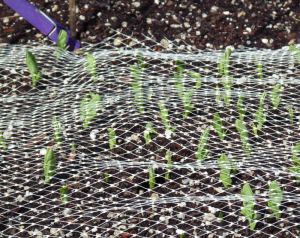
#4. Peas need to be grown under netting or cages in order to foil uninvited dinner guests. Upside down black plastic latticed plant carriers from the garden store worked well for the first few weeks, as did the onion bag netting we recycled. Neither of these methods was deep enough to allow for much growth and I would like to keep the peas protected longer, just in case. We lost a whole planting of snap peas in the back garden because something came along and snipped the tops off each of the vines. (Argh!!) We’ll keep the tall covers on these for the first several inches of growth and you can check out our Pea Trial page if you want know how our test of the burlap covered cages does.

Spring Obsessed

1 Comment

Raised and Ready

Raised and Ready

Yesterday I realized that the collards that have wintered over so well have noticed it’s about to be Spring and are getting ready to go to seed. I quickly made them into everything from frittata with onion and bacon to classic Southern-style ‘greens’ to bags to give away to anyone who haplessly stopped by my house while they were still here. Waste not, want not. ;-)

Saying that I am a bit obsessed with gardening at this time of year is polite understatement. The minute the weather breaks, which is four or five times a day this week, I am rushing out to dig compost into soil, turn new planting beds, pot up young tomatoes or check on the peas.

Inside Starts vs. Direct Planting

Inside Starts vs. Direct Planting

I gave up the container I was using as a cold frame and decided to test the wisdom of starting bean seeds early. They sprout well, grow fast and are hard to keep from getting leggy, not to mention carrying them back and forth from the house for hardening off. So, I took a six-packs worth of Roc D’or Yellow Wax Bush Beans (55-60 days) and popped them into this cosy bed along with roughly the same amount of seeds planted today. The left over space I filled in with Jewel-Toned Beets (55 days) because the very next planting bed over, a shallowed raised bed build into the patio, I have other beets grown from early transplants to compare them with. The front and back edges I filled in with King Midas carrots (68-75days.) They will take longer than the beans or beets in this bed, but the soil here is so perfect for them–fluffy down at least a foot–that I couldn’t resist.
Onions Waiting

Onions Waiting

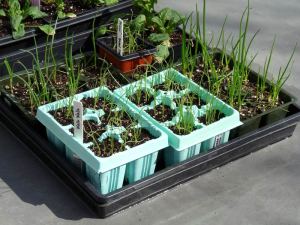
I tucked the first of the onions into their planting bed this afternoon, between rain drops. The soil in my raised beds drains well enough to work even when the weather has been wet for weeks. I planted the Red Long of Tropea (90 -110 days) I grew from seed given to me by the folks at Blue House Farm.


Red Long of Tropea

Red Long of Tropea


These beautiful Italian onions have a unique shape that I think will appeal to the kids and they are meant to be eaten fresh when they bulb in the Summer. They are considered Long Day onions. The Red Onion Festival is held in Tropea during the first week of July, and our lattitude is a bit South of them, so here’s hoping.

I started work on two new raised beds today. My husband actually did most of the work for the first bed, a 4’x4′ built with the remains of a Square Foot Gardening kit. It will be in a sunny spot that was part of our lawn until this morning. Tom cut out the sod 6-8″ deep and I’ll fill that with Lyngso Essential Soil Mix when we fill the kids’ Dirt to Dinner willow beds.

Square Foot 3' x 3'

Square Foot 3' x 3'

The second bed is in a sunny corner that might be slightly shaded by the artichokes. I guess I could always cut them back if they get in the way. Those guys could survive without a leaf or two. This bed is built out of two 3’x3’s from the Square Foot Gardening kit, for the extra soil depth needed in this spot. It’s up against the fence and I have done what I could with the soil under the bed but it still ain’t pretty. This one I dug some compost into and will fill with potting mix made according to the Square Foot Gardening method, for the most part. My measuring is never too exact. I have had very good luck with their soil mix over the last few years even though the vermiculite it calls for is hard to find in “coarse.” I also don’t like the warning label that comes on the vermiculite bag, so if you can suggest good alternatives, let’s hear them!

Broccoli Raab

Broccoli Raab

Here’s a job I really need smaller hands to help with. I think every last Broccoli Raab seed I planted spouted–twice! And now I need to prick out the plants that are too close together and move them to another spot. You’re supposed to do this before the leaves touch the leaves of the plant next to them, so I’m already very late. I know I could snip some of them at soil level to thin the patch, which I may yet muster the courage to do. But I go to a lot of trouble to sprout these little guys! I hate to go out there with scissors and chop half their heads off just like that! Maybe I can move them into flats for the Dirt to Dinner kids to take home. A lot of them like broccoli…I wonder if I have a flashlight bright enough to work by…