 Last night we experienced a record low in the Dirt to Dinner garden and this morning we woke up to lots of frost on the vegetables. I’m very curious to see how our winter vegetables respond. Many of the varieties we have growing are either ‘frost tolerant’ or ‘frost hardy’ and I bet you last night will tell us which ones are which! It’s also officially time to put all the ‘tender’ plants into the compost pile except for the one tomato we are keeping under row cover and anything we want to try growing under glass for our winter experiments. I just picked some really nice snow peas yesterday, maybe this morning I can find some frost peas to go with them. ;-)
Author Archives: Hand in Hand Parenting
Dark Days Dirt to Dinner Hunter’s Stew
1 Comment
Everything But the Huntee
For some reason the holidays and all the local eating have brought out a craving for Hunter’s Stew. I originally intended to do it with venison, but had a hard time finding the cuts that I wanted and the buffalo I was offered instead admittedly looked fabulous. It may have come from just outside the 100 mile radius we’re shooting for, but the duck and the rabbit were both local, as were all the vegetables.
The stew started with Dirt to Dinner garden-grown onions, carrots, potatoes and pumpkin, seasoned with thyme, rosemary and parsley, also out of the yard. I planned to add in the shallots we grew, but forgot and used garlic instead. I would have happily added parsnips or celery, but neither of them are ready yet. The peas you see in the picture never made it into the kitchen. They were delicious straight out of the pods.

Garden Snack
The stew will be served with a turnip-rutabaga mash to soak up the delicious broth. It has eight hours in the crock pot to go, but I’m not sure I’m going to make it that long. I was worried that the duck would give the stew a greasy feel to it, so I only added the browned duck legs and it is smelling just right.
The Thankful Garden
Leave a comment
Rutabaga
I’m amazed at all the things still going strong in the Dirt to Dinner garden at this time of year. In the Midwest, where I grew up, all I had in my garden in late November was frost.
If you’d like to see all the ingredients we have available this year for a Thanksgiving feast, I made a VoiceThread to share them with you.
If you just want the short-list of what is growing, it goes something like this: Ancho peppers, artichokes, arugula, asparagus, basil, beans, beets, broccoli, carrots, cabbage, cauliflower, chard, chives, chicory, collards, ginger, gourds, Hungarian peppers, kale, Komatsu, luffa, mustard, onions, parsley, parsnips, potatoes, radishes, rutabagas, tomatoes, turnips, sage, shelling peas, snap peas, snow peas, spinach, strawberries and a lone watermelon.
Dark Days Dirt to Dinner Week 1
1 CommentBig Soup from the Garden
The Dark Days of Winter Eat Local Challenge began Sunday, November 15 and goes through March 31, 2010. Basically the idea is to make at least one meal each week with 90% local, sustainable, organic, ethical ingredients. I’m trying to cook as close to home as possible using ingredients that come straight out of the Dirt to Dinner garden.
 This weekend, to get warmed up, I took a few small liberties with Alice Water’s “Winter Minestrone with Turnips, Potatoes, and Cabbage” recipe from The Art of Simple Food. But I like to think that Alice would approve. It was fresh, organic and as local as the front yard after all. Some friends came down from San Francisco, and the enthusiastic audience set the tone.
I had to improvise right from the start with the soffritto because I don’t have celery ready yet. Our celery started from last year’s seed is still tiny. What we do have a bit of in the Dirt to Dinner garden is gorgeous ‘Rainbow’ chard. We fought the leaf miners long and hard this year to get that chard, so I’m making the best of it. Not only did we add it to the “Massaged Kale Salad” the last time the group met, I also used it for the soup. I took two long beet-red stalks of chard and chopped them as I would have the celery and tossed them in with one of the last “White Globe” onions and a variety of carrots ranging from ‘Yellowstone’ to ‘Purple Dragon’ which I snuck out of our carrot Fort Knox as thinnings. When the soffritto had colored nicely, I tossed in garlic, a handful of fresh thyme & some dried Italian parsley that we had growing all over in the spring.
Then I added a pound of ‘Tokyo Market’ turnips, with the greens, the leftover chard leaves, a handful of last tomatoes from a volunteer plant out back, a couple handfuls of our ‘All Blue’ potatoes and sliced up rings of two small leeks. The turnips have been growing in a low bed in the front garden for about six weeks now and they are wonderful. Germination rates have been amazing for this variety and they are small, sweet, tender turnips that even the kids eat happily. The leeks are slow growing and much thinner than I had hoped but they still taste good and the kids often prefer them to onions. The ‘All Blues’ are a story all their own!
The night before I had soaked some of the drying beans we grew this summer with kombu and toward the end of cooking, I added in about 3 cups of these along with the softened piece of kombu. All of this was topped off with a head of chopped Chinese Cabbage pulled from the garden and thoroughly rinsed to remove the slugs hiding in many of the leaf folds.
The bowls of soup were finished off with a splash of nice olive oil and a heaping spoonful of, admittedly not local, Parmesan. I could have finished them with homemade/homegrown pesto, but the cheese was a lovely addition. If you know how I can get some made within 100 miles, I’d love to try it.
Confounding the Peas
1 Comment
Not the peas we had in mind!
A major issue in observation studies is that we often don’t always know what the potential confounding factors may be. In the soil fertility experiment we started a few weeks ago the confounders have overcome the experiment to the point that it was almost impossible to tell what was happening.
First, the planter was visited by our resident rodents, the hopping mice that peek out at us from the bushes and love to steal tasty treats. They dug out many of the seeds and presumably ate them.
Next, maybe due to the delicious rodent perfume worn by our mice, a cat visited the planter and dug through one side of the box creating a large mound containing who-knows-what sort of catly gifts. And that was before the huge storm that blew everything around and even washed some of the soil right out of the planter and onto the plastic around it.

Who's That Growing in Our Bed?
In spite of all of this, a few things did actually sprout. If you look carefully at the East side of the soil test bed, the “Tomato Soil” side, you can see how we counted twelve sprouts the last time we recorded data from this experiment. But 12 sprouts of what, exactly?
At least three of the sprouts were squat, strong-looking stems with rounded leaves on them. The rest were spindly stems with elongated, pointed leaves on them. Only the first three were a match to the pea patches growing in two nearby planters.

Pea Patch Volunteers
So, since this a really great experiment concept, and we already have the nicely amended (thanks for all your help, Cat!) soil on one side and the do-nothing-to-it “Tomato Soil” on the other side, we decided to replant this experiment to see if we can get a less confounded idea of what happens.
The bed was smoothed on the West side, and the cat pile was carefully removed. The bed was then replanted with 1 oz. of ‘Alaska’ (Earliest of All) peas, also known as Pisum sativum var sativum, packed for 2009. These were planted equally on the two sides but we decided to allow the existing pea sprouts to stay. They were marked so we can take them out of the data if we choose to.

Burlap Fail
Then the bed was carefully covered with burlap and cages to discourage visitors. Unfortunately, this morning there seem to be a whole lot of holes in the burlap that weren’t there when we put it on! Kids weren’t the only ones out trick-or-treating last night. We’ve been raided by varmints! (I”m sorry about all those things I said, Cat. Please come back to the garden. We need you! We’ll plant more catnip, I promise!)
It looks like at least a dozen holes were dug into the planting area last night. There’s no way to tell if the mice are eating the new seeds or the old seeds that might be still left in the soil. But there are certainly some of the seeds still undisturbed in the planting area.
Pea Prison
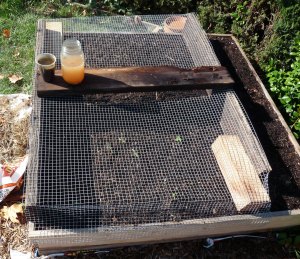
In order to try to salvage this experiment we grabbed a few things we had around the garden and built a mesh wire cage over the planter like the one we use for the carrots’ Fort Knox. Hopefully this will give the peas a chance to sprout and grow through the tender and delicious stage. We noted that the peas that we started weeks ago who were sitting nearby in their nursery packs waiting to be planted are undisturbed.
We didn’t have a large enough piece of hardware cloth to cover the entire bed so we covered an equal amount of each side and will leave the area with the most rodent damage exposed for now. Maybe that will help keep the mice from breaking into the seeds we are trying to save and then we can plant it with another crop in a week or two when we see how things germinate.
 From Dirt to Dinner