Dark Days Stir Fry

2 Comments

Roman BroccoliTired of all the rich holiday food and desperately in need of a fresh vegetable, I grabbed an empty dish pan and headed out into the garden this afternoon to see what I could find to turn into dinner. The first thing I pulled were some nice fat rutabagas. I’m hoping to re-purpose they bed they are growing in very soon so I wanted to use them up anyway.

Next to the rutabagas there was a very nice head of ‘Romanesco’ Broccoli growing. I have been watching this plant carefully because I’m not entirely sure how to tell if it’s ready to eat or not, but I was more than happy with the size so I figured it was worth a try.

Next to the ‘Romanesco,’ there were lots of side-shoots on my regular broccoli, so I collected those. I picked through the snow pea vines and found half a dozen pods that were ready to eat. In search of more variety and color, I pulled some bright white ‘Tokyo Market’ turnips and several different kinds of carrots, ‘Yellowstones,’ ‘Romeos’ and ‘Nantes.’

Inside again, I diced and sliced the vegetables, including the turnip greens, and tossed them into a skillet with olive oil and a red onion left over from burgers my husband cooked a few nights ago. I added a few dashes of white wine vinegar and tamari and covered the pan to steam everything. When the vegetables were almost done, I tossed in diced jerk smoked pork chops hubby cooked on New Year’s Day and stirred it all together for a few minutes before calling it done.

Simple. Fresh. Very satisfying.

Dark Days Dirt to Dinner Hunter’s Stew

1 Comment

Everything But the Huntee

For some reason the holidays and all the local eating have brought out a craving for Hunter’s Stew. I originally intended to do it with venison, but had a hard time finding the cuts that I wanted and the buffalo I was offered instead admittedly looked fabulous. It may have come from just outside the 100 mile radius we’re shooting for, but the duck and the rabbit were both local, as were all the vegetables.

The stew started with Dirt to Dinner garden-grown onions, carrots, potatoes and pumpkin, seasoned with thyme, rosemary and parsley, also out of the yard. I planned to add in the shallots we grew, but forgot and used garlic instead. I would have happily added parsnips or celery, but neither of them are ready yet. The peas you see in the picture never made it into the kitchen. They were delicious straight out of the pods.

Garden Snack

The stew will be served with a turnip-rutabaga mash to soak up the delicious broth. It has eight hours in the crock pot to go, but I’m not sure I’m going to make it that long. I was worried that the duck would give the stew a greasy feel to it, so I only added the browned duck legs and it is smelling just right.

Dark Days Dirt to Dinner Week 1

1 Comment

Big Soup from the Garden

The Dark Days of Winter Eat Local Challenge began Sunday, November 15 and goes through March 31, 2010. Basically the idea is to make at least one meal each week with 90% local, sustainable, organic, ethical ingredients. I’m trying to cook as close to home as possible using ingredients that come straight out of the Dirt to Dinner garden.

Chinese CabbageThis weekend, to get warmed up, I took a few small liberties with Alice Water’s “Winter Minestrone with Turnips, Potatoes, and Cabbage” recipe from The Art of Simple Food. But I like to think that Alice would approve. It was fresh, organic and as local as the front yard after all. Some friends came down from San Francisco, and the enthusiastic audience set the tone.

I had to improvise right from the start with the soffritto because I don’t have celery ready yet. Our celery started from last year’s seed is still tiny. What we do have a bit of in the Dirt to Dinner garden is gorgeous ‘Rainbow’ chard. We fought the leaf miners long and hard this year to get that chard, so I’m making the best of it. Not only did we add it to the “Massaged Kale Salad” the last time the group met, I also used it for the soup. I took two long beet-red stalks of chard and chopped them as I would have the celery and tossed them in with one of the last “White Globe” onions and a variety of carrots ranging from ‘Yellowstone’ to ‘Purple Dragon’ which I snuck out of our carrot Fort Knox as thinnings. When the soffritto had colored nicely, I tossed in garlic, a handful of fresh thyme & some dried Italian parsley that we had growing all over in the spring.

Then I added a pound of ‘Tokyo Market’ turnips, with the greens, the leftover chard leaves, a handful of last tomatoes from a volunteer plant out back, a couple handfuls of our ‘All Blue’ potatoes and sliced up rings of two small leeks. The turnips have been growing in a low bed in the front garden for about six weeks now and they are wonderful. Germination rates have been amazing for this variety and they are small, sweet, tender turnips that even the kids eat happily. The leeks are slow growing and much thinner than I had hoped but they still taste good and the kids often prefer them to onions. The ‘All Blues’ are a story all their own!

The night before I had soaked some of the drying beans we grew this summer with kombu and toward the end of cooking, I added in about 3 cups of these along with the softened piece of kombu. All of this was topped off with a head of chopped Chinese Cabbage pulled from the garden and thoroughly rinsed to remove the slugs hiding in many of the leaf folds.

The bowls of soup were finished off with a splash of nice olive oil and a heaping spoonful of, admittedly not local, Parmesan. I could have finished them with homemade/homegrown pesto, but the cheese was a lovely addition. If you know how I can get some made within 100 miles, I’d love to try it.

Dispersing Seeds

Leave a comment
Ready to Thresh

Ready to Thresh

This week during Open Garden, we collected the bean seeds that have been drying on the plants for several weeks and examined the soy bean seeds that had been left to undergo their natural dispersal process. At the final stage of drying the bean pods will twist until they burst, allowing the beans inside to pop out of the shells and spread out in the surrounding around.

Ready to Store

Ready to Store

The trick to collecting your soup beans is getting to them just before they hit this stage. You want the pods to be dry and brittle, but not at the point of starting to twist. I usually have to find one that has already twisted and flung out its seeds before I realize it’s time to pick the rest of them. Once the dried seed pods are collected, you can put them into a paperbag and shake the closed bag to break open the pods and free the beans. Then lift out the dried shells to toss into the compost bin and what’s left in the bag is your beans.

Ready for Soup

Ready for Soup

Just to be sure that they are really dry, I sometimes add a commercial desiccant packet to the bottom of the container I keep them in, but a little dried milk in a folded piece of paper towel will also do the trick.

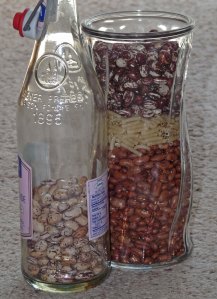
To use the beans, I soak them overnight with a good size piece of kombu (seaweed) to make them easier to digest. Then I throw out that soaking water but save the kombu to cook with the beans. In the Spring I definitely plan to try more varieties of drying beans for soup all Winter long.

October 10th, 2009 by Sidney, Kimberly and Marilee

Leave a comment

Opening Circle: Mackenzie shared a beautiful, new song with African lyrics. The English lyrics are as follows:

Welcome to my village
You are part of my village
We are all one village

Today we passed an invisible “talking stick” and shared the name of our favorite veggies. We also shared the progress of our seed jars. Most of the seeds had quickly germinated and in some cases had multiple leaves, or the seeds remained dormant with mold growing on the moist paper towel.

We discussed that the newly emerging plants were initially feeding on the nutrients within the seed and then each new plant grew toward the sunlight. Sidney shared a seed dispersal experience describing how a neighbor’s dog collected and distributed seeds which had caught onto his fur.

Mackenzie introduced our special guest today, Suzanne Mills, her mother from San Diego. Suzanne was busy helping everyone today with the experiments, cooking, clean up and sharing stories about growing up with Mackenzie. Thank you Suzanne!

Garden Chores:

The front yard was cleaned up with old growth tomato plants taken away to the compost pile.
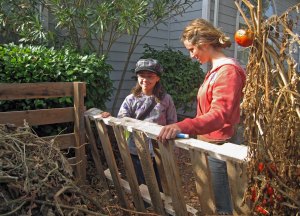
Large Compost Bin

Tomato Plants Become Compost

Science Project:

We talked about the 3 elements; sunlight, water and soil and how they relate to plants.

There were 3 experiments. Mackenzie prompted the investigation with a question about one of the elements and then we created our scientific guess, sometimes referred to as a hypothesis.

Q#1 What happens to roots with various amounts of water?

Hypothesis: Plants need water

Method: 5 cups of soil were given varying amount of water and ability to drain water.

C1 – no water

C2 Water once with cup drainage holes

C3 Water once with no drainage holes

C4 Water several times with cup drainage holes

C5 Water several times with no drainage holes

Q#2 What does soil do for plants?

H: Quality soil gives us bigger leaves

M: 3 pea seeds using 3 methods were planted in the garden

P1 Peas with water and sun

P2 Peas with poor soil with water

P3 Peas with good soil, sun and water

Q#3 How does light affect plantʼs growth?

H: Plants donʼt need light but they grow better with light

M: Put 3 cups filled with seeds and soil into 3 areas of varying light

C1 Inside without light (closet)

C2 Create a collar of foil around the cup to maximize light capture

C3 Put cup outside with no foil collar

Garden Senses Exercise

How Does the Garden Feel?

Senses in the Garden:

Everyone had fun searching the garden and acting like a detective finding 18 different

textures, smell, sounds, colors, tastes. The “brightness” of each individual piece was

enjoyed.

Cooking Project:

Cooking 3 different dishes using Polenta; Polenta crust pizza, soft polenta with olive oil, soft polenta with tomatoes, olive oil and mozzarella cheese, and apple upside down cake.

Polenta is a dish made from boiled cornmeal. When boiled, polenta has a smooth, creamy texture due to the gelatinization of starch in the grain.

Polenta Pizza

Let's Eat!

We watched Talia finish up cooking a pot of soft polenta. After adding the polenta to boiling water she stirred the mixture for over an hour. Her patience paid off as the batch passed the thickening test with her mixing spoon standing straight up from the mixture.

Owen, Kevin, Kimberly and others sliced and diced tomatoes, mozzarella, and basil to decorate the top of the polenta crust.

Everything was delicious.