First Journalist Report

4 Comments

Saturday in the Garden
by Talya Klinger

Saturday, September 26, was a big day for Dirt to Dinner and for a particular Green June Beetle (Cotinis Nitida), who was the day’s initially Unidentifiable Bug Talking Object.

Seed_FloatThe pea seed carrier competition was on. Everyone worked hard to make seed carriers that could float on water for 5 minutes, move 2 feet horizontally on their own, and fly from the top of the play structure.  A popular creation idea for floating seeds was to press peas into Styrofoam balls, and then release them into the competition buckets.  Movement and flight were typically accomplished simultaneously with one creation serving two purposes. Many participants’ creations were balloons filled with air , but left untied, so the seeds could easily release. To disperse the peas, people let their creations fly from the top of the play structure.  Others let their balloons explode, enabling their seeds to disperse with a blast.

Seedy_GranolaIn the kitchen, kids were making seedy granola.  Nuts, seeds, dried fruit (but not raisins fortunately enough!), and maple syrup were combined and baked. As a result, many of us are enjoying delicious homemade granola for breakfast and snacks this week.
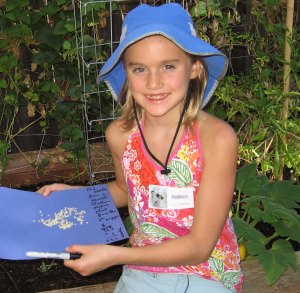
PepperSeedsJuli was also cooking up a storm, along with some other parents. Lunch was a spicy pasta with veggies in it and cheese  on top. Tomatoes and peppers had to be harvested to make the sauce. Fortunately, we had learned a whole lot about pepper seeds earlier in the morning, thanks to S. Almost as soon as she arrived, she began  counting pepper seeds. She estimated that the pepper plant in the backyard has 852 seeds on it, using the seeds of one pepper and some multiplication. However many seeds it has, it sure made for a delicious lunch!
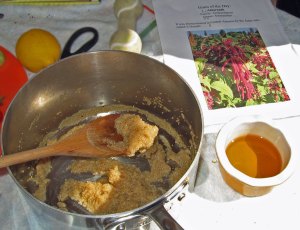
AmaranthPasta wasn’t the only grain product to rule the day. Actually, the official grain of the day was amaranth, a grain domesticated in Central America. The Aztecs called it Huautli. Mackenzie boiled some up, giving us honey to drizzle over it.
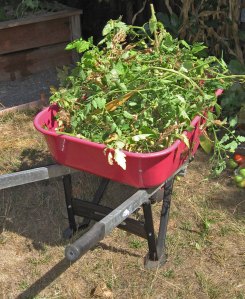
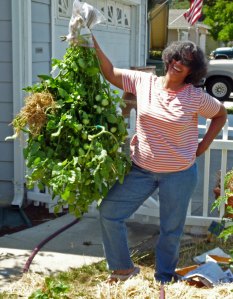
RecycledTomatoPlantsAnd if you think the day was just about seeds and grains, then you didn’t notice the dead tomato plant removal going on at the back of the garden just after lunch. Because of a lot of cutting, pulling, and hauling, the big pink wheelbarrow was filled with the stalks of summer’s tomato crop. The bed is now ready for winter’s spinach. If anybody has any spinach salad recipes, we should be ready to sample them in a couple of months.

Our first Dirt to Dinner of Fall 2009 was the perfect recipe of sunshine, friends, songs, bugs, dirt, worms, seeds, plants, and food!
The Disappearing Tomatoes

Leave a comment

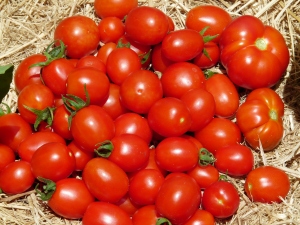
07 03 09_0069We love fresh tomatoes. Sliced onto a plate with a little salt over them; with mozzarella, a little basil and some balsamic vinegar (Yum!); with crushed crackers and some more balsamic vinegar—also delicious; sliced onto a grilled cheese sandwich before the grilling part—another treat.

But there are limits. And when we cannot face another heaping bowl of lovely, fresh tomatoes calling out to be eaten, we dig out the stock pot and make some catsup.

You can make 24 pounds of fresh tomatoes fit into three or maybe four pint jars this way! It may be an even better tomato disappearing trick than drying. (We’ll have to do an experiment to see how they really compare…hmmm…good thing the kids are back starting in September.)

After several batches and many opinions, here is the recipe we have settled on for delicious, homemade catsup. Or ketchup. Or however you spell it where you’re from.

Let us know how you like it!

Tomato Ketchup
(about 3 or 4 pint jars)

24 pounds ripe tomatoes
3 cups chopped onions
1 or 2 red peppers, on the hot side 
4 teaspoons whole cloves
2 sticks cinnamon, broken in pieces
1½ teaspoons whole allspice
3 tablespoons celery seeds
3 cups cider vinegar
1½ cups sugar
¼ cup pickling or kosher salt

Wash tomatoes. Quarter tomatoes into 4-gallon pot. Add onions and red peppers. Bring to boil and simmer 20 minutes, uncovered.

Combine spices in a spice bag. Place spices and vinegar in a 2-quart saucepan. Bring to boil. Cover, turn off heat and let stand for 20 minutes. Remove spice bag from the vinegar and add the vinegar to the tomato mixture. Boil about 30 minutes. Press boiled mixture through a food mill or sieve. Return to pot. Add sugar and salt and boil gently, stirring frequently until volume is reduced by one-half or until mixture rounds up on spoon without separation. Pour into hot pint jars, leaving 1/8-inch headspace. Wipe jar rims. Adjust lids. Process half-pints in a boiling water bath for 15 minutes.

End of the Season

Leave a comment

Ready-to-GrowThe garden is quiet now that the last session of the Spring 09 Dirt to Dinner project is done.
Real-World Wide Web

Real-World Wide Web

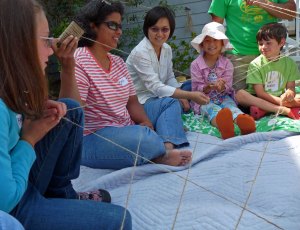
We explored the interconnectedness of the food webs we participate in every day. Latecomers spent part of the afternoon asking why we all had on nametages that said things like “Flowers,” “Oak Tree,” “Earthworms” and “Cougar.”

We also dug the potatoes that have been growing in the black nursery cloth circles since the start of the program. The plants had long ago bloomed and were mostly ready for us.

Washing the Dirt Off Dinner

Washing the Dirt Off Dinner

There were lots of the red-skinned potatoes with a blush color inside. I hope the folks at Common Ground know what they were because we liked them and they might work for next year’s Red White and Blue Potato Salad. They kept their color and held up nicely when we cooked them for the Balsamic Green Beans and Potatoes.

Some of the kids chose to pull the plants with their *many* green tomatoes and take them home to hang for ripening.

Roma Tomato Prepped for Dry Hanging

Roma Tomato Prepped for Dry Hanging

We are experimenting with three or four different ways to ripen green tomatoes and I’m curious to see what works best. Right now my favorite is to put them into a paper bag with a ripe apple or tomato and to let them redden that way. We are testing the plant hanging method, sunny window sills, newspaper wrapping and apple-in-a-bag. We’ll let you know how it comes out!

We also stabilized the gourd trellis and planted the gourds, picked the Principe Borghese and Costaluto Genovese tomatoes that were ready and explored the Ice Box watermelon ripening that has happened so far. (Not there yet, but close and already quite tasty!)

Everyone Loves the Eating Part!

Everyone Loves the Eating Part!

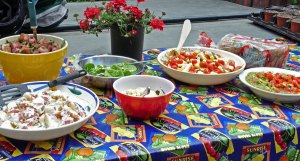
Today’s lunch included Balsamic Green Beans and Potaotes, Red White and Blue Potato Salad, Spinach Salad with Goat Cheese, Egg Salad, Tomato Basil Mozzarella, Roasted Tomatillo and Avocado Salsa.

Thank you to everyone who made this year’s program possible, including our generous donors at Seeds of Change, The National Gardening Association Seed Donation Program, the generous and helpful folks at Bauer Lumber and Mark Lassen at Lassen Construction.

The Tomatoes Are Coming!

3 Comments
From Sun Ripened to Sun Dried

From Sun Ripened to Sun Dried

I’m trying to remember this moment as the calm before the tomato storm. I have a feeling this nice hot weather is about to inundate us with tomato bounty. I have the drying screen, dehydrator and oven drying recipes ready to go. I’m still looking for the perfect catsup. Let us know if you have a recipe you like!

We will have quite a few of the Principe Borghese tomatoes ready to go first. They have been ripening one at a time here and there, but now there are suddenly *lots* of orange ones on the vines and the vines seem less robust, as if all their energy is going into the fruits now.

Shades of Genoa

Shades of Genoa

I am really looking forward to tasting the Costaluto Genovese tomatoes. They look wonderful on the vine with their deep creases and funky shapes.

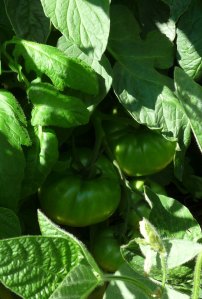
I tried to count the other day and I think there are at least a dozen varieties of tomatoes growing in the Dirt to Dinner garden; Principe Borghese for drying, Roma for sauce and cooking, three varieties of grape tomato for eating, the Orange German Strawberry tomato my mother-in-law sent over for fun, the Big Beef for burgers and other slicing needs. And the there are what I think must be  the Crimson Carmellos, which grow like monsters! Green-GloryThey are the most robust tomato vines I have ever seen. If you are out late in the evening watering too close to this thing, I swear it might toss one brawny arm over your shoulders and keep you there all night telling you its garden tales as the moon rises.

The fruits are a shiny deep green and I know the label for the plant is hidden down there somewhere, behind the lost shallots that I foolishly thought might actually enjoy a little shade provided by the tomato. Ha! They better be nocturnal to be surviving under there. At least the Edamame beans still get some light from the side.

I am also enjoying the dry farmed tomatoes planted outside the fence in the squash garden. The squash aren’t big enough yet to be much help shading the ground, but the tomato plants still seem happy.

Romas Getting Ready

Romas Getting Ready

Between drying, making pizza sauce, making catsup, whatever the kids will eat in salads and on sandwhiches, I think we’re pretty much set for tomatoes!

And the really interesting thing is the way the tomatillos have taken off! There are both verde and whatever purple is in Spanish varieties out there and they have taken over the corner growing bed to a slightly unhealthy extreme. Yesterday I found some kind of mold growing on one of their leaves. I may need to get out there and pick off the affected parts of the plant. It’s so dense in this patch that the air circulation can’t be good.

Not sure why I didn’t figure out that tomatillo plants got so big and spready when we planted them. They all seem so small and helpless in the beginning! :-)

Tomatillo-Twins

The Planter is Planted!

Leave a comment
Dirt to Dinner Individual Raised Bed Planting Areas    Dirt to Dinner Individual Raised Bed
Planting Areas

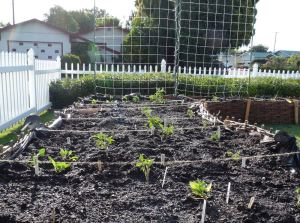
Hooray! The Dirt to Dinner willow raised bed planter is now home to 14 individual 2×4 planting sections, one for each of the families in the Spring program. And today, April 11th, was finally the day the beds were first planted. The 112′ “L” shaped bed created with willow hurdles from Master Garden Products in Oregon holds about 18″ of soil on disturbed adobe that has been lawn for the last ten+ years, with the sod removed. (We’re still trying to fit it all into the composter in layers–it could be a while!)

The planter now holds different combinations of tomatoes, tomatillos, peppers, chard, beets, carrots, a wide selection of radishes, including one patch with four varieties growing side by side for comparison, lettuce, watermelon, cantaloupe and cosmos, among others!

You'll Be Missed

You'll Be Missed

During the planting of starts and seeds, a square foot of Broccoli Raab starts were transported into the front garden, in hopes of being chosen as residents of the new planting bed. Sadly, one of the broccoli starts did not survive the move. The kids chose to honor the broccoli’s return to the soil with this memorial. ;-)

Not only did we get the planting beds planted today, but we also had lunch on time! (A process it has taken us a while to perfect.) In the kitchen, the kids prepared Strawberry Lemonade, Mashed Sweet Potatoes and Quinoa Confetti  Salad with beets, carrots, cabbage, red onion, radishes, celery, fennel and fresh herbs. The sweet potatoes were said to, “smell like a pie!”

Grate Help

Grate Help

The quinoa salad was not as popular with the kids as the kale salad we tried during Class 2 but it was tasty, fresh and welcomed by most of the adults. It made me wonder if there is some more fundamental reason kids tend not to like certain foods. I’ve been reading the new edition of Harold McGee’s classic On Food and Cooking: The Science and Lore of the Kitchen and in the vegetable section he talks about the chemistry of many of the vegetables we are encouraging the Dirt to Dinner kids to eat, a chemistry which is often a defense mechanism for plants designed to keep things from eating them! What if immature digestive systems are more sensitive to these chemical defenses and there’s a biological reason children turn up their noses at the foods grownups spend a lot of time trying to convince them are good for them? Certainly, feeding them fresh versions right out of the garden gets around any obvious taste or processing-into-tastelessness issues. Just a wild idea. Let me know if you have thoughts better founded in biochemistry than my musings!