The Last of June

Leave a comment

Squash-PatchFor the last week we have been battening down the Dirt to Dinner garden with various kinds of mulch to help it thrive in the hot weather. We are testing several kinds of compost, straight worm castings, tan bark and rice straw (which is cheap, soft, and easier to keep in place than I had feared.)

Even so, some of the squash plants still look unhappy by dinner-time. And days that threaten to see 90 degrees or better require watering morning and evening for some of the plantings, especially places where we have young plants growing or seeds starting for rutabagas, parsnips, etc..
Cucumber Hopeful

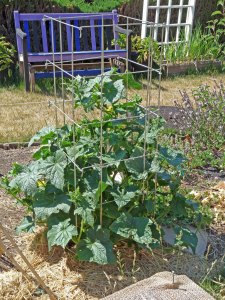
Cucumber Hopeful

Many of the plants seem to be enjoying the heat. The peppers are flowering. The tomatoes are happily turning red. The watermelons are busily climbing their supports. This vine, which I hope is a cucmber, seems undaunted by the temperatures. It’s a volunteer that turned up near the patch where I am trying to grow the new Luffa plants and some Bloomsdale Spinach which will appreciate the shade underneath. Whatever it is, it’s a robust deep green vine that looks like it may grow us something tasty.

Right next door to the Luffa, Spinach and their Mystery friend is the new Fort Knox bed where we are growing five different varieties of carrots and the parsnips under a 1/2″ wire cover and burlap shade where rodents can’t get into them and tear them up before we are ready to eat them. We were going to end up with some sort of betacarotene deficiency around here if we don’t find better ways to deal with our ‘guests’ than just the old burlap covers.

Spaghetti on the Vine

Spaghetti on the Vine

At least there seems to be no doubt that we will have Spaghetti Squash. The plants are bowing the bamboo pole that supports their trellis a little bit more each day.

Of course, I had to pick one early and cook it to be sure it really *was* Spaghetti Squash. I have another variety that I knew was Spaghetti Squash growing not to far from this one that clearly has no intention of climbing the trellis we have provided for it and the stems also look different, so I took a little convincing, but now there’s no doubt.

Still, I can’t seem to look at a Spaghetti Squash without thinking of my mother’s garden-inspired dinner creations which, she told us all the way through the 70’s, would taste, “Just like pizza!” if only we could actually be convinced to try them. Rest assured, I will not be making the kids try the recipe for Spaghetti Squash Lasagna that I saw on the Internet the other day.

The Tomatoes Are Coming!

3 Comments
From Sun Ripened to Sun Dried

From Sun Ripened to Sun Dried

I’m trying to remember this moment as the calm before the tomato storm. I have a feeling this nice hot weather is about to inundate us with tomato bounty. I have the drying screen, dehydrator and oven drying recipes ready to go. I’m still looking for the perfect catsup. Let us know if you have a recipe you like!

We will have quite a few of the Principe Borghese tomatoes ready to go first. They have been ripening one at a time here and there, but now there are suddenly *lots* of orange ones on the vines and the vines seem less robust, as if all their energy is going into the fruits now.

Shades of Genoa

Shades of Genoa

I am really looking forward to tasting the Costaluto Genovese tomatoes. They look wonderful on the vine with their deep creases and funky shapes.

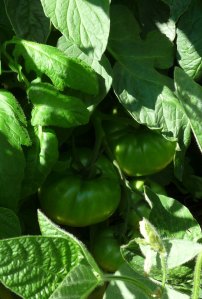
I tried to count the other day and I think there are at least a dozen varieties of tomatoes growing in the Dirt to Dinner garden; Principe Borghese for drying, Roma for sauce and cooking, three varieties of grape tomato for eating, the Orange German Strawberry tomato my mother-in-law sent over for fun, the Big Beef for burgers and other slicing needs. And the there are what I think must be  the Crimson Carmellos, which grow like monsters! Green-GloryThey are the most robust tomato vines I have ever seen. If you are out late in the evening watering too close to this thing, I swear it might toss one brawny arm over your shoulders and keep you there all night telling you its garden tales as the moon rises.

The fruits are a shiny deep green and I know the label for the plant is hidden down there somewhere, behind the lost shallots that I foolishly thought might actually enjoy a little shade provided by the tomato. Ha! They better be nocturnal to be surviving under there. At least the Edamame beans still get some light from the side.

I am also enjoying the dry farmed tomatoes planted outside the fence in the squash garden. The squash aren’t big enough yet to be much help shading the ground, but the tomato plants still seem happy.

Romas Getting Ready

Romas Getting Ready

Between drying, making pizza sauce, making catsup, whatever the kids will eat in salads and on sandwhiches, I think we’re pretty much set for tomatoes!

And the really interesting thing is the way the tomatillos have taken off! There are both verde and whatever purple is in Spanish varieties out there and they have taken over the corner growing bed to a slightly unhealthy extreme. Yesterday I found some kind of mold growing on one of their leaves. I may need to get out there and pick off the affected parts of the plant. It’s so dense in this patch that the air circulation can’t be good.

Not sure why I didn’t figure out that tomatillo plants got so big and spready when we planted them. They all seem so small and helpless in the beginning! :-)

Tomatillo-Twins

Bugs, Bees and Birds

1 Comment

Special-GuestToday at Dirt to Dinner we had a special visit from entomology professor Helda Morales from Chiapas, Mexico and two of her colleagues. Professor Morales loves bugs and studies both integrated pest management and the social aspects of pest control. She would like to start her own educational garden project for children when she returns to Mexico.

Our other special guest has feathers, but no name that I know of. She is an orphaned

Bug Collecting

Bug Collecting

baby jay Mackenzie is nursing. And she was a perfectly integrated pest manager for us today! One of the activities in the garden this morning was discovering the wide variety of insect life that calls our garden home. Some of these are beneficial to our crops, like the enormous carpenter bees we often see flying around our tomato plants, others are more destructive and are eating some of the plants we are growing. And some of them were beneficial to Miss Jay. They became her lunch!

Taming the Jungle

Taming the Jungle

The garden is filling out beyond our expectations and looked something beyond lush on over toward jungly when everyone arrived today. One of the visiting professors taught us how to tell the productive branches from the extra, leafy branches of our tomatoes plants and lots of pruning and tying and thinning out commenced. We are having good luck staking our determinant varieties with split bamboo and various types of plant ties. And now the garden beds will have lots more light and air and the plants growing under or around our tomatoes will thanks us.

We also added drip irrigation for over half of the big growing area! (Thanks, Ken!) That will be another big step in keeping our plants healthy and happy. Tomatoes, and many other garden vegetable plants, stay much healthier when you are able to water in a way that doesn’t get their leaves wet. Drip irrigation also uses less water and prevents soil compaction so I’m excited to start using it as much as we can.

Baby Bird Bugs

Baby Bird Bugs

Now that we are turning the corner into Summer and have just three Dirt to Dinner sessions remaining in the Spring program, I’m happy to report that the kids are very enthusiastic about seeing and working in their growing beds. They are really enjoying the meals they are able to prepare during the sessions using as much food as possible right out of the garden. And they seem comfortable and at ease with both the process and the work of growing food. Today they examined squash flowers and peeked under the dirt at the developing potatoes. They did multi-sensory explorations of some of the plants. They made delicious salsa in both mild and spicy varieties. They harvested chard and radishes and onion and salad greens and pulled spent broccoli and spinach. They started a new compost bin and added a new layer to the worm condo and flopped down around the puppy box to cool off in the shade.

It was a good day in the garden. :-)

Watching the Squash

2 Comments

Squash-ClockThere are no zucchini plants in the Dirt to Dinner garden, for reasons that will be obvious to you by August, if they aren’t already. ;-) Instead I’ve been trying to learn more about the squash varieties we do have going. For instance, did you know that the ‘pumpkin’ you buy canned to make into pumpkin pie is actually a squash that is most closely related to Butternut? I’m loving all the details available at Watch Your Garden Grow, from the University of Illinois Extension. It even includes recipes!

Spaghetti Trellis

Spaghetti Trellis

So far, the most vigorous grower we have out in the garden is the Spaghetti Squash which we are hoping to convince to grow up the trellis we have so generously provided just for this purpose. Unfortunately, the plants have designs on the wide open spaces in front of them and keep growing away from the trellis which backs up against theshade of the bushes that edge the garden. We could actually consider relocating the trellis, but there are still carrots and big white Icicle Radishes growing where it would need to go. Note for next year: Squash trellises need to be on the sunny side of the squash plants.

Net Lonving Squash?

Net Loving Squash?

At least the mystery squash seems happy to give it a try. Though, in my heart of hearts, I’m worried that this might actually be a cantaloupe plant of some kind. I’m not actually sure how to tell the difference. If it has big triangular leaves with spiny stems and sends out those little twisty tendrils that cling onto other plants and –hopefully–trellis netting, it could be anything from a Delicata to a cucumber as far as I can tell right now. I better go back to my website on growing squash to see how much more I can pick up.

Delicata Shade Crop

Delicata Shade Crop

These guys I am pretty sure really are Delicata. They are a Compact Winter Squash from Renee’s Garden that gets great reviews for growing well and tasting a lot like sweet potatoes, which most of the kids are happy to eat. I took this picture just before I thinned them down to the recommended “2 strongest plants per hill.” I could have carefully pricked out the extra plants and moved them to a sunny spot so we could see exactly how much difference the sunlight would make, but it’s starting to feel like there’s an awful lot of squash growing around here. There are eight of the compact Winter squash plants left after thinning, half Delicata and half Early Butternut. There are at least twenty plants representing the dozen different varieties mixed into the Zucche in Miscuglio we got from Grow Italian with names like Tonda Padana, Serpente Di Sicilia and Berrettina Piacentina

Pre-Colimbus Natives

Pre-Columbus Natives

And, not to worry, it’s not *all* Winter squash. There are two Summer squash plants that I know of in the garden. They are Golden Scallopini Bush squash from Seeds of Change. It’s a rare native American cultivare that predates Columbus. And it makes small 3-6″ squash with a flying saucer shape that I hope will appeal to the kids.

Test Potatoes Are Up

2 Comments


Test Potato

Test Potato

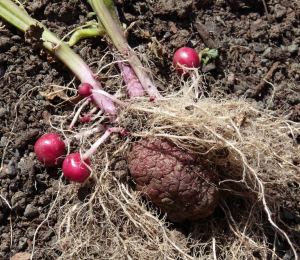
Growing potatoes is kind of mysterious, so we grew one test potato on it’s own so that we could pull it part-way through the season and all the kids (and the rest of us!) could see what was going on under there. We planted all the potatoes right around Saint Patrick’s Day, except for the Blues because their seed potatoes didn’t arrive from Seed Savers until later. 

Forming New Potatoes

Forming New Potatoes

It’s easy to see that the potatoes–and the roots–all form *above* the seed potato that you plant in the ground. You almost have to think about these guys upside down. It’s the soil that you put in on top of them that they care most about, not so much the soil that they are sitting on when they get planted. I was amazed to see how many potatoes were forming on this one plant that hadn’t even been hilled. 

Basket of Rattes

Basket of Rattes

Now I am curious to see how many potatoes we will be able to raise in the small spaces we have used. The La Ratte seed potatoes from Full Circle Farm are growing in an old trash basket that might hold five gallons, if we’re lucky. There are four plants in there and they have been hilled nearly to the top.

Big-BagI think I remember that the potato sacks we used each hold fifteen gallons, and they are nearly full of soil at this point as well. Each sack is planted with four or five potatoes, the same amount we used in the much smaller basket of La Rattes. So maybe we’ll find out the consequences of crowding when we compare the harvests, but it will be hard to interpret, since we used different varieties.

The real test of how many potatoes we can produce in garden this size will be the All Blue’s.

On Blue Hill

On Blue Hill

When I asked at the nursery the other day what they would recommend we use to supplement our own compost when we hill our 4′ x 8′ potato patch they started doing the math for how many cubic feet we would need and some eyebrows went up. “How many potatoes are you growing?!” was asked more than once.

But that’s OK. It’s only 32 plants. Kids love potatoes, right? And these potatoes will be nearly purple. That’s got some fun appeal, doesn’t it? Not to mention all the antioxidants from the phytochemicals that cause the color in the first place. 

I better go find out what you need to do to store potatoes for the winter…