Potting Up

1 Comment

The tomato seeds start out in little pellets, and the irony is not lost on me that I am growing “local” food by starting seeds in a product that has come all the way from Vietnam.

Starting Local Food in Fiber Grow from Vietnam

Starting Local Food in Fiber Grow from Vietnam

Digging up peat bogs to dry them and ship them to gardeners everywhere contributes to global warming, so I thought I was doing a good thing by getting Fiber Grow pellets. But once I got home and turned the package over and read the Made in Vietnam sticker, I wasn’t so sure anymore. It takes a lot of resources to ship not-peat moss around the world too.

Tomato Sprouts

Tomato Sprouts

Anyway, the tomatoes, for better or worse, begin their lives on the top of the refrigerator in their Vietnamese fiber homes. It takes a week or two sometimes at the right temperature for them to germinate. They like to be warm. The first batch I started, only about half of them ever sprouted at all.

Once they have “true” leaves, the tomatoes and their Vietnamese pots go into the regular 6-packs you might see at the garden store.

First Potting

First Potting

They will stay in the 6-packs for several weeks until they begin to fill out, develop stronger stems, make more leaves and start to be recognizable as tomato plants.

The next time the plants are potted up, they will be set deep into individual containers with potting soil
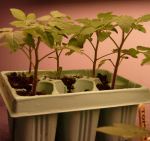
Tomato Starts in 6-pack

Tomato Starts in 6-pack

and a little mature compost to help them grow strong. This may sound nasty, but you bury them deep enough in the new pots that some of the early leaves will be under the soil, so you carefully tear these leaves off. Where the leaves were on the stems, roots will grow in the soil making the plant sturdier when it finally sees the garden soil.

The tomato seeds that I started in early January are just now moving into their own pots for the first time, so this process has taken about 6 weeks. It takes a long time to grow tomatoes from seed but I am really looking forward to all the pasta sauce and sundried tomatoes, salads, catsup…
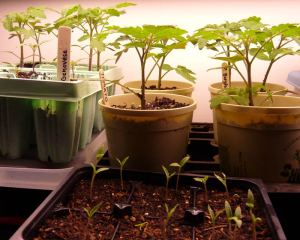
Tomatoes in Four Sizes
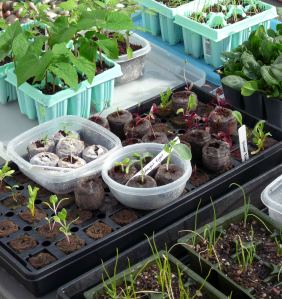
Tomatoes in Four Sizes

The Last Winter Carrots

Leave a comment


Starts hardening off

Starts hardening off

This morning some of the starts that have been growing under lights in the garage are having a field trip out into the partially cloudy day. We still have at least five days until the last date of expected frost, so I’m going to give them a few hours a day up to all day over the next week or so as they get ready for possible planting on the 28th.

We have beets, two different kinds of tomato plants, three types of onions, Swiss chard, spinach, bush beans, cabbage, cucumbers and some flower starts pictured here.


Last night *something* went through the carrot patch and perfectly munched the Winter carrots, leaving the separated tops undisturbed on the soil. At least our raiders left us everything we need to make nice compost to grow more carrots!

The Last of the Winter Carrots

The Last of the Winter Carrots

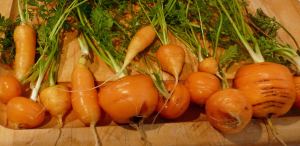
I got out a digging fork and gently dug around to find the last of the remaining carrots that have wintered over.  Next year I will do lots more of them. These were delicious and very welcome in stews and soups. There are a few small patches of carrots coming up and there are three or four varieties ready for the Dirt to Dinner kids to arrive on the 28th. My favorite way to plant them is using carrot tape, which I have just found out how to make oursevles, so I’ll be adding that to the project list.


Here’s what we ended up with when it was time to make lunch:

Romeos Ready to Cook

Romeos Ready to Cook


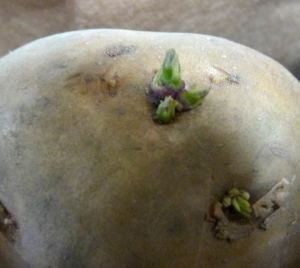
We have two different varieties of potatoes started and will be able to plant them in bags or various containers for the kids to experiment with. I can’t wait to see how they do. We should be able to start eating new potatoes about half way through our program.

Potatoes Growing Eyes

Potatoes Growing Eyes


Eye See You

Eye See You

Garden in a Jar

3 Comments
Sprouting Jar

Sprouting Jar

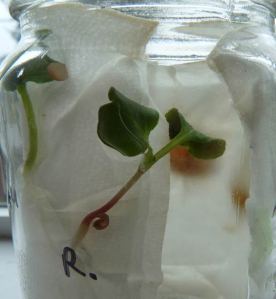
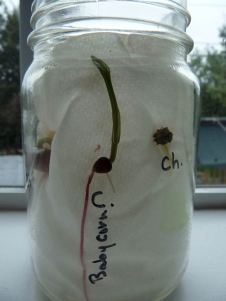
When kids put a seed in the ground, what comes up looks nothing like the seed they started with.  So, to get a bug’s eye view of the sprouting process that usually happens under ground, and to help in the identification of what is going to come up in their garden beds, it’s fun to make a sprouting jar when you are planting your garden bed with seeds.

Take any clear glass or plastic container and line it with a fairly sturdy layer of absorbant paper, like a good paper towel.  Pour an inch or so of water into the jar and let it soak up the paper towel, wetting the towel to the sides of the jar.  Adjust as needed to see that the paper makes good contact with the side of the jar.

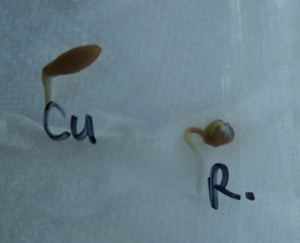
As you choose seeds to plant in your seed bed, save one seed of each variety you plant for the sprouting jar.  Using a flat plant label or a popsicle stick, slide the seed down into the jar between the glass and the wet paper towel.

Sprouting Seeds

Sprouting Seeds

Then mark on the outside of the container what you’ve added. I wrote right on the outside of the jar with a permanent marker. At this point it’s also a good idea to tape down the top edge of the paper towel so you don’t accidentally move the seeds away from their labels.

Set the jar in a warm spot where you won’t forget about it and make sure to add water every day so that the paper towel, and the seeds, stay moist.

Day 2

In just 24 hours we already had our first sprout, a radish!
jar-day-2_01-30-09_0151

Day 3

Here’s how the radish is looking. And you can also see that the cucumber next door has begun to sprout as well.

Radish Day 3

Radish Day 3

And here is the very beginning of a pea sprout.

Pea Sprout Tip

Pea Sprout Tip

2/6/2009

Sprouts are here!

Cucumber Sprout

Cucumber Sprout

Radish Sprout

Radish Sprout

Pea and Bean Sprouts

Pea and Bean Sprouts

Corn Sprout

Corn Sprout

Making Hay

Leave a comment

Obviously the Rainy Season is back.  But man we got a lot of good gardening in while the weather held. The peas have started off strong.  Now I just have to hope that nobody eats the plants before they can grow any peas.  That’s what happened to the Fall crop I tried in back.  I really should find some way to cover them or at least mess with any birds or squirrels who might try. We’ve been letting the dog into the front yard at odd intervals to try to keep things unpredictable.  

The grow lights in the garage are up and in use.  The grow light on top of the refrigerator is still our best bet for germination, but once things sprout they should be cosy enough under the big light in the garage. It gives off a little bit of heat and it’s not drafty there.

Cabbages, califlower, and broccoli are all in and doing fine so far.  Not a lot of growth but you can tell that they are establishing themselves slowly.  We have two different stages of spinach going right now, both the plants that over-wintered, which are starting to bush out and are about ready for us to start picking, and the seedlings that I just set out last week, which are doing OK in spite of the now-foul weather.

What Wintered Over from 2008 into 2009

Leave a comment

kaleRussian Red Kale did well in a not very sunny spot in the raised beds through rain, cold, hail, frost and crazy dogs running through the beds.  It stores well and is great in soups.

Utah something Celery did wonderfully well.  I picked it from the outside in and used it all winter long.  It wasn’t bothered by anything and has wonderful spring-like color in the garden in a low sun area.

White onions have been growing since Fall.  The tops aren’t pretty since the frost, but they are growing some new green stems that seem more sturdy.  Who knows?  Maybe the tops always die down when the weather gets severe?  We’ll have to see how they do next year.  It’s also time to get more onions in so they are well established as the day lengthens.

Beets would not come up for love or money this Fall.  I planted them several times and got nothing but weeds.  Will try these with the Spring crew and see how that goes.  Maybe in Jiffy pots so they can sprout inside and then go into the garden???

Several varieties of carrots did well all Fall and Winter long.  They are tough to get started.  I have small patches of them trying to get going so we have more for Spring.  I could have easily used twice what we planted, maybe more.  But they were fun to have. I especially liked the ball type variety but the seed packet is now lost.

Collards were not as hardy as the kale, but they made it through and we like the taste better than the kale.  Could have used more of these guys, espcially since the chard did not make it through the winter well.  It was bug riddled and yellowing by October.

The artichokes you couldn’t kill with a shovel.  They are already back and looking great.  I suspect they would grow in cement mix if you let them.

Peas had a very tough winter.  The second they sprouted something came and ate all their leaves off over and over.  We started some right after the new year and they seem to be doing better so far.  I’ll protect this batch as seedlings better and see how we do.  I might have to go back to buying starts for these guys.