When’s the Last Date of Expected Rain?

Leave a comment

We made it past the last date of expected frost, February 19th, without much fanfare but I am hoping for at least a break in the rain for our first garden session of the project this coming Saturday.

Fresh Produce

Fresh Produce

We have also scheduled our first extra field trip, to the grand opening of the Full Circle Farm produce stand on Wednesday, March 4th from 4:00 to 6:00. This is a great place for us to visit because the kids will have a working day on the farm at Full Circle coming up on the 28th. That ought to make it abundantly clear how the produce gets to the farmstand.  ;-)

The garden is starting to take shape. There is lots to do and to build and some small garden beds ready for planting. We got a very generous donation of seed from the National Gardening Association. We’ll make a Thank You card for that when we’re together.

We’ve created a Ning for the kids to use to share their ideas, photos, videos, blogs and comments as the project progresses. Now all we need is a four or five hour break in the Spring rain, and we’re all set!

The Great Raised Bed Debate

6 Comments

I was clearly naive about the number of options for raised beds there were to consider. Long gone are the days when my mother tossed a couple of railroad ties against the hillside and called it a garden. And the cost has changed too!

These gorgeous beds from Naturalyards would have cost well over a

Natrualyards Cedar

Naturalyards Cedar

$1000 to hold the Dirt to Dinner growing plots for each of the kids.  Not quite what we had budgeted for! But if money were no object, these would be the beds for me. They are beautiful, easy to assemble, available in lots of size choices and look like they would last a generation.

Link-A-BOrd

Link-A-Bord

I also like the idea of Link-a-Bord bins that would have snapped together.  They are made of all recycled materials.  They are light and easy to construct.  They come with two different depths, both a little shallower than I like for vegetable gardening, but reasonably priced. They still have the nice, neat look that any realtors scanning the neighborhood would approve of.

There were also quite an array of sizes and shapes to choose from. Want a good geometry exercise for the kids?  How many square feet of space do you get with this?

Traingle Raised Beds

Traingle Raised Beds

It’s an equilateral triangle with 7’ sides. Then it has another equilateral triangle on top so you can have that section be twice the planning depth of the large triangle ends, so now you really need to look at the cubic feet,…

When the calculator cooled off, it didn’t make sense to go with the funky shapes, much as I wanted to.

Paver Raised Beds

Paver Raised Beds

Lee Valley had some great kits where you use 16” pavers and their hardware to build beds. These things probably would have survived the next Big One, but somehow concrete and kids and all those nuts and bolts didn’t work for me for this project.  Though I love Lee Valley and the excuse to get some fun tools would have been worth it.

I was hoping to get back to the more natural “wild” look of at least the Natruayards design, if not something onto the other side of that when I came across a post on a gardening chat site that referred to the 600 year-old technology of raised bed design used in English gardens. That’s when I found mastergardenproducts.com.

Historic Willow Raised Beds

Historic Willow Raised Beds

willowraisedbedmodern

Modern Willow Raised Beds

Oh yeah. That’s as granola-y as they come.  It’s perfect. Sadly, it’s nearly impossible to find enough Willow that size to make similar boxes today, but the ones we’ll be using in the Dirt to Dinner garden will look something like the modern ones before we seal them with linseed oil, line them and fill them with our garden planting mix.

I’m a little worried that the sticks will need some kind of covering on the top to keep from sticking us, but I’m sure we’ll figure something out.  And we may even weave some of our own versions to see how they compare.

A View of the Garden

2 Comments

http://voicethread. com/share/ 323777

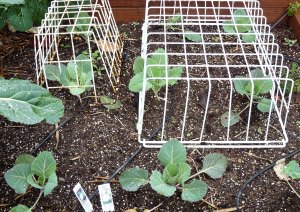
If you want to take a quick look around the garden to see what has wintered over and what is already starting to poke it’s head up in the Dirt to Dinner garden, the Voicethread link above will give you a chance.  

Cabbage and Califlower

Cabbage and Califlower

One of the students interested in the class has already watched the video twenty times!  I can’t wait to get that enthusiasm into the garden.

Monday the folks from Getting Going Growing will be visiting to see if they can share garden planning tips with us. I’m sure we have a lot to learn and am really looking forward to their visit.

Dirt to Dinner Field Trips

Leave a comment

We’re considering adding three or four related field trips to the Dirt to Dinner program. Here are some of the ideas so far: 
Rice Soil Farm in Half Moon Bay
UC Berkeley Urban Bee Gardens
Ceres Project – Consider contacting our Food Precurement Coordinator, Chris Sitting, chris@ceresproject.org to volunteer to harvest produce at several local farms.
Blue House Farm
Sunnyvale Demonstration Garden 
Gamble Garden

Project Specifics

Leave a comment

The garden is a natural lab that can bring together a wide variety of skills and interests from architecture to poetry with lots of learning in between. This Spring Davis and I will be using the garden as the base for most of our homeschooling activities and testing out many of the projects propsed for Dirt to Dinner classes.  

Here are some further details about projects kids may be invited to try during the Dirt to Dinner class sessions.

Botany will be explored in many different practical, hands-on ways, with additional ideas from Botany on Your Plate. We will examine parts of different kinds of plants, the wide variety of seeds, test different sprouting methods, try growing similar plants under different conditions and other related experiments.

Butterfly or Hummingbird Garden to test which plants and growing patterns attrack which kinds of birds or butterflies.

Compost Science (Chemistry, Physics, Biology) using, among other things, a Scientific Inquiry for High School students program developed at Cornell University.

Ecology with examples from California Academy of Sciences Sustainability Made Simple. We’ll also be looking at food in terms of globalization, fair trade, wise use of available resources, and culture with the support of many additional resources. Kids will also be introduced to Bee Gardening based on the work being done on urban bee gardens at UC Berkeley or the Great Sunflower Project.

Math concepts including number operations, algebra, geometry, measurement, data analysis and probablity will all be part of our garden explorations with further inspiration from Math in the Garden.

Nutrition and Cooking will be covered with careful additions from resources such as the Simply in Season cookbook and What the World Eats. We will also plan service projects around feeding ourselves and others with the help of the staff of the Ceres Project.

New project ideas and individual projects that need a garden home are also welcome.  Join us!