Leeks, Sweet Potatoes and When is Spring?

1 Comment

I started some sweet potatoes in Ball jars on the window sill to grow slips for planting later this spring. I used three sweet potatoes from the cupboard but I can’t tell you which varieties they are yet. I don’t imagine there are very many varieties in local commercial production so it should be easy to narrow down. I’ll ask around and see what I can figure out.

I also quickly started some leek seeds for the Dirt to Dinner kids to plant now that I have finally grasped the difference between summer leeks and winter leeks. I am using Sherwood Leeks from last year’s Seeds of Change seed donation for the summer planting. I hope they sprout. They were packed for 2007 so I planted about a third more seed than I actually wanted in case germination is spotty. I’ve read that onion seeds don’t keep well and these have been through less than ideal storage conditions since they arrived.

The big news here is that the Principe Borghese tomato seeds I planted on Christmas are sprouting! When I saw the first sprout I popped one of the few remaining dried tomatoes from last year’s crop into my mouth just so I could taste them again. I can already hear the dehydrator whirring. ;-)

The Cincinnati Market radishes are also sprouting nicely in a sheltered bed in the garden. I grew up in Cincinnati, so as soon as I saw them in the Seed Savers Exchange catalog I knew I had to grow them. I hope they taste good. I guess I can always pickle them if we don’t like them raw in salads. I would probably devour small disks of cardboard if they were pickled well.

Today was also the day for the first of the All Red and Red Gold potatoes to start heading into the soil. I think the problem with last year’s All Blue crop was that the plants didn’t have enough room. We only gave them roughly a square foot each because we were using a deep bed for planting. But this spacing produced lots of very small blue potatoes, which tells me the plants were too crowded horizontally in spite of the extra space we gave them along the vertical.

The reds are getting three square feet a piece–eventually. Right now there are Sugar Daddy snap peas planted in between the potato rows. Hopefully this won’t crowd them. The peas should be grown and out of the way by the time the potato plants need the space and the soil hilling gets deeper. Well, that’s the idea anyway.
Pea Trials Year 2

Leave a comment
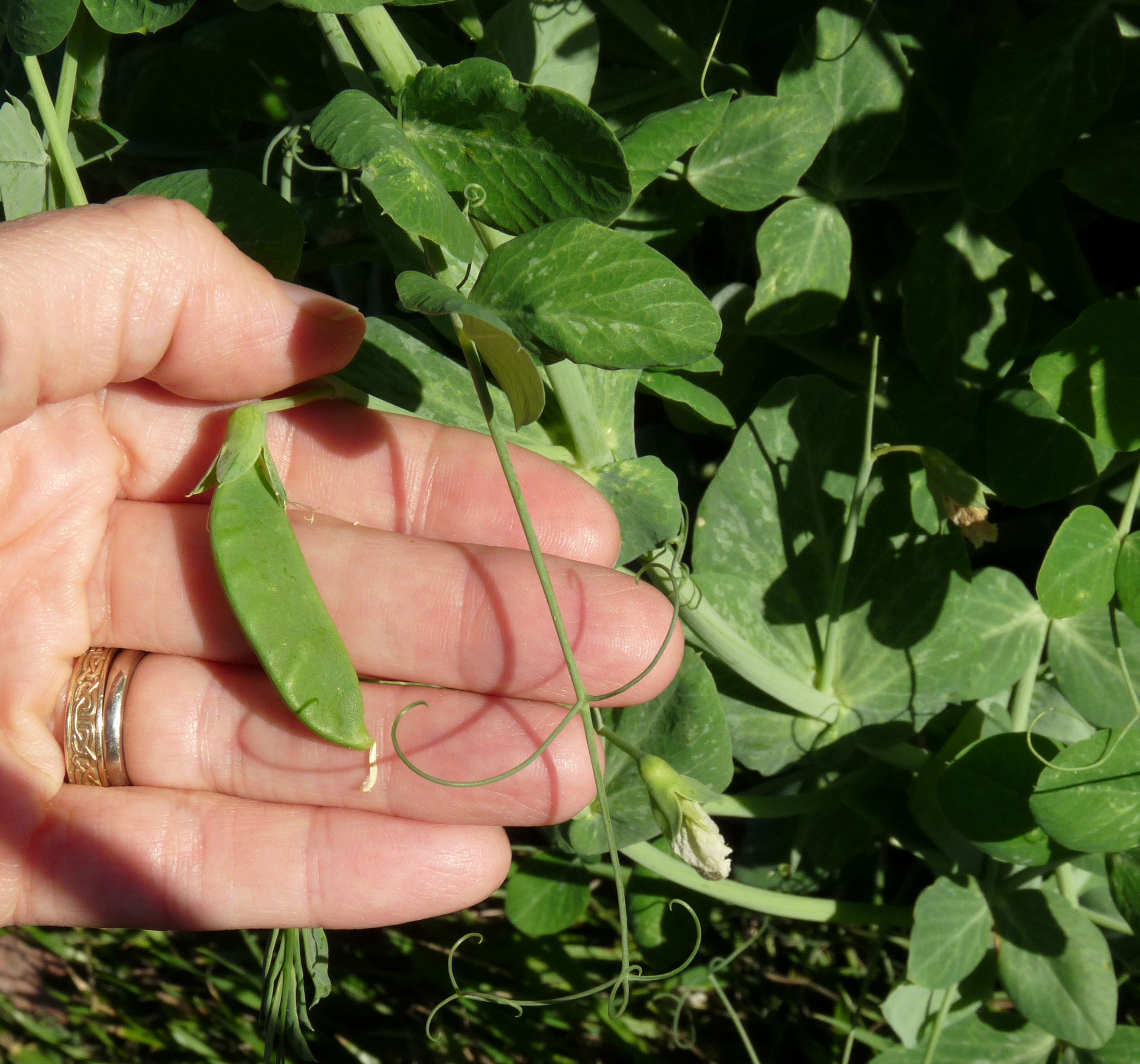
Pea pod in hand

Fall Wando Success

This year, rather than start the Pea Trial in January, I decided it might be worth while to try growing different varieties right through the winter. I started with a shelling pea that I always see mentioned along with it’s resistance to heat, Wando, and planted it on August 13th. I figured it had the best chance with our fall weather. Maybe it was just luck, but we have been eating peas in the garden from this small test patch since October right into December. Frost got some of them, but the plant has put out new flowers and started over.

In mid-September some of the Dirt to Dinner kids and I planted two more test patches of peas. One side is Cascadia snap peas and the other is Oregon Sugar Pod snow peas. Pea plantingThese have also survived the three or four frost days and the winter winds. If it gets too cold though, the pods on the vine are ruined. But we pick them off and toss them into the compost and the plant puts out more flowers. I put in a test patch of Thomas Laxton peas on October 31st but as soon as I thought it was safe to take the burlap off of them (11/15) the patch was decimated by whatever evil critter out there chews the leaves off all the sprouting vines. I have to remember that in the Dirt to Dinner garden peas planted directly in the soil need protection until they are well established.

We also have another small patch of Petit Pois peas put in on November 12th with starts from Yamagami’s in Cupertino.

These diminutive peas are authentic French petit pois and are ever so sweet, ready to use at miniature size, when the slim pods are just 3” to 4” long. Each pod contains six or seven tiny peas, less than half the size of regular shelling peas. Their buttery flavor and tenderness cannot be matched! Plentifully produces petit pois on disease-resistant, 18” to 24” vines. These small, delicate vines need support.

Block planted Petit Pois

Petit Pois Perfect

The plants are still pretty petite right now at the end of December. I haven’t seen any flowers develop but they are shaded by a massive tomato plant I was trying to winter over. Not sure that experiment is going to be worth the space or potential shade cast though. The tomato is a very unhappy grey-green right now that does not bode well. Maybe I will cut it back to whatever looks healthy and green and give the poor peas some more sunlight. I’ll check their color more closely when the rain lets up.

On Christmas, which was a gorgeous gardening day here, I put in about 50 Sugar Daddy snap pea seeds, under covers and started another 30 in the garage as back-up just in case those get destroyed. In January I plan to do some of the Italian pea varieties we liked from the trial last year and I swear there is a packet of Laxton’s Progress peas around here somewhere that are waiting to be planted. If only I could remember what I did with them!

Confounding the Peas

1 Comment
Planter box or cat box?

Not the peas we had in mind!

A major issue in observation studies is that we often don’t always know what the potential confounding factors may be. In the soil fertility experiment we started a few weeks ago the confounders have overcome the experiment to the point that it was almost impossible to tell what was happening.

First, the planter was visited by our resident rodents, the hopping mice that peek out at us from the bushes and love to steal tasty treats. They dug out many of the seeds and presumably ate them.

Next, maybe due to the delicious rodent perfume worn by our mice, a cat visited the planter and dug through one side of the box creating a large mound containing who-knows-what sort of catly gifts. And that was before the huge storm that blew everything around and even washed some of the soil right out of the planter and onto the plastic around it.

Sprouts

Who's That Growing in Our Bed?

In spite of all of this, a few things did actually sprout. If you look carefully at the East side of the soil test bed, the “Tomato Soil” side, you can see how we counted twelve sprouts the last time we recorded data from this experiment. But 12 sprouts of what, exactly?

At least three of the sprouts were squat, strong-looking stems with rounded leaves on them. The rest were spindly stems with elongated, pointed leaves on them. Only the first three were a match to the pea patches growing in two nearby planters.

Tomato Sprouts

Pea Patch Volunteers

So, since this a really great experiment concept, and we already have the nicely amended (thanks for all your help, Cat!) soil on one side and the do-nothing-to-it “Tomato Soil” on the other side, we decided to replant this experiment to see if we can get a less confounded idea of what happens.

The bed was smoothed on the West side, and the cat pile was carefully removed. The bed was then replanted with 1 oz. of ‘Alaska’ (Earliest of All) peas, also known as Pisum sativum var sativum, packed for 2009. These were planted equally on the two sides but we decided to allow the existing pea sprouts to stay. They were marked so we can take them out of the data if we choose to.


Holes in burlap row cover

Burlap Fail

Then the bed was carefully covered with burlap and cages to discourage visitors. Unfortunately, this morning there seem to be a whole lot of holes in the burlap that weren’t there when we put it on! Kids weren’t the only ones out trick-or-treating last night. We’ve been raided by varmints! (I”m sorry about all those things I said, Cat. Please come back to the garden. We need you! We’ll plant more catnip, I promise!)

It looks like at least a dozen holes were dug into the planting area last night. There’s no way to tell if the mice are eating the new seeds or the old seeds that might be still left in the soil. But there are certainly some of the seeds still undisturbed in the planting area.


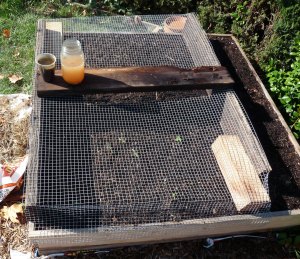
Mesh cover for garden bed

Pea Prison

In order to try to salvage this experiment we grabbed a few things we had around the garden and built a mesh wire cage over the planter like the one we use for the carrots’ Fort Knox. Hopefully this will give the peas a chance to sprout and grow through the tender and delicious stage. We noted that the peas that we started weeks ago who were sitting nearby in their nursery packs waiting to be planted are undisturbed.

We didn’t have a large enough piece of hardware cloth to cover the entire bed so we covered an equal amount of each side and will leave the area with the most rodent damage exposed for now. Maybe that will help keep the mice from breaking into the seeds we are trying to save and then we can plant it with another crop in a week or two when we see how things germinate.


Peas and Potatoes

Leave a comment
Potatoes Looking Done

Potatoes Looking Done

Last weekend at our Open House the kids harvested the last of the All Blue potatoes. The plants were looking pretty sad by the time we got to them. Which is fine. That’s what potato plants do. When the vines die down then you have an easy way to tell that they aren’t doing anything more to grow the potatoes and you can take them out of the ground now. The ones I hadn’t already stolen ‘new’ for potato salads, that is.

This week during our Open Garden time, we pulled the spent vines and tossed them into the compost. Then we added a layer of finished compost and the worm castings we saved when we added a new level to the worm farm and mixed those in well with the existing soil.

Split Bamboo to Keep the Dew and Mold Off the Plants

Split Bamboo to Keep the Dew and Mold Off the Plants

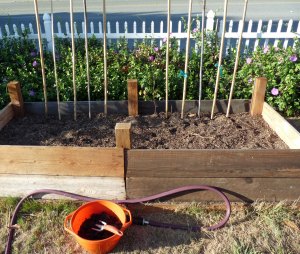
Peas like to have something to climb on, even if they aren’t the pole varieties that grow very tall. On one side we put in Cascadia Snap peas and the seed packet says they climb to 32″. Our poles extend well beyond that, but we figured there was no harm and that way the poles stay a good size to use with our determinant tomato plants in the Spring.

The other side of the bin holds Oregon Sugar Pod Snow Peas, the ones that you pick and eat flat. We are only expecting those vines to grow to 28″ or so, but it still helps to keep pea vines off the ground when you are growing them in the Fall. We don’t know if the weather will be wet or the slugs will be hungry so climbing gives the vines a little bit of an edge against both bugs and disease. Peas also don’t like to be touched and having them staked will make it easier for us to harvest the peas without messing too much with the sensitive vines or possibly spreading disease from one plant to another.

Spacing Out the Pea Seeds

Spacing Out the Pea Seeds

The Cascadia peas are planted ~1″ to 1 1/2″ apart and the Oregon Sugar Pod packet insists that they need 2″. The packet actually says “Seed Spacing: 2″ (Yes. 2″)” which made me feel like they knew me and maybe had seen how closely we had packed in the peas last year during the Winter Pea Trial. I think for one of those varieites we calculated almost 100 peas planted in a single square foot. We gave the Oregon Sugar Pods each their 2″. If they don’t all sprout we can always fill in next week when we see what we’ve got coming up.

The middle section of the bed on the Oregon Sugar Pod side we planted some Golden Beets. Next week during Open Garden we can keep filling in the bed. It might be nice to try some greens along the front of the bed where they will get a bit of shade and we have a seed donation package coming from Territorial Seed Company that might have some interesting things in it we’ll want to add. We also still have kale, broccoli, spinach, cauliflower and celery plants we have started that are all getting ready to look for more permanent homes. There’s always plenty to do in the Dirt to Dinner garden!

Opening the Fall Program

Leave a comment
Squirrel o' Lantern

Squirrel o' Lantern

Today was the Open House for the new Fall 09 Dirt to Dinner program. We focused on three things. Getting to know one another and the garden. A chance to get more familiar with the different responsibilities we’ll each be taking on in the garden this session. And an exploration of some of the seeds that are available in the garden and that we will use this Fall to plant both here and at home.

During today’s Seed Hunt, kids spotted seeds in the garden including onion, celery, edamame, green bean, pumpkin, corn, grass, dandelion, lettuce, potato, lemon, cucumber, watermelon, tuscan melon, tomato, tomatillo, pepper, squash, pea, sunflower and “bird seed.” How many of them could you identify? We’ll be saving seed from many of these varieties to use again next year. I’ve already planted some of the celery seed we saved and hope to see it sprouting this week.

Many of the kids planted seeds to take home with them, made seed jars to watch sprout and tried several varieties of cucumber and melons–while noticing that their seeds all look very much the same. Sometimes it’s easier to tell which plants belong to the same family by looking at their seeds than it is by looking at the finished fruits.

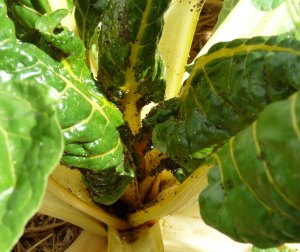
Chard Seeds?

Chard Seeds?

One enterprising student matched up a number of the seeds by plant family and noticed that it’s almost impossible to tell the difference between seeds for chard and seeds for beets. In fact, Harold McGee in On Food and Cooking says “Chard is the name given to varieties of the beet, Beta vulgaris, that have been selected for thick, meaty leaf stalks (subspecies cicla) rather than their roots.”

One of my highlights of the day was hunting through the finished compost pile with one new young gardener intent on checking out the various bugs we found there. I was also impressed with the spontaneous way the kids joined in the potato harvest. We’ll be saving many of the potatoes they planted today through the winter to be used as seed potatoes in the early spring.