Compost Resurrection

1 Comment
100 Years of Farming  

100 Years of Farming

I spent part of Easter Sunday in the garden, pretty much like I do every day. I cleared the sod that we piled willy-nilly around the compost bins when the kids took the turf up for the Dirt to Dinner bed in the front garden. Once I made my way to the compost bin that’s done cooking, I dug underneath to see what the compost was like. The dog helped. Remind me not to get a digging breed next time. ;-)

The first thing that greeted me under there was a worm. Looked ready to me.

I got a large cement mixing tub and balanced the family heirloom across it to sift the compost. My husband’s family were Italian immigrants who farmed in Santa Cruz for several generations. This frame has come down to us from the family farm and I’m honored to use it. My mother-in-law briefly toyed with the idea of setting it out with the trash last Clean-Up Week, but even though the squirrels have done their worst, it survives as part of the Dirt to Dinner project here with us.
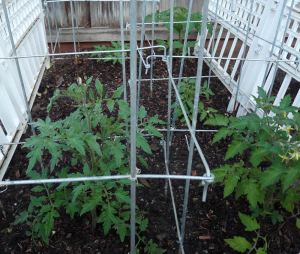
Tomato Variety

Tomato Variety

I sifted the compost through the frame, relocating the worms and adding whatever didn’t make it through the frame to the compost bin that we are currently building up. Then I took my tubfull of “black gold” over to the tomato bed. One of my recent don’t-know-how-I’d-survive-without-her phone calls to my mother-in-law went something like this, “Can I grow six varieties of tomatoes in the same bed?”

“They won’t mind but you can’t save the seed.”

“Why not?”

“They might not breed true into what you expect them to be next time.”

Just like kids, in other words. 

I carefully surrounded my six tomaotes with compost made from the scraps from the food we’ve already eaten, chewed by worms and other unseen helpers, sifted through more than a hundred years of family farming. It felt like a perfect moment in keeping with the resurrection theme of the day.

The best place to seek God is in a garden.  You can dig for him there. 
~George Bernard Shaw
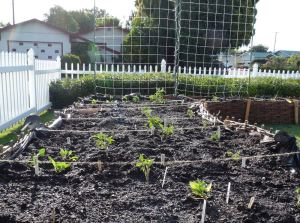
The Planter is Planted!

Leave a comment
Dirt to Dinner Individual Raised Bed Planting Areas    Dirt to Dinner Individual Raised Bed
Planting Areas

Hooray! The Dirt to Dinner willow raised bed planter is now home to 14 individual 2×4 planting sections, one for each of the families in the Spring program. And today, April 11th, was finally the day the beds were first planted. The 112′ “L” shaped bed created with willow hurdles from Master Garden Products in Oregon holds about 18″ of soil on disturbed adobe that has been lawn for the last ten+ years, with the sod removed. (We’re still trying to fit it all into the composter in layers–it could be a while!)

The planter now holds different combinations of tomatoes, tomatillos, peppers, chard, beets, carrots, a wide selection of radishes, including one patch with four varieties growing side by side for comparison, lettuce, watermelon, cantaloupe and cosmos, among others!

You'll Be Missed

You'll Be Missed

During the planting of starts and seeds, a square foot of Broccoli Raab starts were transported into the front garden, in hopes of being chosen as residents of the new planting bed. Sadly, one of the broccoli starts did not survive the move. The kids chose to honor the broccoli’s return to the soil with this memorial. ;-)

Not only did we get the planting beds planted today, but we also had lunch on time! (A process it has taken us a while to perfect.) In the kitchen, the kids prepared Strawberry Lemonade, Mashed Sweet Potatoes and Quinoa Confetti  Salad with beets, carrots, cabbage, red onion, radishes, celery, fennel and fresh herbs. The sweet potatoes were said to, “smell like a pie!”

Grate Help

Grate Help

The quinoa salad was not as popular with the kids as the kale salad we tried during Class 2 but it was tasty, fresh and welcomed by most of the adults. It made me wonder if there is some more fundamental reason kids tend not to like certain foods. I’ve been reading the new edition of Harold McGee’s classic On Food and Cooking: The Science and Lore of the Kitchen and in the vegetable section he talks about the chemistry of many of the vegetables we are encouraging the Dirt to Dinner kids to eat, a chemistry which is often a defense mechanism for plants designed to keep things from eating them! What if immature digestive systems are more sensitive to these chemical defenses and there’s a biological reason children turn up their noses at the foods grownups spend a lot of time trying to convince them are good for them? Certainly, feeding them fresh versions right out of the garden gets around any obvious taste or processing-into-tastelessness issues. Just a wild idea. Let me know if you have thoughts better founded in biochemistry than my musings!

Full Circle Farm Visit

Leave a comment
Working on the Farm   Working on the Farm

This morning was our field trip to visit Full Circle Farm, the educational farm in the Santa Clara Unified School District in Sunnyvale.

The volunteer Garden Manager, Melissa, introduced us to the garden and showed the kids the large worm box that supplies part of the nutrients needed by the vegetables growing on the farm.

The farm hopes to soon be able to make all of it’s own compost and to use that as the only soil additives for the produce grown on Full Circle Farm. Part of our group helped turn compost piles that will contribute to this process.

Other members of our class sifted garden soil to make it into potting soil for new plants that are beginning life in the Full Cirlce Farm greenhouse. We need to make some screens like the ones they use at the farm for the Dirt to Dinner garden. They are wonderful for sifting compost and getting the lumpy “uncooked” bits back into the pile for some further decomposing. I’ll check our books for a sample design and take it with me to the hardware store this week.

Planting Fingerling Potatoes

Planting Fingerling Potatoes

Our class planted some small fingerling potatoes on the farm this week. They weren’t cut and developing big ‘eyes’ like the ones we started two weeks ago in the Dirt to Dinner garden, these were very small and planted whole in the soil. Melissa gave us some of these “seed” potatoes so the kids could start their own potato patches at home or in the Dirt to Dinner garden. There are also extra Yukon Gold and Purple potato “seeds” here in case they want to try several varieties and compare the plants and their growth, production or taste.

Wearing a Little Soil

Wearing a Little Soil

It was fun to see what you can do with a garden that covers over half an acre. By comparision, the whole lot that holds the Dirt to Dinner garden is about 1/8th of an acre. The size of the garden beds we currently have under cultivation is ~300 square feet. Because we are using raised beds and biointensive planting and growing techniques along with vertical supports, we can grow a lot more in a small space than if we did that same space in traditional rows the way much of the Full Circle Farm produce is planted, but it was still great to see what’s possible when you really have the room to spread out. I can dream, can’t I?


eyeing-the-fields

March Garden Tour

1 Comment

Today I created a new Voicethread tour of the current state of the Dirt to Dinner garden: http://dirttodinner.ed.voicethread.com/share/407685/

You can compare it with where we originally started here: http://dirttodinner.ed.voicethread.com/share/323777/

I love Voicethread and can’t wait to get the kids started making their own. I set up the whole class with accounts today and am looking forward to seeing what they will share. It will be a wonderful way to bring their home gardening projects into the Dirt to Dinner classroom.

Voicethread ideas:

  • Sharing information on the microclimate where students live
  • Comparing how various growing projects do in the garden vs. at individual students homes
  • Creating a chronicle of a growing project, the process of composting, development of a plant from a seed, etc.
  • How to do something from the project such as pot-up a tomato plant or make your own carrot tape
  • Show how you prepared a recipe from the project for your family 
  • Create your own!

Ahead of Schedule

Leave a comment
Lyngo Soil Delivery    Lyngo Soil Delivery

I can’t believe it, but all the soil is in the beds for the Dirt to Dinner project. When the semi originally dumped one cubic foot of Diestel compost and six cubic feet of Essential Soil mix onto the driveway, my husband had to have been thinking to himself, “Two weeks–minimum.” But it’s all in place and looks delicious. It’s like someone covered all the bare and ugly spots and all the new planting beds with dark chocolate frosting.

Lining Willow Raised Bed "Hurdles"

Lining Willow Raised Bed "Hurdles"

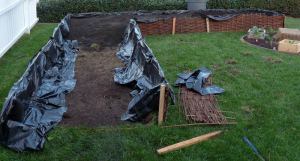
The new willow raised bed is sitting on top of the ground the kids removed the sod from this weekend. It’s fully constructed, filled with soil, topped with compost and ready for them to plant in. The kids did a great job preparing the spot where the bed sits. Then we straightened the willow “hurdles” and tapped them into the ground with a mallet. After the bed was shaped and squared, copper wires are attached around all the corners to further support the “L” shape the kids decided to build in. After that, the inside of the frame was lined with black plastic and the soil was added.

We have also been thinking about adding a vertical growing element and may install trellising along two sides of the bed before we are done. It would give the project a lot more growing space and be a good exercise in growth habits and the flexibility–or inflexibility–of spacing guidelines.

Willow Raised Bed Almost Done

Willow Raised Bed Almost Done

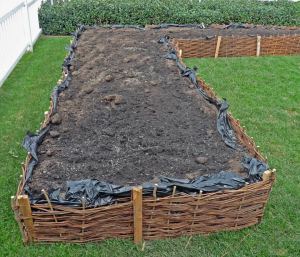
Here’s the nearly finished willow raised bed, ordered as two 4′ x 12′ beds, then arranged in an “L” shape to add an additional 16 square feet of planting space that will be used by our instructor, Mackenzie, for her demonstration gardening space. Total growing area is 112 square feet, or 9.3 square feet per participating child, if anybody is counting. ;-)

We are built out two weeks before our earliest estimate and the weather feels ready to go too. We are also ahead of schedule in some of our growing and planting. The 85-year-old neighbor, who was raised on a farm in Iowa, assures me that it is safe to put out my tomatoes now, so I have gotten severl different varieites and am excited to see the German “Orange Strawberry” tomato plant my mother-in-law is sending over this weekend. I’m going to need a protected spot for that one.

P. Borghese in Flower

P. Borghese in Flower

I think I’m happy to report that we have our first tomato flowering. Though it might have actually been a stress response to being too crowded by the other tomato plants where it was pottted. Anyway, it’s in a good spot now growing with some Bok Choy on one side and Spinach on the other. I’m trying to find space for a dozen of the P. Borghese tomatoes to have lots of them for drying since the whole family *loves* sun-dried tomatoes. Of course, I have no idea how many tomatoes each plant will give, when they will give them, or how many we actually need for drying enough for the rest of the year. This is a year for learning what *not* to do next year!

Here’s the sum total of what I know about my dozen or more tomato plants right from the Victory Seed web site:

75 days, determinate — Italian heirloom variety very popular in Italy and California for splitting in half and sun drying. They maintain color and flavor well. The plants produce heavy yields of small, red plum-shaped fruits. The plants will benefit from support such as caging.

We plan to track how many pounds of tomatoes given by each plant, the height of the plants, the size of the cage needed for the plants, the amount of square feet required to grow the plants and anything else we might need to know to grow them well again next year if we like them.