Peas and Potatoes

Leave a comment
Potatoes Looking Done

Potatoes Looking Done

Last weekend at our Open House the kids harvested the last of the All Blue potatoes. The plants were looking pretty sad by the time we got to them. Which is fine. That’s what potato plants do. When the vines die down then you have an easy way to tell that they aren’t doing anything more to grow the potatoes and you can take them out of the ground now. The ones I hadn’t already stolen ‘new’ for potato salads, that is.

This week during our Open Garden time, we pulled the spent vines and tossed them into the compost. Then we added a layer of finished compost and the worm castings we saved when we added a new level to the worm farm and mixed those in well with the existing soil.
Split Bamboo to Keep the Dew and Mold Off the Plants

Split Bamboo to Keep the Dew and Mold Off the Plants

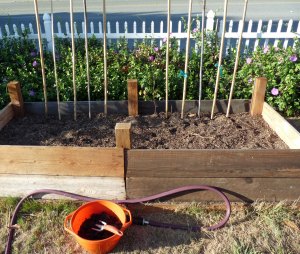
Peas like to have something to climb on, even if they aren’t the pole varieties that grow very tall. On one side we put in Cascadia Snap peas and the seed packet says they climb to 32″. Our poles extend well beyond that, but we figured there was no harm and that way the poles stay a good size to use with our determinant tomato plants in the Spring.

The other side of the bin holds Oregon Sugar Pod Snow Peas, the ones that you pick and eat flat. We are only expecting those vines to grow to 28″ or so, but it still helps to keep pea vines off the ground when you are growing them in the Fall. We don’t know if the weather will be wet or the slugs will be hungry so climbing gives the vines a little bit of an edge against both bugs and disease. Peas also don’t like to be touched and having them staked will make it easier for us to harvest the peas without messing too much with the sensitive vines or possibly spreading disease from one plant to another.

Spacing Out the Pea Seeds

Spacing Out the Pea Seeds

The Cascadia peas are planted ~1″ to 1 1/2″ apart and the Oregon Sugar Pod packet insists that they need 2″. The packet actually says “Seed Spacing: 2″ (Yes. 2″)” which made me feel like they knew me and maybe had seen how closely we had packed in the peas last year during the Winter Pea Trial. I think for one of those varieites we calculated almost 100 peas planted in a single square foot. We gave the Oregon Sugar Pods each their 2″. If they don’t all sprout we can always fill in next week when we see what we’ve got coming up.

The middle section of the bed on the Oregon Sugar Pod side we planted some Golden Beets. Next week during Open Garden we can keep filling in the bed. It might be nice to try some greens along the front of the bed where they will get a bit of shade and we have a seed donation package coming from Territorial Seed Company that might have some interesting things in it we’ll want to add. We also still have kale, broccoli, spinach, cauliflower and celery plants we have started that are all getting ready to look for more permanent homes. There’s always plenty to do in the Dirt to Dinner garden!

Hints of Things to Come

2 Comments
Our First Picolo Provencal Peas    

Our First Picolo Provenzale Peas

Friday morning–early–I was sitting in downtown Palo Alto in a Board meeting, in clean clothes with no visible dirt on me. But when someone there asked me what was good with me, I excitedly blurted out to the entire room, “We have peas!” Evidently, you can take the girl out of the garden, but…

These are the only peas that have survived from this year’s Pea Trial, the Pisello Nano Picolo Provenzale. I’ve been hunting for more seed for this variety and finally found it from Seeds from Italy. They are the U.S. distributor for Franchi Sementi spa of Bergamo, Italy, seedsmen since 1783. 1783, wow, I like the sound of that.

My mother-in-law comes from an Italian family and has liked other varieties of their seeds. I got some of the small Picolo Provenzale peas and also some of the Telefono variety which grow to 5-6′. 

Italian Winter Squash Sampler

Italian Winter Squash Sampler

I couldn’t help also ordering their collection of Winter Squash. They send you ten different varieties–and a bottle gourd–so we will be trying Padana, Marina di Chioggia, Quintale, Piena di Napoli, Tromba d’Albenga, Serpente di Sicilia, and four or five others. Just listen to the description for the Marina di Chioggia, “Very old variety from near Venice. 4-5 pound round fruit, grey/green knobby skin with sweet orange flesh. Essential for great soup, gnocci, roasting. Excellent keeper. 105 days.” Ahhh, those Italians!

The Pea Index

The Pea Index

But right now the garden is starting to show us a few more hints of things to come. The peas that got me all excited in the first place are growing pretty much flat until they are about the size of my index finger and then they start to round out some as the peas inside develop.

The January planting is roughly a square foot of pea plants that are flowering and developing peas at a rapid pace now that the weather has warmed some. They still have plenty of cool nights, which they supposedly like. I hope so, last night it got down to 39 and there was actually a light frost on the grass this morning when I went out. At this point, before a single pea has been eaten, I have to say that our January planting plan really has ended up getting us ahead of things, even if the peas got eaten by everything and developed very slowly. There are no flowers yet on the February planted patch yet.

Bush Beans Emerging from Flowers

Bush Beans Emerging from Flowers

We do have tiny beans growing though. The Bush Beans Roc D’Or Yellow Wax that are growing in a container on the back patio, where it is protected and warm, are flowering and slender beans have started to form.

I had expected two beans to form from each of the flowers but these are forming a single bean, which is still green but will turn a bright yellow as they mature. I love the way they look with the remains of the flower they formed from still stuck to their tips. These plants were also an early test that has turned out to be a good idea. These Bush Beans were sprouted inside under lights and planted as starts alongside seeds of the same variety that were put in at the same time these plants were hardened off. The beans growing from seed are doing well, but they don’t have flowers yet and are clearly behind the beans started indoors.

Even with starting things early, there isn’t much to eat in the garden right now. For lunch I made Pickled Radish salad with some of our delicious celery thrown in for good measure. I sliced the celery as thinly as possible, just like the radish, and pickled them together in the sea salt and sugar. Then I combined the radish tops and celery leaves, chopped them loosely and wilted them with a bit of water before tossing the radish and celery pickles with the dressing and the greens.

Maybe by next week I’ll be able to serve it with some fresh peas!

Early Lessons from the Pea Trial

Leave a comment

Lessons from the Pea Trial–So Far

Pisello Nano Piccolo Provenzale

Pisello Nano Picolo Provenzale

#1. Early planting does not equal early eating. It’s not just 55-60 days, it’s the *right* 55-60 days. We thought an early start would give us peas sooner, but that hasn’t turned out to be the case. Peas that were supposed to be ready to start picking in 55-60 days are just now 6″ tall a week after the 60 day mark we were hoping for. The peas planted February 18th may or may not be ready for picking by mid-April. We’ll let you know!

#2. Peas planted early seem to get damaged by pests a lot more than peas planted later. Maybe because there’s not much else out there looking green and delicious in January and early February. Or maybe we just got smarter about the covers we used as the trial went on.

#3. Peas appear to sprout and grow better in February than they do in January. Weather will surely influence this. We’ll track it next year and compare. This year January was warm and sunny, if that weather had continued, maybe the peas would have been on the table by now.

Pea Sprouts Protected by Plastic Netting

Pea Sprouts Protected by Plastic Netting

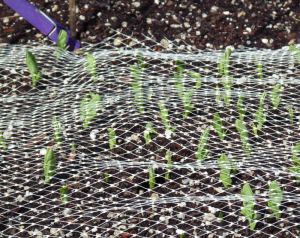
#4. Peas need to be grown under netting or cages in order to foil uninvited dinner guests. Upside down black plastic latticed plant carriers from the garden store worked well for the first few weeks, as did the onion bag netting we recycled. Neither of these methods was deep enough to allow for much growth and I would like to keep the peas protected longer, just in case. We lost a whole planting of snap peas in the back garden because something came along and snipped the tops off each of the vines. (Argh!!) We’ll keep the tall covers on these for the first several inches of growth and you can check out our Pea Trial page if you want know how our test of the burlap covered cages does.