Mom, Can I Have More Kale?

Leave a comment
Massaged Kale Salad              

Massaged Kale Salad

Today in Dirt to Dinner the kids made an amazing Massaged Kale Salad with a medley of Roasted Root Vegetables. Delicious! And as you can see, beautifully presented. Can you imagine how satisfying it was for a bunch of parents to stand around and see the kids going for seconds of a salad made with raw kale right from the garden! Not to mention they were also eating roasted turnips, parsnips, potatoes, rutabagas, carrots and more. All in all a very satisfying meal to help consume. You can find a recipe for the salad (not exactly the way we made it–but close) on the “I Love Kale” blog at http://iheartkale.blogspot.com/2009/01/massaged-kale-salad-with-grated-root.html

Team Work

Team Work

And they had worked up quite an appetite finding garden bugs, playing an elaborate kind of tag that reinforces ideas about predator – prey relationships and food webs at work in a garden. And designing and digging the space for the Dirt to Dinner planting beds.

One thing we can already tell you after just two sessions of Dirt to Dinner is that when you have twelve plus kids on hand and lunch to prepare for 25, three hours goes mighty fast. Because there is so much to do, we are already guessing that the kids likely to get the most of the program will be the ones who are able to be here on Mondays for Open Garden hours when they can move at their own pace.

Dug Up Discovery

Dug Up Discovery

Just today while the group was together we had a scavenger hunt to see what kinds of insect life we could find in the garden, met the worms who will inhabit our worm farm, picked kale, celery and lemons and played the predator-prey game about cabbage, cabbage worms, moths and birds.

Then one group prepared and roasted the root vegetables and then planted potatoes outside in flexible bins and the other group prepared the Massaged Kale Salad and did a math and spatial awareness puzzle to try to figure out what shapes the pieces for the garden boxes could be arranged in to maximize the square feet for gardening while still allowing kids to reach all the plants that would be in the beds without putting their weight on the soil.
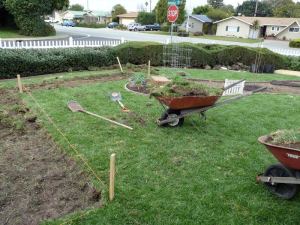
Mid-Dig

Mid-Dig

Want to try it? You can cut up sticks, straws, string, strips of paper, etc. into four 4″ lengths and eight 6″ lengths and let us know what shape configuration gives you the most square inches while still allowing easy access to the space inside the sticks. We know of two shapes that will give you 112 square inches. The largest configuration the Dirt to Dinner kids came up with today was a 112 square inch “L.” So that’s the shape that the kids measured and marked out and eventually framed with our 4′ and 6′ lengths of willow hurdles to make a 112′ garden bed.

Ready for the Dirt

Ready for the Dirt

Early Lessons from the Pea Trial

Leave a comment

Lessons from the Pea Trial–So Far

Pisello Nano Piccolo Provenzale

Pisello Nano Picolo Provenzale

#1. Early planting does not equal early eating. It’s not just 55-60 days, it’s the *right* 55-60 days. We thought an early start would give us peas sooner, but that hasn’t turned out to be the case. Peas that were supposed to be ready to start picking in 55-60 days are just now 6″ tall a week after the 60 day mark we were hoping for. The peas planted February 18th may or may not be ready for picking by mid-April. We’ll let you know!

#2. Peas planted early seem to get damaged by pests a lot more than peas planted later. Maybe because there’s not much else out there looking green and delicious in January and early February. Or maybe we just got smarter about the covers we used as the trial went on.

#3. Peas appear to sprout and grow better in February than they do in January. Weather will surely influence this. We’ll track it next year and compare. This year January was warm and sunny, if that weather had continued, maybe the peas would have been on the table by now.

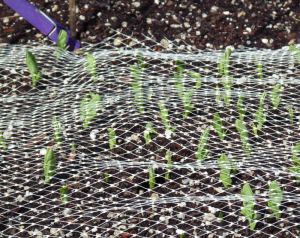
Pea Sprouts Protected by Plastic Netting

Pea Sprouts Protected by Plastic Netting

#4. Peas need to be grown under netting or cages in order to foil uninvited dinner guests. Upside down black plastic latticed plant carriers from the garden store worked well for the first few weeks, as did the onion bag netting we recycled. Neither of these methods was deep enough to allow for much growth and I would like to keep the peas protected longer, just in case. We lost a whole planting of snap peas in the back garden because something came along and snipped the tops off each of the vines. (Argh!!) We’ll keep the tall covers on these for the first several inches of growth and you can check out our Pea Trial page if you want know how our test of the burlap covered cages does.

Spring Obsessed

1 Comment

Raised and Ready

Raised and Ready

Yesterday I realized that the collards that have wintered over so well have noticed it’s about to be Spring and are getting ready to go to seed. I quickly made them into everything from frittata with onion and bacon to classic Southern-style ‘greens’ to bags to give away to anyone who haplessly stopped by my house while they were still here. Waste not, want not. ;-)

Saying that I am a bit obsessed with gardening at this time of year is polite understatement. The minute the weather breaks, which is four or five times a day this week, I am rushing out to dig compost into soil, turn new planting beds, pot up young tomatoes or check on the peas.

Inside Starts vs. Direct Planting

Inside Starts vs. Direct Planting

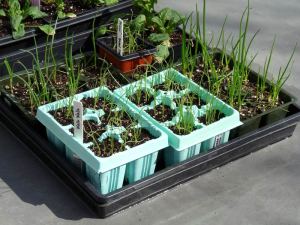
I gave up the container I was using as a cold frame and decided to test the wisdom of starting bean seeds early. They sprout well, grow fast and are hard to keep from getting leggy, not to mention carrying them back and forth from the house for hardening off. So, I took a six-packs worth of Roc D’or Yellow Wax Bush Beans (55-60 days) and popped them into this cosy bed along with roughly the same amount of seeds planted today. The left over space I filled in with Jewel-Toned Beets (55 days) because the very next planting bed over, a shallowed raised bed build into the patio, I have other beets grown from early transplants to compare them with. The front and back edges I filled in with King Midas carrots (68-75days.) They will take longer than the beans or beets in this bed, but the soil here is so perfect for them–fluffy down at least a foot–that I couldn’t resist.

Onions Waiting

Onions Waiting

I tucked the first of the onions into their planting bed this afternoon, between rain drops. The soil in my raised beds drains well enough to work even when the weather has been wet for weeks. I planted the Red Long of Tropea (90 -110 days) I grew from seed given to me by the folks at Blue House Farm.


Red Long of Tropea

Red Long of Tropea


These beautiful Italian onions have a unique shape that I think will appeal to the kids and they are meant to be eaten fresh when they bulb in the Summer. They are considered Long Day onions. The Red Onion Festival is held in Tropea during the first week of July, and our lattitude is a bit South of them, so here’s hoping.

I started work on two new raised beds today. My husband actually did most of the work for the first bed, a 4’x4′ built with the remains of a Square Foot Gardening kit. It will be in a sunny spot that was part of our lawn until this morning. Tom cut out the sod 6-8″ deep and I’ll fill that with Lyngso Essential Soil Mix when we fill the kids’ Dirt to Dinner willow beds.

Square Foot 3' x 3'

Square Foot 3' x 3'

The second bed is in a sunny corner that might be slightly shaded by the artichokes. I guess I could always cut them back if they get in the way. Those guys could survive without a leaf or two. This bed is built out of two 3’x3’s from the Square Foot Gardening kit, for the extra soil depth needed in this spot. It’s up against the fence and I have done what I could with the soil under the bed but it still ain’t pretty. This one I dug some compost into and will fill with potting mix made according to the Square Foot Gardening method, for the most part. My measuring is never too exact. I have had very good luck with their soil mix over the last few years even though the vermiculite it calls for is hard to find in “coarse.” I also don’t like the warning label that comes on the vermiculite bag, so if you can suggest good alternatives, let’s hear them!

Broccoli Raab

Broccoli Raab

Here’s a job I really need smaller hands to help with. I think every last Broccoli Raab seed I planted spouted–twice! And now I need to prick out the plants that are too close together and move them to another spot. You’re supposed to do this before the leaves touch the leaves of the plant next to them, so I’m already very late. I know I could snip some of them at soil level to thin the patch, which I may yet muster the courage to do. But I go to a lot of trouble to sprout these little guys! I hate to go out there with scissors and chop half their heads off just like that! Maybe I can move them into flats for the Dirt to Dinner kids to take home. A lot of them like broccoli…I wonder if I have a flashlight bright enough to work by…

Potting Up

1 Comment

The tomato seeds start out in little pellets, and the irony is not lost on me that I am growing “local” food by starting seeds in a product that has come all the way from Vietnam.

Starting Local Food in Fiber Grow from Vietnam

Starting Local Food in Fiber Grow from Vietnam

Digging up peat bogs to dry them and ship them to gardeners everywhere contributes to global warming, so I thought I was doing a good thing by getting Fiber Grow pellets. But once I got home and turned the package over and read the Made in Vietnam sticker, I wasn’t so sure anymore. It takes a lot of resources to ship not-peat moss around the world too.

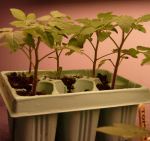
Tomato Sprouts

Tomato Sprouts

Anyway, the tomatoes, for better or worse, begin their lives on the top of the refrigerator in their Vietnamese fiber homes. It takes a week or two sometimes at the right temperature for them to germinate. They like to be warm. The first batch I started, only about half of them ever sprouted at all.

Once they have “true” leaves, the tomatoes and their Vietnamese pots go into the regular 6-packs you might see at the garden store.

First Potting

First Potting

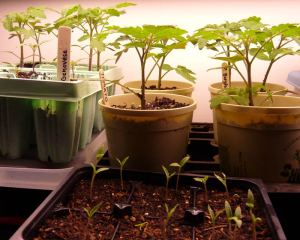
They will stay in the 6-packs for several weeks until they begin to fill out, develop stronger stems, make more leaves and start to be recognizable as tomato plants.

The next time the plants are potted up, they will be set deep into individual containers with potting soil

Tomato Starts in 6-pack

Tomato Starts in 6-pack

and a little mature compost to help them grow strong. This may sound nasty, but you bury them deep enough in the new pots that some of the early leaves will be under the soil, so you carefully tear these leaves off. Where the leaves were on the stems, roots will grow in the soil making the plant sturdier when it finally sees the garden soil.

The tomato seeds that I started in early January are just now moving into their own pots for the first time, so this process has taken about 6 weeks. It takes a long time to grow tomatoes from seed but I am really looking forward to all the pasta sauce and sundried tomatoes, salads, catsup…

Tomatoes in Four Sizes

Tomatoes in Four Sizes

The Great Raised Bed Debate

6 Comments

I was clearly naive about the number of options for raised beds there were to consider. Long gone are the days when my mother tossed a couple of railroad ties against the hillside and called it a garden. And the cost has changed too!

These gorgeous beds from Naturalyards would have cost well over a

Natrualyards Cedar

Naturalyards Cedar

$1000 to hold the Dirt to Dinner growing plots for each of the kids.  Not quite what we had budgeted for! But if money were no object, these would be the beds for me. They are beautiful, easy to assemble, available in lots of size choices and look like they would last a generation.

Link-A-BOrd

Link-A-Bord

I also like the idea of Link-a-Bord bins that would have snapped together.  They are made of all recycled materials.  They are light and easy to construct.  They come with two different depths, both a little shallower than I like for vegetable gardening, but reasonably priced. They still have the nice, neat look that any realtors scanning the neighborhood would approve of.

There were also quite an array of sizes and shapes to choose from. Want a good geometry exercise for the kids?  How many square feet of space do you get with this?

Traingle Raised Beds

Traingle Raised Beds

It’s an equilateral triangle with 7’ sides. Then it has another equilateral triangle on top so you can have that section be twice the planning depth of the large triangle ends, so now you really need to look at the cubic feet,…

When the calculator cooled off, it didn’t make sense to go with the funky shapes, much as I wanted to.

Paver Raised Beds

Paver Raised Beds

Lee Valley had some great kits where you use 16” pavers and their hardware to build beds. These things probably would have survived the next Big One, but somehow concrete and kids and all those nuts and bolts didn’t work for me for this project.  Though I love Lee Valley and the excuse to get some fun tools would have been worth it.

I was hoping to get back to the more natural “wild” look of at least the Natruayards design, if not something onto the other side of that when I came across a post on a gardening chat site that referred to the 600 year-old technology of raised bed design used in English gardens. That’s when I found mastergardenproducts.com.

Historic Willow Raised Beds

Historic Willow Raised Beds

willowraisedbedmodern

Modern Willow Raised Beds

Oh yeah. That’s as granola-y as they come.  It’s perfect. Sadly, it’s nearly impossible to find enough Willow that size to make similar boxes today, but the ones we’ll be using in the Dirt to Dinner garden will look something like the modern ones before we seal them with linseed oil, line them and fill them with our garden planting mix.

I’m a little worried that the sticks will need some kind of covering on the top to keep from sticking us, but I’m sure we’ll figure something out.  And we may even weave some of our own versions to see how they compare.