Opening Circle: Mackenzie shared a beautiful, new song with African lyrics. The English lyrics are as follows:
Welcome to my village
You are part of my village
We are all one village
Today we passed an invisible “talking stick” and shared the name of our favorite veggies. We also shared the progress of our seed jars. Most of the seeds had quickly germinated and in some cases had multiple leaves, or the seeds remained dormant with mold growing on the moist paper towel.
We discussed that the newly emerging plants were initially feeding on the nutrients within the seed and then each new plant grew toward the sunlight. Sidney shared a seed dispersal experience describing how a neighbor’s dog collected and distributed seeds which had caught onto his fur.
Mackenzie introduced our special guest today, Suzanne Mills, her mother from San Diego. Suzanne was busy helping everyone today with the experiments, cooking, clean up and sharing stories about growing up with Mackenzie. Thank you Suzanne!
Garden Chores:
The front yard was cleaned up with old growth tomato plants taken away to the compost pile.
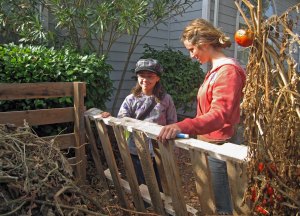
Tomato Plants Become Compost
Science Project:
We talked about the 3 elements; sunlight, water and soil and how they relate to plants.
There were 3 experiments. Mackenzie prompted the investigation with a question about one of the elements and then we created our scientific guess, sometimes referred to as a hypothesis.
Q#1 What happens to roots with various amounts of water?
Hypothesis: Plants need water
Method: 5 cups of soil were given varying amount of water and ability to drain water.
C1 – no water
C2 Water once with cup drainage holes
C3 Water once with no drainage holes
C4 Water several times with cup drainage holes
C5 Water several times with no drainage holes
Q#2 What does soil do for plants?
H: Quality soil gives us bigger leaves
M: 3 pea seeds using 3 methods were planted in the garden
P1 Peas with water and sun
P2 Peas with poor soil with water
P3 Peas with good soil, sun and water
Q#3 How does light affect plantʼs growth?
H: Plants donʼt need light but they grow better with light
M: Put 3 cups filled with seeds and soil into 3 areas of varying light
C1 Inside without light (closet)
C2 Create a collar of foil around the cup to maximize light capture
C3 Put cup outside with no foil collar

How Does the Garden Feel?
Senses in the Garden:
Everyone had fun searching the garden and acting like a detective finding 18 different
textures, smell, sounds, colors, tastes. The “brightness” of each individual piece was
enjoyed.
Cooking Project:
Cooking 3 different dishes using Polenta; Polenta crust pizza, soft polenta with olive oil, soft polenta with tomatoes, olive oil and mozzarella cheese, and apple upside down cake.
Polenta is a dish made from boiled cornmeal. When boiled, polenta has a smooth, creamy texture due to the gelatinization of starch in the grain.

Let's Eat!
We watched Talia finish up cooking a pot of soft polenta. After adding the polenta to boiling water she stirred the mixture for over an hour. Her patience paid off as the batch passed the thickening test with her mixing spoon standing straight up from the mixture.
Owen, Kevin, Kimberly and others sliced and diced tomatoes, mozzarella, and basil to decorate the top of the polenta crust.
Everything was delicious.
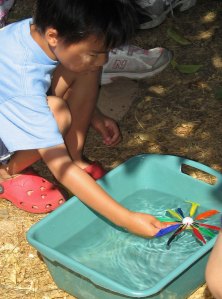 The pea seed carrier competition was on. Everyone worked hard to make seed carriers that could float on water for 5 minutes, move 2 feet horizontally on their own, and fly from the top of the play structure. A popular creation idea for floating seeds was to press peas into Styrofoam balls, and then release them into the competition buckets. Movement and flight were typically accomplished simultaneously with one creation serving two purposes. Many participants’ creations were balloons filled with air , but left untied, so the seeds could easily release. To disperse the peas, people let their creations fly from the top of the play structure. Others let their balloons explode, enabling their seeds to disperse with a blast.
 In the kitchen, kids were making seedy granola. Nuts, seeds, dried fruit (but not raisins fortunately enough!), and maple syrup were combined and baked. As a result, many of us are enjoying delicious homemade granola for breakfast and snacks this week.
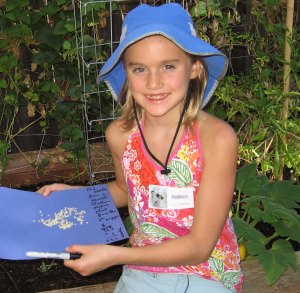 Juli was also cooking up a storm, along with some other parents. Lunch was a spicy pasta with veggies in it and cheese on top. Tomatoes and peppers had to be harvested to make the sauce. Fortunately, we had learned a whole lot about pepper seeds earlier in the morning, thanks to S. Almost as soon as she arrived, she began counting pepper seeds. She estimated that the pepper plant in the backyard has 852 seeds on it, using the seeds of one pepper and some multiplication. However many seeds it has, it sure made for a delicious lunch!
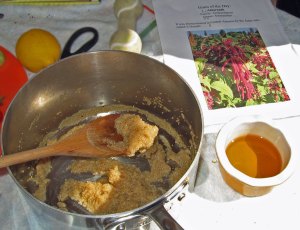 Pasta wasn’t the only grain product to rule the day. Actually, the official grain of the day was amaranth, a grain domesticated in Central America. The Aztecs called it Huautli. Mackenzie boiled some up, giving us honey to drizzle over it.
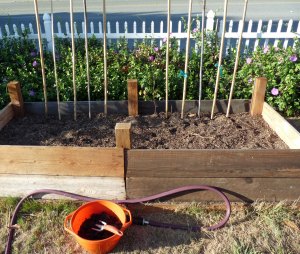
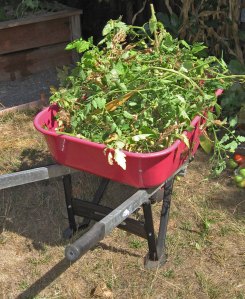 And if you think the day was just about seeds and grains, then you didn’t notice the dead tomato plant removal going on at the back of the garden just after lunch. Because of a lot of cutting, pulling, and hauling, the big pink wheelbarrow was filled with the stalks of summer’s tomato crop. The bed is now ready for winter’s spinach. If anybody has any spinach salad recipes, we should be ready to sample them in a couple of months.







 From Dirt to Dinner