A & C Pickling Cucumber
An important part of the perfect pickle, the crunch, is impossible to recreate unless you have fresh pickling cucumbers on hand and pickle them at peak freshness. Or so I have been told. My family’s pickling tradition consists of my mother doing whatever was printed in The Joy of Cooking and turning out a jar or two of kosher dills if the mood struck her and the cucumber harvest was cooperative that year.
In Dirt to Dinner, we like to teach the kids as much as possible about their food, where it comes from, how to grow it, what it’s history is, and how to preserve it for later. So today we started four different varieties of pickling cucumbers in the raised beds in the back garden, where the soil is well warmed. ‘Bushy Cucumber’, from Seed Savers Exchange, a variety from southern Russia where it is recommended for your dacha garden because it grows a compact “bushy” plant. ‘Double Yield Cucumber’, a variety from 1924, that we ate fresh last year. ‘A & C Pickling Cucumber’, also from Seed Savers Exchange, a variety introduced in 1928, that says it produces very uniform fruit but shows some healthy diversity in the photo. And ‘The Pickle of Paris’ or ‘Cetriolino Piccolo di Parigi’ which I hope will produce small gherkins for pickling, but we’re not totally sure of, because all the printing on the packaging is in Italian.

Lemon Cucumbers
There were also some slicing cucumbers that we couldn’t do without. We started a few seeds for some of the good old ‘Straight Eight‘ cucumbers that have been favorites here for the last few years. We also planted heirloom ‘Lemon‘ cucumbers, donated by Botanical Interest. These plants grew very slowly last year but the fruits were delicious when they finally came. That should probably be a lesson to us not to start them so early in the year, but here we go again, planting them in March. Maybe in a few weeks I will start a few plants from these seeds inside so we can do a comparison of the harvests. We also started ‘Armenian‘ cucumbers from seed donated by Territorial Seed Company. We had a variety of Armenian cucumbers last year that did well and were delicious. In fact, these are my personal favorites for quick-pickling with salt, vinegar and herbs, or for dipping in hummus. They were grown in a very protected spot last year and did well. I’ll be looking for another sheltered corner for them for this season.
This summer we plan to try the Pick-a-Vegetable Dill Pickle recipe from the Complete Book of Home Preserving and these Garlic Dills from Food in Jars.
3/26/2010 Update
Our first direct-seeded cucumbers sprouted today, the ‘Bushy‘ variety from Seed Savers. The slicing cucumbers all started in pots are starting to poke up their heads today as well, ‘Lemon‘, ‘Armenian‘, and ‘Straight Eight‘s which were first and look strongest out of the gate.




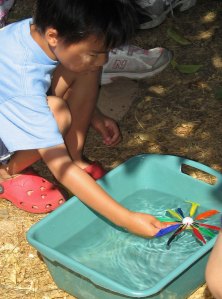 The pea seed carrier competition was on. Everyone worked hard to make seed carriers that could float on water for 5 minutes, move 2 feet horizontally on their own, and fly from the top of the play structure. A popular creation idea for floating seeds was to press peas into Styrofoam balls, and then release them into the competition buckets. Movement and flight were typically accomplished simultaneously with one creation serving two purposes. Many participants’ creations were balloons filled with air , but left untied, so the seeds could easily release. To disperse the peas, people let their creations fly from the top of the play structure. Others let their balloons explode, enabling their seeds to disperse with a blast.
 In the kitchen, kids were making seedy granola. Nuts, seeds, dried fruit (but not raisins fortunately enough!), and maple syrup were combined and baked. As a result, many of us are enjoying delicious homemade granola for breakfast and snacks this week.
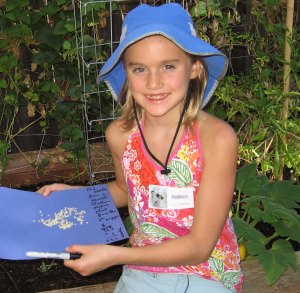 Juli was also cooking up a storm, along with some other parents. Lunch was a spicy pasta with veggies in it and cheese on top. Tomatoes and peppers had to be harvested to make the sauce. Fortunately, we had learned a whole lot about pepper seeds earlier in the morning, thanks to S. Almost as soon as she arrived, she began counting pepper seeds. She estimated that the pepper plant in the backyard has 852 seeds on it, using the seeds of one pepper and some multiplication. However many seeds it has, it sure made for a delicious lunch!
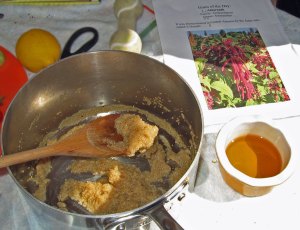 Pasta wasn’t the only grain product to rule the day. Actually, the official grain of the day was amaranth, a grain domesticated in Central America. The Aztecs called it Huautli. Mackenzie boiled some up, giving us honey to drizzle over it.
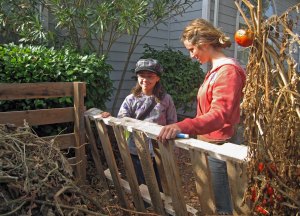
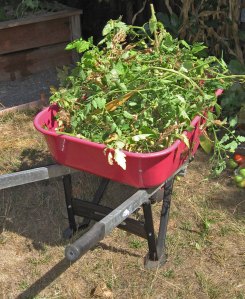 And if you think the day was just about seeds and grains, then you didn’t notice the dead tomato plant removal going on at the back of the garden just after lunch. Because of a lot of cutting, pulling, and hauling, the big pink wheelbarrow was filled with the stalks of summer’s tomato crop. The bed is now ready for winter’s spinach. If anybody has any spinach salad recipes, we should be ready to sample them in a couple of months.

 From Dirt to Dinner