May Dirt to Dinner Update

Leave a comment
Sprouting and Growing    Sprouting and Growing

There’s no doubt that the garden is starting to fill out nicely. If I hadn’t noticed it myself, the evening parade of dog walkers would have been happy to remind me.

We continue to receive attention and even gifts from neighborhood well-wishers. We now have two new lavender plants, starts from lavender bushes up the road that attract several different types of bees. We have a new moisture meter, which is addicting to use and is a huge help in watering. The small horseradish we were given has turned into an enormous pot of lush leaves and roots. And the seed donation from Seeds of Change has arrived with many interesting varieties we may want to try.

Bauer Lumber in Mountain View has also been very generous with donations of scrap wood that has come in handy several times already and which will be used to complete the potato bed as the hills get higher.

Thanks everybody! It’s wonderful to have your support.

Easter Egg Radishes make delicious pickles

Easter Egg Radishes make delicious pickles

In the kitchen, I have finally perfected my radish pickling brine recipe and can’t wait for everyone to try it out the next time we meet. It’s a mix of mostly sea salt, apple cider vinegar and tamari and it tames the stronger radishes in a way I hope the kids will like. Oh, and did I mention that recipe also uses a pinch or two of suagar and a swirl of honey? That could be part of what’s helping smooth it out. Delicious!

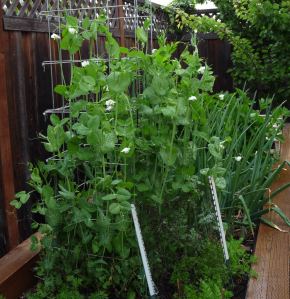
The January planting of shelling peas is just about done producing and we are moving on to pick the February shell peas and the snap peas. I’m sure people walking past the other side of the fence think we are growing the world’s tallest Snap Peas. Little do they know the peas are started in raised beds that are three feet tall. I won’t tell if you won’t.
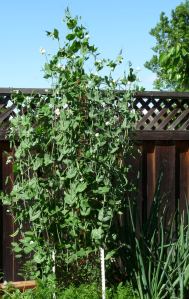
Eight Foot Tall Snap Peas

Eight Foot Tall Snap Peas

The broccoli is also still producing nice side shoots, but will flower if given half a chance. The Broccoli Raab the kids planted in their individual beds is also prone to flowering. I’m keeping the flowers trimmed to see if it will go back to making more broccoli or not.

Intensive Planting to the Max

Intensive Planting to the Max

Some of the individual planting beds are small jungles at this point. Remind me to go over plant spacing with the kids again. :-)

This one has carrots, radishes, beets and tomato plants–and that’s just in the first two square feet!
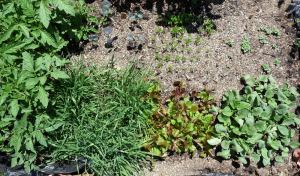
Square Foot Patchwork

Square Foot Patchwork

These will be a wonderful experiment since they are all planted differently with more or less attention to the spacing ‘suggestions’ we used at planting time. Here’s one bed that was planted with careful attention to the square foot measures that gives it a visual patchwork look that many of our visitors find appealing.

I wish I could keep the rest of the garden looking that nice and neat!


Circle of Pollinator Attractors

Circle of Pollinator Attractors

We have added a few more flowers to our pollinator collection, a blue basil, some coreopsis and others. And we have our first potato plant flower bud! I wonder what it will look like? I’m actually not sure at this point which sack of potatoes is which, so I’m not sure which kind of bud this will be. I hope Mackenzie remembers or we may not know until it’s time to pick the potatoes.

The blue potatoes sent up blue sprouts, which I would never have expected.  I didn’t even recognize them as sprouts when they first came up because they looked so dark against the soil and compost. Who knows? Maybe it will have blue flowers as well!
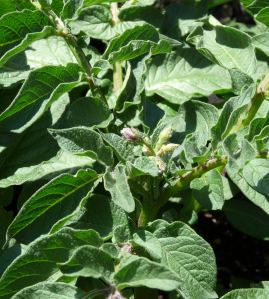
First Spud Bud

First Spud Bud

Testing the Light in the Garden

1 Comment

tilled-3sisters-bed1One of the experiments we are conducting in the Dirt to Dinner garden is a test of our ability to bring more light into a shady section up against one of the fences. It’s after 10:00 am and the sunlight still hasn’t gotten to this patch. It’ll be a little better in June and July, but less than ideal light is a fact of life for that patch of ground.
We divided the shady section into two roughly equal-size garden patches with a section of tomatoes dividing them. The right-hand section is our control, the left-hand section has white plastic attached to the fence to reflect light onto the plants during times when the sunlight is available in other parts of the garden, but doesn’t reach the plants in this spot.

The Corn is Sprouting

The Corn is Sprouting

The kids made their Three Sisters corn mounds in both beds and planted the same corn variety in each bed. Yesterday, May 5th, the light bed had ten corn sprouts poking up out of the soil at the end of the day. The shadier control patch had none. Today, May 6th, the light test bed now has eleven sprouts, the shady side, just four.

I want to find a soil thermometer and see just how different the temperatures of the two sides are. It must be enough to influence germination. I can’t wait to see how the rest of the bean and squash planting goes.

The Three Sisters

3 Comments
Native American Three Sisters from Renees Garden

This week at Dirt to Dinner each group of kids got to learn about and planted their own Three Sisters garden. We are using seeds from Renee’s Garden that include Earth Tones Indian Dent Corn which we will later grind into cornmeal, Scarlet Runner Beans, which the kids–and the pollinators around the garen–will like, and Sugar Pie Pumpkins.

The pattern for our garden also comes from traditional sources. This week when we were all together, the kids dug compost into the bed and formed the first set of mounds we’ll use, the corn mounds. Next time we are together, in about two weeks, they will form a second series of ammended mounds, this time for the squash. (The beans get planted in the corn mounds.)

Here’s the wonderful diagram from Renee’s that demonstrates the process so much better than I could write it out.

We actually have two patches because we are testing a way to get more light into the garden with one of the planting beds and using the other as a control, so we also have a tomato patch worked into the mix to separate the two Three Sisters beds. There is a demonstration bed of six different tomato varieties that divides the light augmented plot from the control plot. This already looks so different from the endless acres of monoculture corn rows I grew up with in Ohio. I can’t wait to see how it grows!

corn-pouchTo celebrate the corn planting the kids also made corn pouches which will sprout a sample of the Indian Dent Corn and a sample of the monoculture corn plated across those fields in Ohio and allow us to talk about genetic variation and why it’s important to have plant diversity.

Then they prepared a beautiful lunch that included mini corn muffins and an artful display of finger foods with yogurt dip and hummus.

All in all, a very satisfying day!

April Garden Tour

Leave a comment
Teacher's Growing Bed

Teacher’s Growing Bed


For a tour of some of the Dirt to Dinner garden highlights, you can check out the April Voicethread. You can see the garden’s development so far this Spring, all the individual growing beds the kids have planted, our experiments with four different varieties of potatoes and how all the various pea growing trials are turning out.

Here are some of the thing we are able to eat from the garden right now:
peas, broccoli, celery, parsley, spinach, chard, scallions, bok choi and radishes.

The next crop we expect to come in should be our early green beans, the Yellow Wax beans. They are looking good, but are still small and green. No sign yet of the yellow color that will let us know they are ready for picking. And we are looking forward to snap peas, carrots and planting our corn.

One for Wind, One for Crow

Leave a comment
Edamame-cide   

Edamame-cide

…One to die and one to grow.

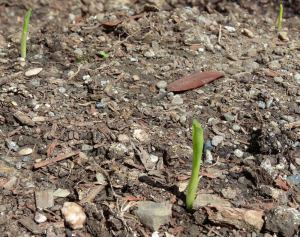
Have I ever mentioned that gardening can be a very frustrating hobby? Just look at this poor Edamame soy bean sprout! I forgot to put their little plastic covers back over them last night after I watered and every last beautiful soy bean sprout was slaughtered in the night. Or, most likely, in the very early morning by the crows.

Why do they do this? They don’t eat the sprouts. They just tear them out of the ground and bite them so they can’t grow! Don’t they know the rule in the Dirt to Dinner garden is, “You kill it–you eat it?” (Let me know if you have any good recipes that call for crow. We’ll talk.)

Heart of the Artichoke

Heart of the Artichoke

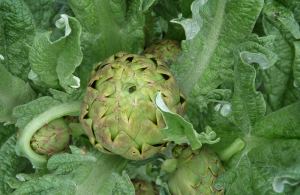
Not only that, but some time after I took this picture this morning, the artichoke plant these blooms are on fell over, for no apparent reason, into the pea patch next door! I am about to go out there and prop it up with some bamboo poles and a trellis net.

Let me assure you, the plants do not look this way in the gardening catalog! Maybe this is the real reason that people don’t generally grow their vegetable gardens in the front yard. At least when you put the garden in the back and the plants are strung up with bailing wire, no one sees them but you!

Four-Foot Snap Peas?

Four-Foot Snap Peas?

I would just clip off the artichokes and cut the whole plant back to the ground and let it start over next year, but this is a picture of the last plants I ‘gave up’ on.

This is a patch of Sugar Snap peas I planted during a warm spell on January 18th from starts I picked up when I bought the broccoli.

They immediately had all their tops snipped off by some pestilent critter and I thought they were all goners. But they fooled me. They grew back from the roots again! Each plant sent up a new shoot from underground and now they are happily climbing the supports we set out for them.

I’m sure they could have grown a lot faster, had they not had their heads chopped off a week after I planted them, but they are flowering and getting ready to make peas at the same time as the February planting of the Picolo Provenzale peas in the front.