The Gardener’s Code

Leave a comment
The Gardener's Code 


The Gardener's Code

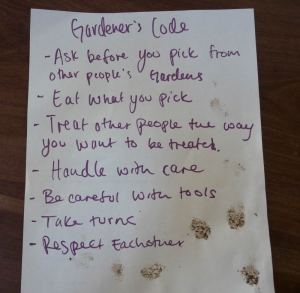
This week at Dirt to Dinner, the kids spent some time discussing the way they’d like things to go in the garden. The first thing that came up was about respecting things that other people have grown in the garden, which I thought showed that the kids really are developing the sense of ownership that we had hoped they would have for the garden and the plants that they tend here. With meetings happening only every other week, we didn’t know how that feeling would develop but are glad to see that it has. The second point was originally discussed more in terms of “You kill it, you eat it,” which took responsibility for the space here, and by extension the world around us, to an uncomfortably visceral point there for a moment, before it spoftened into, “Eat what you pick.”

I think it was really fun for the kids “signing” the code with thumb prints of mud. But I did notice that we’ll need to review the picking code the next time the kids are here. Several young broccoli plants mysteriously lost all their broccles before they were ready while the crew was working on the nearby planting bed. ;-) At least we can hope they got eaten!

The Planter is Planted!

Leave a comment
Dirt to Dinner Individual Raised Bed Planting Areas    Dirt to Dinner Individual Raised Bed
Planting Areas

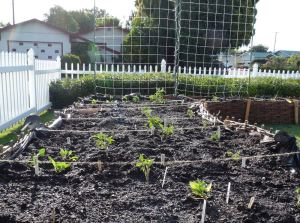
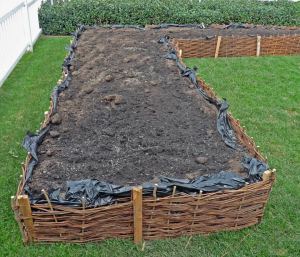
Hooray! The Dirt to Dinner willow raised bed planter is now home to 14 individual 2×4 planting sections, one for each of the families in the Spring program. And today, April 11th, was finally the day the beds were first planted. The 112′ “L” shaped bed created with willow hurdles from Master Garden Products in Oregon holds about 18″ of soil on disturbed adobe that has been lawn for the last ten+ years, with the sod removed. (We’re still trying to fit it all into the composter in layers–it could be a while!)

The planter now holds different combinations of tomatoes, tomatillos, peppers, chard, beets, carrots, a wide selection of radishes, including one patch with four varieties growing side by side for comparison, lettuce, watermelon, cantaloupe and cosmos, among others!

You'll Be Missed

You'll Be Missed

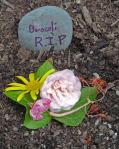
During the planting of starts and seeds, a square foot of Broccoli Raab starts were transported into the front garden, in hopes of being chosen as residents of the new planting bed. Sadly, one of the broccoli starts did not survive the move. The kids chose to honor the broccoli’s return to the soil with this memorial. ;-)

Not only did we get the planting beds planted today, but we also had lunch on time! (A process it has taken us a while to perfect.) In the kitchen, the kids prepared Strawberry Lemonade, Mashed Sweet Potatoes and Quinoa Confetti  Salad with beets, carrots, cabbage, red onion, radishes, celery, fennel and fresh herbs. The sweet potatoes were said to, “smell like a pie!”

Grate Help

Grate Help

The quinoa salad was not as popular with the kids as the kale salad we tried during Class 2 but it was tasty, fresh and welcomed by most of the adults. It made me wonder if there is some more fundamental reason kids tend not to like certain foods. I’ve been reading the new edition of Harold McGee’s classic On Food and Cooking: The Science and Lore of the Kitchen and in the vegetable section he talks about the chemistry of many of the vegetables we are encouraging the Dirt to Dinner kids to eat, a chemistry which is often a defense mechanism for plants designed to keep things from eating them! What if immature digestive systems are more sensitive to these chemical defenses and there’s a biological reason children turn up their noses at the foods grownups spend a lot of time trying to convince them are good for them? Certainly, feeding them fresh versions right out of the garden gets around any obvious taste or processing-into-tastelessness issues. Just a wild idea. Let me know if you have thoughts better founded in biochemistry than my musings!

March Garden Tour

1 Comment

Today I created a new Voicethread tour of the current state of the Dirt to Dinner garden: http://dirttodinner.ed.voicethread.com/share/407685/

You can compare it with where we originally started here: http://dirttodinner.ed.voicethread.com/share/323777/

I love Voicethread and can’t wait to get the kids started making their own. I set up the whole class with accounts today and am looking forward to seeing what they will share. It will be a wonderful way to bring their home gardening projects into the Dirt to Dinner classroom.

Voicethread ideas:

  • Sharing information on the microclimate where students live
  • Comparing how various growing projects do in the garden vs. at individual students homes
  • Creating a chronicle of a growing project, the process of composting, development of a plant from a seed, etc.
  • How to do something from the project such as pot-up a tomato plant or make your own carrot tape
  • Show how you prepared a recipe from the project for your family 
  • Create your own!

Ahead of Schedule

Leave a comment
Lyngo Soil Delivery    Lyngo Soil Delivery

I can’t believe it, but all the soil is in the beds for the Dirt to Dinner project. When the semi originally dumped one cubic foot of Diestel compost and six cubic feet of Essential Soil mix onto the driveway, my husband had to have been thinking to himself, “Two weeks–minimum.” But it’s all in place and looks delicious. It’s like someone covered all the bare and ugly spots and all the new planting beds with dark chocolate frosting.

Lining Willow Raised Bed "Hurdles"

Lining Willow Raised Bed "Hurdles"

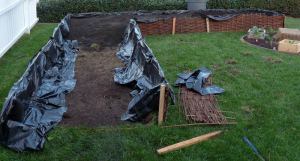
The new willow raised bed is sitting on top of the ground the kids removed the sod from this weekend. It’s fully constructed, filled with soil, topped with compost and ready for them to plant in. The kids did a great job preparing the spot where the bed sits. Then we straightened the willow “hurdles” and tapped them into the ground with a mallet. After the bed was shaped and squared, copper wires are attached around all the corners to further support the “L” shape the kids decided to build in. After that, the inside of the frame was lined with black plastic and the soil was added.

We have also been thinking about adding a vertical growing element and may install trellising along two sides of the bed before we are done. It would give the project a lot more growing space and be a good exercise in growth habits and the flexibility–or inflexibility–of spacing guidelines.

Willow Raised Bed Almost Done

Willow Raised Bed Almost Done

Here’s the nearly finished willow raised bed, ordered as two 4′ x 12′ beds, then arranged in an “L” shape to add an additional 16 square feet of planting space that will be used by our instructor, Mackenzie, for her demonstration gardening space. Total growing area is 112 square feet, or 9.3 square feet per participating child, if anybody is counting. ;-)

We are built out two weeks before our earliest estimate and the weather feels ready to go too. We are also ahead of schedule in some of our growing and planting. The 85-year-old neighbor, who was raised on a farm in Iowa, assures me that it is safe to put out my tomatoes now, so I have gotten severl different varieites and am excited to see the German “Orange Strawberry” tomato plant my mother-in-law is sending over this weekend. I’m going to need a protected spot for that one.

P. Borghese in Flower

P. Borghese in Flower

I think I’m happy to report that we have our first tomato flowering. Though it might have actually been a stress response to being too crowded by the other tomato plants where it was pottted. Anyway, it’s in a good spot now growing with some Bok Choy on one side and Spinach on the other. I’m trying to find space for a dozen of the P. Borghese tomatoes to have lots of them for drying since the whole family *loves* sun-dried tomatoes. Of course, I have no idea how many tomatoes each plant will give, when they will give them, or how many we actually need for drying enough for the rest of the year. This is a year for learning what *not* to do next year!

Here’s the sum total of what I know about my dozen or more tomato plants right from the Victory Seed web site:

75 days, determinate — Italian heirloom variety very popular in Italy and California for splitting in half and sun drying. They maintain color and flavor well. The plants produce heavy yields of small, red plum-shaped fruits. The plants will benefit from support such as caging.

We plan to track how many pounds of tomatoes given by each plant, the height of the plants, the size of the cage needed for the plants, the amount of square feet required to grow the plants and anything else we might need to know to grow them well again next year if we like them.

Planning Meets Reality

Leave a comment

Scattered Seeds

Scattered Seeds

I am pretty thrilled with our inaugural Dirt to Dinner class. We had twelve kids and twelve adults. And it didn’t rain! Everybody met new people, everybody planted some seeds, everybody cooked part of our lunch and there was plenty of good food to go around.

Here’s what we thought we would do and a little bit about how it actualy went.

Class plan:

a)  Welcome circle and Intros (personal and intro to the program)  

We all got to know one another’s names and talked about our favorite vegetables or fruits.

b)  Safety, boundaries and behavior goals

We spent some time on safety in the garden and in the kitchen but we will probably want to go over Gary Riekes’ thoughts on behavior goals a little bit more when we have a chance. Though the kids seemed to get along very well all day without it.

c)  Ice breakers

We played a game where you form small groups based around the individuals in the larger group who have a particular characteristic or have done a certain thing (“Have you ever eaten a worm?”) You introduce yourself, again, to the members of the small group as they form, so you learn something about one another and get a chance to remember everyone’s name while you play.

d)  Plant parts activity
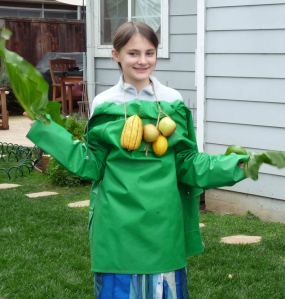
Plants Part Costume Model

Plants Part Costume Model

Seeing the first part of the plant parts “costume” going on reminded me to run for the camera. This was an exercise I’m willing to bet they won’t soon forget!

Then the kids did a Plant Parts Scavenger hunt through what’s already growing in the garden to see if they could find edible roots, stems, leaves and flowers. We found carrots and radishes, celery and onions, kale and collards, lemons, nectarine flowers, rosemary blooms and artichokes.

Many of these were passed around so that whoever wanted to could nibble on them. It’s a good thing celery loves that back garden because the kids got a kick out of picking it and nibbling on it right there.

e)  Group A Plant Parts scavenger hunt and Seed Starting
and Group B Kitchen Intro and Favorite Veggies

Soffrito with onion and garlic

Soffrito with onion and garlic

One group of families started out in the kitchen where they did a wonderfully focused job preparing two pots of Garden Vegetable Soup, one by the recipe, and one with a few additions based on what we had on hand from the garden and families bringing their favorite vegetables to share. The soup started with a nice soffrito (or roux, depending on where you are from) of several kinds of onions and garlic in olive oil.

f)   Group A Kitchen Intro and Favorite Veggies
Group B Plant Parts scavenger hunt and Seed Starting


Flower Starts

Flower Starts

The families who started at the potting station planted a variety of flowers and Spring vegetables. We have seeds for many different kinds of flowers that are favorites of bees, hummingbirds or butterflys. The group is already drawing up plans for special planting areas devoted to pollinators. We also planted peas, spinach, lettuce and early beans and picked out a spot to grow carrots, radishes, and other Spring vegetables that need to be direct seeded into the ground.


Watering In Seeds

Watering In Seeds

The seeds were watered in and the kids took them home to germinate in a warm place.


g)  Lunch

The soup was delicious! It was served with a chopped salad and good bread and lots of the kids actually ate it. :-) The dish washing plan with three different dishpans with soapy water, rinse water with lemon and clear rinse water worked very well. 

h)  Rain Measures/Journal decoration

We didn’t cover rain measures today, but some of the kids worked on decorating the covers of their journals a bit while the finsihing touches were being added to lunch. 

i) Closing circle, intentions, thoughts on the day

We all said something about our favorite part of the day. I heard everything from “Food!” to “Growing community” to “The way everybody put in a little bit of something to make the soup come together.” I also heard one very proud voice sharing that the highlight of the day was climbing to the top of the play structure, which reminded me that we all take different paths to the garden. :-)