One for Wind, One for Crow

Leave a comment
Edamame-cide   

Edamame-cide

…One to die and one to grow.

Have I ever mentioned that gardening can be a very frustrating hobby? Just look at this poor Edamame soy bean sprout! I forgot to put their little plastic covers back over them last night after I watered and every last beautiful soy bean sprout was slaughtered in the night. Or, most likely, in the very early morning by the crows.

Why do they do this? They don’t eat the sprouts. They just tear them out of the ground and bite them so they can’t grow! Don’t they know the rule in the Dirt to Dinner garden is, “You kill it–you eat it?” (Let me know if you have any good recipes that call for crow. We’ll talk.)
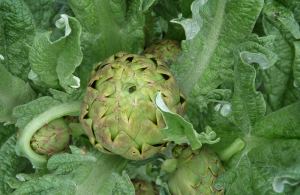
Heart of the Artichoke

Heart of the Artichoke

Not only that, but some time after I took this picture this morning, the artichoke plant these blooms are on fell over, for no apparent reason, into the pea patch next door! I am about to go out there and prop it up with some bamboo poles and a trellis net.

Let me assure you, the plants do not look this way in the gardening catalog! Maybe this is the real reason that people don’t generally grow their vegetable gardens in the front yard. At least when you put the garden in the back and the plants are strung up with bailing wire, no one sees them but you!
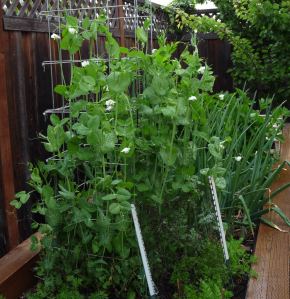
Four-Foot Snap Peas?

Four-Foot Snap Peas?

I would just clip off the artichokes and cut the whole plant back to the ground and let it start over next year, but this is a picture of the last plants I ‘gave up’ on.

This is a patch of Sugar Snap peas I planted during a warm spell on January 18th from starts I picked up when I bought the broccoli.

They immediately had all their tops snipped off by some pestilent critter and I thought they were all goners. But they fooled me. They grew back from the roots again! Each plant sent up a new shoot from underground and now they are happily climbing the supports we set out for them.

I’m sure they could have grown a lot faster, had they not had their heads chopped off a week after I planted them, but they are flowering and getting ready to make peas at the same time as the February planting of the Picolo Provenzale peas in the front.
The Gardener’s Code

Leave a comment
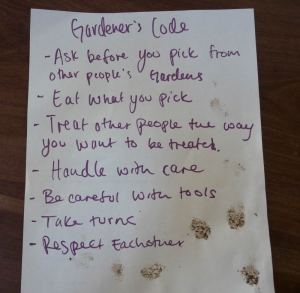
The Gardener's Code 


The Gardener's Code

This week at Dirt to Dinner, the kids spent some time discussing the way they’d like things to go in the garden. The first thing that came up was about respecting things that other people have grown in the garden, which I thought showed that the kids really are developing the sense of ownership that we had hoped they would have for the garden and the plants that they tend here. With meetings happening only every other week, we didn’t know how that feeling would develop but are glad to see that it has. The second point was originally discussed more in terms of “You kill it, you eat it,” which took responsibility for the space here, and by extension the world around us, to an uncomfortably visceral point there for a moment, before it spoftened into, “Eat what you pick.”

I think it was really fun for the kids “signing” the code with thumb prints of mud. But I did notice that we’ll need to review the picking code the next time the kids are here. Several young broccoli plants mysteriously lost all their broccles before they were ready while the crew was working on the nearby planting bed. ;-) At least we can hope they got eaten!

The Planter is Planted!

Leave a comment
Dirt to Dinner Individual Raised Bed Planting Areas    Dirt to Dinner Individual Raised Bed
Planting Areas

Hooray! The Dirt to Dinner willow raised bed planter is now home to 14 individual 2×4 planting sections, one for each of the families in the Spring program. And today, April 11th, was finally the day the beds were first planted. The 112′ “L” shaped bed created with willow hurdles from Master Garden Products in Oregon holds about 18″ of soil on disturbed adobe that has been lawn for the last ten+ years, with the sod removed. (We’re still trying to fit it all into the composter in layers–it could be a while!)

The planter now holds different combinations of tomatoes, tomatillos, peppers, chard, beets, carrots, a wide selection of radishes, including one patch with four varieties growing side by side for comparison, lettuce, watermelon, cantaloupe and cosmos, among others!

You'll Be Missed

You'll Be Missed

During the planting of starts and seeds, a square foot of Broccoli Raab starts were transported into the front garden, in hopes of being chosen as residents of the new planting bed. Sadly, one of the broccoli starts did not survive the move. The kids chose to honor the broccoli’s return to the soil with this memorial. ;-)

Not only did we get the planting beds planted today, but we also had lunch on time! (A process it has taken us a while to perfect.) In the kitchen, the kids prepared Strawberry Lemonade, Mashed Sweet Potatoes and Quinoa Confetti  Salad with beets, carrots, cabbage, red onion, radishes, celery, fennel and fresh herbs. The sweet potatoes were said to, “smell like a pie!”

Grate Help

Grate Help

The quinoa salad was not as popular with the kids as the kale salad we tried during Class 2 but it was tasty, fresh and welcomed by most of the adults. It made me wonder if there is some more fundamental reason kids tend not to like certain foods. I’ve been reading the new edition of Harold McGee’s classic On Food and Cooking: The Science and Lore of the Kitchen and in the vegetable section he talks about the chemistry of many of the vegetables we are encouraging the Dirt to Dinner kids to eat, a chemistry which is often a defense mechanism for plants designed to keep things from eating them! What if immature digestive systems are more sensitive to these chemical defenses and there’s a biological reason children turn up their noses at the foods grownups spend a lot of time trying to convince them are good for them? Certainly, feeding them fresh versions right out of the garden gets around any obvious taste or processing-into-tastelessness issues. Just a wild idea. Let me know if you have thoughts better founded in biochemistry than my musings!

Raised Bed Trials

7 Comments
30" Potato and Tomato Raised Bed

24" Potato and Tomato Raised Bed

We are testing a wide variety of raised beds in the Dirt to Dinner garden. Just this week I added two new No Dig beds with tall trellising for cantaloupe and spaghetti squash. They are made of “found” lumber (it was Clean-Up Week in our neighborhood, so the finding part was easy) that 50 years ago was a backyard fence. I figure anything potentially unhealthy has surely leached out of it in all this time. Right?

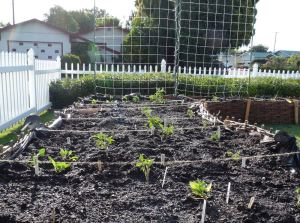
The first bed we added to the front garden we took up the turf and dug the soil underneath, so it’s somewhere between 18″ and 24″ of new ammended soil mixed with the existing clay and topped with an inch of turkey farm compost. This bed holds potatoes and tomatoes, so I’m sure we’ll learn a lot about the quality of both the drainage and the new soil from the way the plants develop. It’s also in a windy corner, which the bush beans we tucked in there while the potatoes and tomatoes are getting started don’t seem too happy about. This also means the bed dries out more quickly than I would like and needs a thick mulching as soon as the plants are better established.

5" No Dig Squash Bed

5" No Dig Squash Bed

The shallowest of the raised beds is a No Dig 5″ deep bed with as close to Mel’s Mix as I could make with the materials at hand. And I do mean, No Dig with this one. It’s made out of found redwood timbers tacked together and laid straight onto the lawn. I am very curious to see how this bed does through the summer. I planted my spaghetti squash in this one, so I really hope it does well.

The idea is that the grass will die underneath the soil, turn into a natural compost and eventually become one with the dirt in the planting box. I imagine adding a lot of compost to this one through the Summer to keep the moisture content up. But will the grass grow up through 5″ of soil?

2'x2' of 6" and 12" Square Foot Sections

2'x2' of 6" and 12" Square Foot Sections

We also have a variety of Square Foot style beds in the Dirt to Dinner garden. My favorite ones, surprisingly, are the bi-levels. I thought I would want everything as deep as possible to hold all the soil and plants I could imagine, but I like the way this one looks in the garden and so far the occupants seem happy with their digs.

By far the largest raised bed in the Dirt to Dinner garden is the kids’ growing area which is over 18″ deep. The kids removed the turf and turned the soil underneath before the bed was constructed. At 112 square feet framed in traditional English willow hurdles, it is unique and also seems to be holding up well. willow-planter-almost-done1I have no doubt that the bed will provide ideal growing conditions and can’t wait to see what the kids do with it.

The original raised beds in this growing space are large plank board planters that stand 3′ high and are 4′ wide. They are great for keeping the dogs out and not having to bend over very far, and they are sturdy enough that you can even stand on the edge to adjust your cages or add to the trellis systems. But they are so deep that the soil compacts in them by a foot down and they are very ungainly to try to turn the soil in them because of their size. It’s tough to get a shovel into them and you end up breaking your back digging them out by hand every year or two to lighten the soil.

March Garden Tour

1 Comment

Today I created a new Voicethread tour of the current state of the Dirt to Dinner garden: http://dirttodinner.ed.voicethread.com/share/407685/

You can compare it with where we originally started here: http://dirttodinner.ed.voicethread.com/share/323777/

I love Voicethread and can’t wait to get the kids started making their own. I set up the whole class with accounts today and am looking forward to seeing what they will share. It will be a wonderful way to bring their home gardening projects into the Dirt to Dinner classroom.

Voicethread ideas:

  • Sharing information on the microclimate where students live
  • Comparing how various growing projects do in the garden vs. at individual students homes
  • Creating a chronicle of a growing project, the process of composting, development of a plant from a seed, etc.
  • How to do something from the project such as pot-up a tomato plant or make your own carrot tape
  • Show how you prepared a recipe from the project for your family 
  • Create your own!