Ahead of Schedule

Leave a comment
Lyngo Soil Delivery    Lyngo Soil Delivery

I can’t believe it, but all the soil is in the beds for the Dirt to Dinner project. When the semi originally dumped one cubic foot of Diestel compost and six cubic feet of Essential Soil mix onto the driveway, my husband had to have been thinking to himself, “Two weeks–minimum.” But it’s all in place and looks delicious. It’s like someone covered all the bare and ugly spots and all the new planting beds with dark chocolate frosting.
Lining Willow Raised Bed "Hurdles"

Lining Willow Raised Bed "Hurdles"

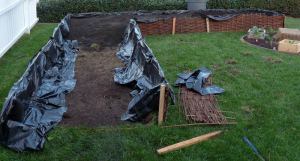
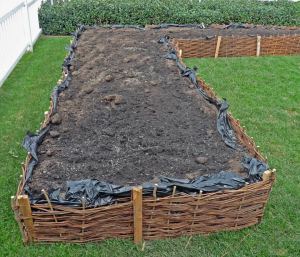
The new willow raised bed is sitting on top of the ground the kids removed the sod from this weekend. It’s fully constructed, filled with soil, topped with compost and ready for them to plant in. The kids did a great job preparing the spot where the bed sits. Then we straightened the willow “hurdles” and tapped them into the ground with a mallet. After the bed was shaped and squared, copper wires are attached around all the corners to further support the “L” shape the kids decided to build in. After that, the inside of the frame was lined with black plastic and the soil was added.

We have also been thinking about adding a vertical growing element and may install trellising along two sides of the bed before we are done. It would give the project a lot more growing space and be a good exercise in growth habits and the flexibility–or inflexibility–of spacing guidelines.
Willow Raised Bed Almost Done

Willow Raised Bed Almost Done

Here’s the nearly finished willow raised bed, ordered as two 4′ x 12′ beds, then arranged in an “L” shape to add an additional 16 square feet of planting space that will be used by our instructor, Mackenzie, for her demonstration gardening space. Total growing area is 112 square feet, or 9.3 square feet per participating child, if anybody is counting. ;-)

We are built out two weeks before our earliest estimate and the weather feels ready to go too. We are also ahead of schedule in some of our growing and planting. The 85-year-old neighbor, who was raised on a farm in Iowa, assures me that it is safe to put out my tomatoes now, so I have gotten severl different varieites and am excited to see the German “Orange Strawberry” tomato plant my mother-in-law is sending over this weekend. I’m going to need a protected spot for that one.

P. Borghese in Flower

P. Borghese in Flower

I think I’m happy to report that we have our first tomato flowering. Though it might have actually been a stress response to being too crowded by the other tomato plants where it was pottted. Anyway, it’s in a good spot now growing with some Bok Choy on one side and Spinach on the other. I’m trying to find space for a dozen of the P. Borghese tomatoes to have lots of them for drying since the whole family *loves* sun-dried tomatoes. Of course, I have no idea how many tomatoes each plant will give, when they will give them, or how many we actually need for drying enough for the rest of the year. This is a year for learning what *not* to do next year!

Here’s the sum total of what I know about my dozen or more tomato plants right from the Victory Seed web site:

75 days, determinate — Italian heirloom variety very popular in Italy and California for splitting in half and sun drying. They maintain color and flavor well. The plants produce heavy yields of small, red plum-shaped fruits. The plants will benefit from support such as caging.

We plan to track how many pounds of tomatoes given by each plant, the height of the plants, the size of the cage needed for the plants, the amount of square feet required to grow the plants and anything else we might need to know to grow them well again next year if we like them.

Square Foot by Square Foot

Leave a comment

Square Foot Tomatoes and Chard

Square Foot Tomatoes and Chard

The Dirt to Dinner garden is starting to really take shape and I’m loving the time I am able to spend out there. One of the fun things we are doing this year is practicing some French Intensive gardening, or “Square Foot” gardening, as it’s often called. I have several beds divided up more or less in this way. Today I put in a two-level 2′ x 2′ bed with my drying tomatoes in the deeper sections and Swiss Chard in the two lower sections that will probably get shaded by the tomato plants, even when I cage them. I hope the Chard doesn’t mind too much. It should have lots of time to establish itself before then–if the crows don’t eat it!

Another bed is divided into three sections with a test bed of beans that I started ahead indoors, beans I started in place a month later, and beets. I lined the edges of this bed with carrots also, so it will be crowded as things mature and I will need to keep it fed. The bush beans won’t mind all being together and the beet tops hopefully won’t shade the carrots too much. We’ll have to see how this one works out.

Square Foot Beans and Beets

Square Foot Beans and Beets

I’m also trying a 3′ x 3′ with two tomato plants, again, and sections of spinach and chard. So that will make a nice comparison bed to the 2′ x 2′. I wish I had grown this type of tomato before. They are a determinate heirloom variety called Principe Borghese but I can’t get any concensus on how tall they like to grow or how bushy they will be. I’ll let you know how they turn out!

Early Lessons from the Pea Trial

Leave a comment

Lessons from the Pea Trial–So Far

Pisello Nano Piccolo Provenzale

Pisello Nano Picolo Provenzale

#1. Early planting does not equal early eating. It’s not just 55-60 days, it’s the *right* 55-60 days. We thought an early start would give us peas sooner, but that hasn’t turned out to be the case. Peas that were supposed to be ready to start picking in 55-60 days are just now 6″ tall a week after the 60 day mark we were hoping for. The peas planted February 18th may or may not be ready for picking by mid-April. We’ll let you know!

#2. Peas planted early seem to get damaged by pests a lot more than peas planted later. Maybe because there’s not much else out there looking green and delicious in January and early February. Or maybe we just got smarter about the covers we used as the trial went on.

#3. Peas appear to sprout and grow better in February than they do in January. Weather will surely influence this. We’ll track it next year and compare. This year January was warm and sunny, if that weather had continued, maybe the peas would have been on the table by now.

Pea Sprouts Protected by Plastic Netting

Pea Sprouts Protected by Plastic Netting

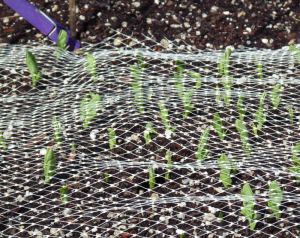
#4. Peas need to be grown under netting or cages in order to foil uninvited dinner guests. Upside down black plastic latticed plant carriers from the garden store worked well for the first few weeks, as did the onion bag netting we recycled. Neither of these methods was deep enough to allow for much growth and I would like to keep the peas protected longer, just in case. We lost a whole planting of snap peas in the back garden because something came along and snipped the tops off each of the vines. (Argh!!) We’ll keep the tall covers on these for the first several inches of growth and you can check out our Pea Trial page if you want know how our test of the burlap covered cages does.

Potting Up

1 Comment

The tomato seeds start out in little pellets, and the irony is not lost on me that I am growing “local” food by starting seeds in a product that has come all the way from Vietnam.

Starting Local Food in Fiber Grow from Vietnam

Starting Local Food in Fiber Grow from Vietnam

Digging up peat bogs to dry them and ship them to gardeners everywhere contributes to global warming, so I thought I was doing a good thing by getting Fiber Grow pellets. But once I got home and turned the package over and read the Made in Vietnam sticker, I wasn’t so sure anymore. It takes a lot of resources to ship not-peat moss around the world too.

Tomato Sprouts

Tomato Sprouts

Anyway, the tomatoes, for better or worse, begin their lives on the top of the refrigerator in their Vietnamese fiber homes. It takes a week or two sometimes at the right temperature for them to germinate. They like to be warm. The first batch I started, only about half of them ever sprouted at all.

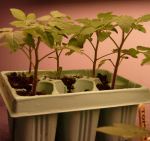
Once they have “true” leaves, the tomatoes and their Vietnamese pots go into the regular 6-packs you might see at the garden store.

First Potting

First Potting

They will stay in the 6-packs for several weeks until they begin to fill out, develop stronger stems, make more leaves and start to be recognizable as tomato plants.

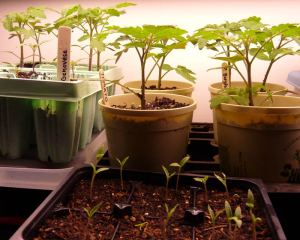
The next time the plants are potted up, they will be set deep into individual containers with potting soil

Tomato Starts in 6-pack

Tomato Starts in 6-pack

and a little mature compost to help them grow strong. This may sound nasty, but you bury them deep enough in the new pots that some of the early leaves will be under the soil, so you carefully tear these leaves off. Where the leaves were on the stems, roots will grow in the soil making the plant sturdier when it finally sees the garden soil.

The tomato seeds that I started in early January are just now moving into their own pots for the first time, so this process has taken about 6 weeks. It takes a long time to grow tomatoes from seed but I am really looking forward to all the pasta sauce and sundried tomatoes, salads, catsup…

Tomatoes in Four Sizes

Tomatoes in Four Sizes

The Great Raised Bed Debate

6 Comments

I was clearly naive about the number of options for raised beds there were to consider. Long gone are the days when my mother tossed a couple of railroad ties against the hillside and called it a garden. And the cost has changed too!

These gorgeous beds from Naturalyards would have cost well over a

Natrualyards Cedar

Naturalyards Cedar

$1000 to hold the Dirt to Dinner growing plots for each of the kids.  Not quite what we had budgeted for! But if money were no object, these would be the beds for me. They are beautiful, easy to assemble, available in lots of size choices and look like they would last a generation.

Link-A-BOrd

Link-A-Bord

I also like the idea of Link-a-Bord bins that would have snapped together.  They are made of all recycled materials.  They are light and easy to construct.  They come with two different depths, both a little shallower than I like for vegetable gardening, but reasonably priced. They still have the nice, neat look that any realtors scanning the neighborhood would approve of.

There were also quite an array of sizes and shapes to choose from. Want a good geometry exercise for the kids?  How many square feet of space do you get with this?

Traingle Raised Beds

Traingle Raised Beds

It’s an equilateral triangle with 7’ sides. Then it has another equilateral triangle on top so you can have that section be twice the planning depth of the large triangle ends, so now you really need to look at the cubic feet,…

When the calculator cooled off, it didn’t make sense to go with the funky shapes, much as I wanted to.

Paver Raised Beds

Paver Raised Beds

Lee Valley had some great kits where you use 16” pavers and their hardware to build beds. These things probably would have survived the next Big One, but somehow concrete and kids and all those nuts and bolts didn’t work for me for this project.  Though I love Lee Valley and the excuse to get some fun tools would have been worth it.

I was hoping to get back to the more natural “wild” look of at least the Natruayards design, if not something onto the other side of that when I came across a post on a gardening chat site that referred to the 600 year-old technology of raised bed design used in English gardens. That’s when I found mastergardenproducts.com.

Historic Willow Raised Beds

Historic Willow Raised Beds

willowraisedbedmodern

Modern Willow Raised Beds

Oh yeah. That’s as granola-y as they come.  It’s perfect. Sadly, it’s nearly impossible to find enough Willow that size to make similar boxes today, but the ones we’ll be using in the Dirt to Dinner garden will look something like the modern ones before we seal them with linseed oil, line them and fill them with our garden planting mix.

I’m a little worried that the sticks will need some kind of covering on the top to keep from sticking us, but I’m sure we’ll figure something out.  And we may even weave some of our own versions to see how they compare.