Mom, Can I Have More Kale?

Leave a comment
Massaged Kale Salad              

Massaged Kale Salad

Today in Dirt to Dinner the kids made an amazing Massaged Kale Salad with a medley of Roasted Root Vegetables. Delicious! And as you can see, beautifully presented. Can you imagine how satisfying it was for a bunch of parents to stand around and see the kids going for seconds of a salad made with raw kale right from the garden! Not to mention they were also eating roasted turnips, parsnips, potatoes, rutabagas, carrots and more. All in all a very satisfying meal to help consume. You can find a recipe for the salad (not exactly the way we made it–but close) on the “I Love Kale” blog at http://iheartkale.blogspot.com/2009/01/massaged-kale-salad-with-grated-root.html

Team Work

Team Work

And they had worked up quite an appetite finding garden bugs, playing an elaborate kind of tag that reinforces ideas about predator – prey relationships and food webs at work in a garden. And designing and digging the space for the Dirt to Dinner planting beds.

One thing we can already tell you after just two sessions of Dirt to Dinner is that when you have twelve plus kids on hand and lunch to prepare for 25, three hours goes mighty fast. Because there is so much to do, we are already guessing that the kids likely to get the most of the program will be the ones who are able to be here on Mondays for Open Garden hours when they can move at their own pace.

Dug Up Discovery

Dug Up Discovery

Just today while the group was together we had a scavenger hunt to see what kinds of insect life we could find in the garden, met the worms who will inhabit our worm farm, picked kale, celery and lemons and played the predator-prey game about cabbage, cabbage worms, moths and birds.

Then one group prepared and roasted the root vegetables and then planted potatoes outside in flexible bins and the other group prepared the Massaged Kale Salad and did a math and spatial awareness puzzle to try to figure out what shapes the pieces for the garden boxes could be arranged in to maximize the square feet for gardening while still allowing kids to reach all the plants that would be in the beds without putting their weight on the soil.
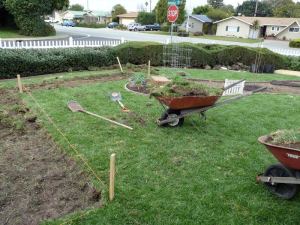
Mid-Dig

Mid-Dig

Want to try it? You can cut up sticks, straws, string, strips of paper, etc. into four 4″ lengths and eight 6″ lengths and let us know what shape configuration gives you the most square inches while still allowing easy access to the space inside the sticks. We know of two shapes that will give you 112 square inches. The largest configuration the Dirt to Dinner kids came up with today was a 112 square inch “L.” So that’s the shape that the kids measured and marked out and eventually framed with our 4′ and 6′ lengths of willow hurdles to make a 112′ garden bed.

Ready for the Dirt
Ready for the Dirt

Rain or Shine

Leave a comment


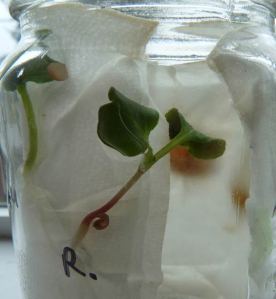
seed-jar-sprouted_02-06-09_I’m getting really excited about our first project meeting this weekend. We all know it won’t really go according to the plan we’ve laid out, but we’ve still spent some time thinking through the first day, the weather, the logistics of getting to know the group and the shared vision we hope to create. 
Here’s what we’ve come up with so far:

Overview
  • Introduce the project and how we’d like to work together
  • Get to know one another
  • Get to know the garden space as it exists now and explore plans for making it work for our project
  • Explore botany basics and the foundation of plant needs
  • Get to know the kitchen and what we will be cooking
  • Make a Thank You note for all the seeds contributed by the National Gardening Association

Detailed Class 1 Plan (Which will be adapted as we go along, I’m sure!)            

10:00 to 1:00 Saturday, February 28th (~One week after last expected
date of frost.)

Theme: Intro to the project, Intro to Botany

Lunch: Vegetable Soup with some of the Favorite Vegetables added

Program Supplies
Plant Parts materials 
Potting soil  
Six-packs for planting 
Seeds (peas, onions, lettuce, beets,spinach, collards, chard, radishes, bush beans, broccoli)
Supplies for water measurers 
Journals, decorations and supplies 
Lunch    

Supplies for Families to Bring

Rain gear
Favorite vegetables, uncooked
Bowls and utensils for the family      

Class<plan:

a)  Welcome circle and Intros (personal and intro to the program)  

b)  Safety, boundaries and behavior goals

c)  Ice breakers

d)  Plant parts activity

e)  Group A Plant Parts scavenger hunt and Seed Starting
Group B Kitchen Intro and Favorite Veggies

f)   Group A Kitchen Intro and Favorite Veggies
Group B Plant Parts scavenger hunt and Seed Starting

g)  Lunch

h)  Rain Measures/Journal decoration

i) Closing circle, intentions, thoughts on the day


Project Specifics

Leave a comment

The garden is a natural lab that can bring together a wide variety of skills and interests from architecture to poetry with lots of learning in between. This Spring Davis and I will be using the garden as the base for most of our homeschooling activities and testing out many of the projects propsed for Dirt to Dinner classes.  

Here are some further details about projects kids may be invited to try during the Dirt to Dinner class sessions.

Botany will be explored in many different practical, hands-on ways, with additional ideas from Botany on Your Plate. We will examine parts of different kinds of plants, the wide variety of seeds, test different sprouting methods, try growing similar plants under different conditions and other related experiments.

Butterfly or Hummingbird Garden to test which plants and growing patterns attrack which kinds of birds or butterflies.

Compost Science (Chemistry, Physics, Biology) using, among other things, a Scientific Inquiry for High School students program developed at Cornell University.

Ecology with examples from California Academy of Sciences Sustainability Made Simple. We’ll also be looking at food in terms of globalization, fair trade, wise use of available resources, and culture with the support of many additional resources. Kids will also be introduced to Bee Gardening based on the work being done on urban bee gardens at UC Berkeley or the Great Sunflower Project.

Math concepts including number operations, algebra, geometry, measurement, data analysis and probablity will all be part of our garden explorations with further inspiration from Math in the Garden.

Nutrition and Cooking will be covered with careful additions from resources such as the Simply in Season cookbook and What the World Eats. We will also plan service projects around feeding ourselves and others with the help of the staff of the Ceres Project.

New project ideas and individual projects that need a garden home are also welcome.  Join us!

Tossing Ideas in the Air to See What Lands

Leave a comment

What is going to work to share the garden space?  What are the goals of this project?

  • Raise healthy food that will be used for cooking, preserving, sharing and eating.
  • Learn and understand what the natural processes around growing food are.
  • Help urban bees by creating a small haven and possible nesting site.
  • Make use of the land resources around the house that are now essentially empty.
  • Bring people together around the space and the projects.
  • Provide welcoming outdoor space for independent projects kids want to do.

What are the current resources available?

  • Aprox. 100 square feet of raised beds under cultivation.
  • Lots of garden books and materials around the house.
  • A desire to grow more food and eat more seasonally and locally.
  • Smart bunch of homeschoolers with some energy.
  • Smart Nature instructor with great energy and experience with Life Lab, etc.
  • Life Lab
  • San Diego Master Gardeners
  • California School Garden Network