I read the other day that wind exposure can activate plant genes for sturdiness. If that happens in peas, tomatoes and potatoes we are about to have the stockiest plantings of vegetables between here and the Pacific. Yesterday’s wind storm was crazy, and today is calmer, but we’re still have gusts of over 30 mph!

First Fruits
I was just starting to wonder if the Principe Borghese tomatoes were setting fruit while the plants were still way too small and thinking that maybe I should pinch off the first few fruits to let the plant get bigger before energy was going into fruit production. Who ever heard of tomatoes in April? The plants aren’t even two feet tall!
But I’ve never tried this variety. It’s my first time trying tomatoes for drying and my mother-in-law and some long-time gardening neighbors thought it best to leave the fruits on the plants. Hopefully they will still be there when the wind settles down again.
Most of the neighbors are keeping an eye on the Dirt to Dinner garden and like to stop by to see what all we’ve got growing. I’ve learned a lot from them about what grows well in the neighborhood, when they plant things and how various varieties have wintered over in their yards. I’m enjoying chatting over the fence with folks as they ask what’s growing where and share what works in their gardens.

Nursery Cloth Growing Bag for Potatoes
Everyone asks about the potato bags. I can’t wait until they are rolled all the way up and full of soil. They will be about 18″ tall and hold a total of 15 gallons of soil and potato plants. They’re not as tall as the new potato bed we’re going to start putting in tomorrow, but they are fun and should be a lot easier to harvest than the wooden planter will be.
Right now we are trying three varieties of potato in the Dirt to Dinner garden. The kids all got La Ratte fingerling seed potatoes when we visited Full Circle Farm a few weeks ago. The ones we planted here haven’t sprouted yet, but the four I am saving to give our teacher, Mackenzie, have started to form eyes, so I’m still hopeful. The other two are an early yellow much like Yukon Gold and a mid-season variety with a redish purple exterior that we also picked up at Common Ground.
In addition to those three test varieites, we just got word that the 2 1/2 pounds of All Blue seed potatoes we ordered have been shipped from the Seed Savers Exchange. Here’s a link to what they might look like at You Grow Girl.

The New Bed Takes Shape
These guys will get a large (for us anyway!) 4′ x 8′ foot bed that we plan to raise at least two feet tall as we hill the potatoes. We’re starting with a redwood frame, held together by nailing the framing boards to 4″x4″ post pieces cut into 2′ sections. It’s going to take a fair amount of sawing, since most of our wood is lumber yard castoffs or otherwise donated scraps, but there’s something very satisfying for the kids that seems to come out of building something out of “nothing.”
 One of the experiments we are conducting in the Dirt to Dinner garden is a test of our ability to bring more light into a shady section up against one of the fences. It’s after 10:00 am and the sunlight still hasn’t gotten to this patch. It’ll be a little better in June and July, but less than ideal light is a fact of life for that patch of ground.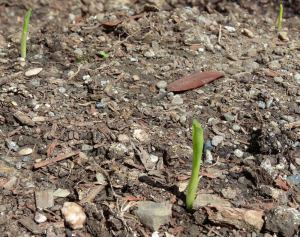
 The piles of seeds for Dirt to Dinner have predictably gotten messy and disorganized. But last night I read a great idea for organizing seeds. When you plant some seeds from a packet, you take the remaining seeds and you store them filed away based on the month when you need to plant them next. If I am planting lettuce each month, I plant my May patch and slip the remaining seeds into the June section so that when June all-too-quickly rolls around, I know what I am trying to find room to plant next.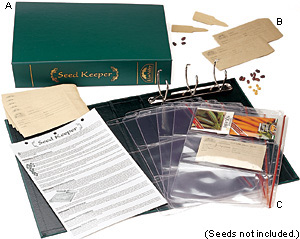


 Here’s the wonderful diagram from Renee’s that demonstrates the process so much better than I could write it out.
 To celebrate the corn planting the kids also made corn pouches which will sprout a sample of the Indian Dent Corn and a sample of the monoculture corn plated across those fields in Ohio and allow us to talk about genetic variation and why it’s important to have plant diversity.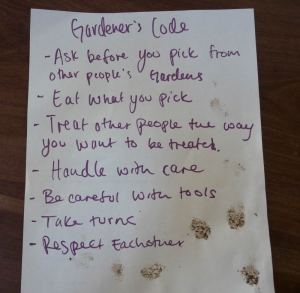
 From Dirt to Dinner