New Level of Vermiculture

Leave a comment
Worm Relocation

Worm Relocation

Worms have to eat too. As we discovered in Open Garden Thursday at Dirt to Dinner, it’s not hard to make a new lunch level for the worms to call home. First we removed the amazing compost the worms had finished with in the bottom layer of their home. (We saved that for our next project in the garden.) And we carefully placed all the worms that we could into the working bins of the worm house. It’s OK if some of the worms end up in the garden–they’ll survive–but we want to keep as many worms working in the bin as we can.
Worm Lunch

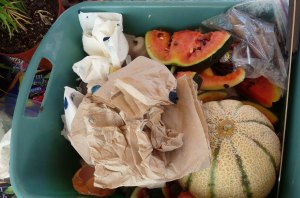
Worm Lunch

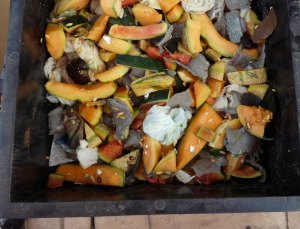
Then we took a collection of kitchen scraps that included several melons we had tried earlier in the day and other bits we knew the worms would enjoy.
Worms Can Work with Small Bits of Food Faster

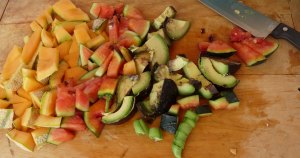
Worms Can Work with Small Bits of Food Faster

And we chopped the large pieces into more manageable bits to make them easier for the worms to use.

Mix Well with Damp Browns

Mix Well with Damp Browns

Next we added some “browns” to the compost we had chopped. Worms need a good mix of food scraps and other “greens” and paper towels, napkins, egg cartons and other “browns” just like you would mix in a regular compost heap. Moisten the browns so they don’t drawn moisture out of the foods and cause the layer to be too dry for the worms to move around comfortably.
From Bottom to Top

From Bottom to Top

Next we lay the newly empty layer on the top of the vermiculture stack and empty the compost bucket into it. The worms will work their way up through the stack. As they finish the compost in the bottom layer they will move up into the next bin searching for new food and bedding and leaving behind beautiful fertile “castings.”

Mix Well with Damp Browns to Fill

Mix Well with Damp Browns to Fill

The worms need to have a mix in the layer of about three parts dampened brown material to one part food scraps or green material. We filled in the layer with torn strips of newspaper to give the worms plenty of new material to work with.

Something to Read While They Work

Something to Read While They Work

The whole layer needs to stay moist, so we finished it off with several sections of newspaper on top that we then sprayed with the hose to keep damp.


Voila! Our worms are ready to move into their new home and start making more fertilizer for the garden.

Thanks, worms! Enjoy your lunch!

Inside A Seed

Leave a comment
Broad Bean Seed and Almond Nut

Broad Bean Seed and Almond Nut

Today in Open Garden time we dissected Broad Bean seeds and almonds to examine the structures you can find inside a seed. Here’s a quick rundown of the process for those of you who weren’t able to be with us today.

We used:

  • Several pods of Broad Beans
  • Almonds
  • Magnifers
  • Food dye
  • Towels for blotting dye
  • Tweezers

We first slit open the pods to examine the structures that hold and protect the seeds. You can see a picture of an almond “fruit” that would hold the almond “seed” you are familiar with here.

Inside a Broad Bean

Inside a Broad Bean

We examined the outer casing of the seed and the nut, called the “seed coat,” noting the differences, then carefully slit the seed coat on the long side of the seed or nut. That allowed us to carefully pry apart both the bean and the almond.

Here’s what we found inside the Broad Bean. One side came away clean and the other side has the plant embryo attached to it.

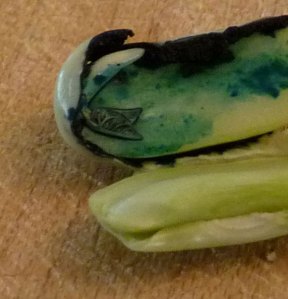
Embryonic Leaves Inside the Broad Bean Seed

Embryonic Leaves Inside the Broad Bean Seed

It wasn’t as easy to see things as we had hoped so we added a little bit of food dye to bring out the contrast. (Thanks for the tip, Mary!)

Look carefully. Can you see the tiny “seed leaves” folded up at the tip of the seed?

Embryonic Almond Bits

Embryonic Almond Bits

Here’s what the almond looked like.

Most of what you see is the cotyledon, the food stored inside the seed for the emerging plant to live on. That’s what makes seeds such nutritious food.

Which ones will you compare?

Which ones will you compare?

You can experiment at home with different kinds of seeds and see which ones give you the best view of their internal workings. If you’d like to share your results here on the blog, you can do that too.

Opening the Fall Program

Leave a comment
Squirrel o' Lantern

Squirrel o' Lantern

Today was the Open House for the new Fall 09 Dirt to Dinner program. We focused on three things. Getting to know one another and the garden. A chance to get more familiar with the different responsibilities we’ll each be taking on in the garden this session. And an exploration of some of the seeds that are available in the garden and that we will use this Fall to plant both here and at home.

During today’s Seed Hunt, kids spotted seeds in the garden including onion, celery, edamame, green bean, pumpkin, corn, grass, dandelion, lettuce, potato, lemon, cucumber, watermelon, tuscan melon, tomato, tomatillo, pepper, squash, pea, sunflower and “bird seed.” How many of them could you identify? We’ll be saving seed from many of these varieties to use again next year. I’ve already planted some of the celery seed we saved and hope to see it sprouting this week.

Many of the kids planted seeds to take home with them, made seed jars to watch sprout and tried several varieties of cucumber and melons–while noticing that their seeds all look very much the same. Sometimes it’s easier to tell which plants belong to the same family by looking at their seeds than it is by looking at the finished fruits.

Chard Seeds?

Chard Seeds?

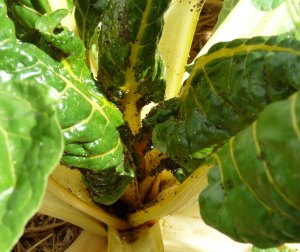
One enterprising student matched up a number of the seeds by plant family and noticed that it’s almost impossible to tell the difference between seeds for chard and seeds for beets. In fact, Harold McGee in On Food and Cooking says “Chard is the name given to varieties of the beet, Beta vulgaris, that have been selected for thick, meaty leaf stalks (subspecies cicla) rather than their roots.”

One of my highlights of the day was hunting through the finished compost pile with one new young gardener intent on checking out the various bugs we found there. I was also impressed with the spontaneous way the kids joined in the potato harvest. We’ll be saving many of the potatoes they planted today through the winter to be used as seed potatoes in the early spring.

Fall Starts

2 Comments

I started some new seedlings for the Dirt to Dinner participants to plant in their home gardens, if they are doing them this Fall. I started a mix of three different varieties of Broccoli and had a heck of a time getting any Early Dell Celery or Snowball Cauliflower to come up. But we went through a heat wave right after I planted, so that may have been the problem. It’s worth trying agin.

Tonight I started:

KaleA Japanese spinach called “Oriental Giant,”
“Bloomsdale” spinach,
Orange Fantasia” chard, which came up beautifully in the Spring and was promptly devoured down to it’s last root by squirrels,
A specialty salad green called “Gala” mache (never tried this one, let me know if it does well for you),
Something the kids would call ‘Dinosaur’ kale that says “Covolo Laciniato Nero Di Toscana Precoce” which I think means “Curly black kale from Tuscany,” but that’s just a guess,
Some more standard looking kale called “True Siberian,”
More Snowball cauliflower,
And the rest of the seed I had for the “Early Dell” celery.

It was luxurious having fresh celery available all Winter long last year and I actually saved seed from the plants we grew. I tried starting some of that along with the Early Dell. I have no idea if it will do well. I found the plant label from last year and it just says “Celery” so no idea if it is a hybrid that might not breed true. Put that one under the category of Experiment! :-)

In the garden we have:

some carrots tucked here and there trying to hide from the creatures that come in the night and dig them up,
some peas just starting,
turnips that could really stand to be thinned,
drying beans for soups this Winter,
sunflowers waiting for us to dry and husk the heads,
onions that still need to be pulled,
blue potatoes that are about ready to come out,
melons, pumpkins and gourds that have been growing all summer
and still more tomatoes!

The Disappearing Tomatoes

Leave a comment

07 03 09_0069We love fresh tomatoes. Sliced onto a plate with a little salt over them; with mozzarella, a little basil and some balsamic vinegar (Yum!); with crushed crackers and some more balsamic vinegar—also delicious; sliced onto a grilled cheese sandwich before the grilling part—another treat.

But there are limits. And when we cannot face another heaping bowl of lovely, fresh tomatoes calling out to be eaten, we dig out the stock pot and make some catsup.

You can make 24 pounds of fresh tomatoes fit into three or maybe four pint jars this way! It may be an even better tomato disappearing trick than drying. (We’ll have to do an experiment to see how they really compare…hmmm…good thing the kids are back starting in September.)

After several batches and many opinions, here is the recipe we have settled on for delicious, homemade catsup. Or ketchup. Or however you spell it where you’re from.

Let us know how you like it!

Tomato Ketchup
(about 3 or 4 pint jars)

24 pounds ripe tomatoes
3 cups chopped onions
1 or 2 red peppers, on the hot side 
4 teaspoons whole cloves
2 sticks cinnamon, broken in pieces
1½ teaspoons whole allspice
3 tablespoons celery seeds
3 cups cider vinegar
1½ cups sugar
¼ cup pickling or kosher salt

Wash tomatoes. Quarter tomatoes into 4-gallon pot. Add onions and red peppers. Bring to boil and simmer 20 minutes, uncovered.

Combine spices in a spice bag. Place spices and vinegar in a 2-quart saucepan. Bring to boil. Cover, turn off heat and let stand for 20 minutes. Remove spice bag from the vinegar and add the vinegar to the tomato mixture. Boil about 30 minutes. Press boiled mixture through a food mill or sieve. Return to pot. Add sugar and salt and boil gently, stirring frequently until volume is reduced by one-half or until mixture rounds up on spoon without separation. Pour into hot pint jars, leaving 1/8-inch headspace. Wipe jar rims. Adjust lids. Process half-pints in a boiling water bath for 15 minutes.