The Gardener’s Code

Leave a comment
The Gardener's Code 


The Gardener's Code

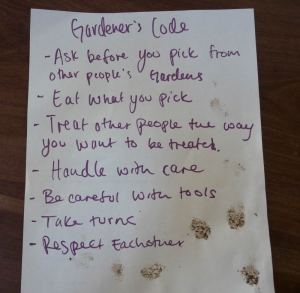
This week at Dirt to Dinner, the kids spent some time discussing the way they’d like things to go in the garden. The first thing that came up was about respecting things that other people have grown in the garden, which I thought showed that the kids really are developing the sense of ownership that we had hoped they would have for the garden and the plants that they tend here. With meetings happening only every other week, we didn’t know how that feeling would develop but are glad to see that it has. The second point was originally discussed more in terms of “You kill it, you eat it,” which took responsibility for the space here, and by extension the world around us, to an uncomfortably visceral point there for a moment, before it spoftened into, “Eat what you pick.”

I think it was really fun for the kids “signing” the code with thumb prints of mud. But I did notice that we’ll need to review the picking code the next time the kids are here. Several young broccoli plants mysteriously lost all their broccles before they were ready while the crew was working on the nearby planting bed. ;-) At least we can hope they got eaten!

The Planter is Planted!

Leave a comment
Dirt to Dinner Individual Raised Bed Planting Areas    Dirt to Dinner Individual Raised Bed
Planting Areas

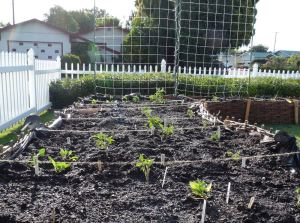
Hooray! The Dirt to Dinner willow raised bed planter is now home to 14 individual 2×4 planting sections, one for each of the families in the Spring program. And today, April 11th, was finally the day the beds were first planted. The 112′ “L” shaped bed created with willow hurdles from Master Garden Products in Oregon holds about 18″ of soil on disturbed adobe that has been lawn for the last ten+ years, with the sod removed. (We’re still trying to fit it all into the composter in layers–it could be a while!)

The planter now holds different combinations of tomatoes, tomatillos, peppers, chard, beets, carrots, a wide selection of radishes, including one patch with four varieties growing side by side for comparison, lettuce, watermelon, cantaloupe and cosmos, among others!

You'll Be Missed

You'll Be Missed

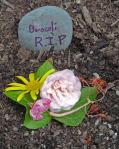
During the planting of starts and seeds, a square foot of Broccoli Raab starts were transported into the front garden, in hopes of being chosen as residents of the new planting bed. Sadly, one of the broccoli starts did not survive the move. The kids chose to honor the broccoli’s return to the soil with this memorial. ;-)

Not only did we get the planting beds planted today, but we also had lunch on time! (A process it has taken us a while to perfect.) In the kitchen, the kids prepared Strawberry Lemonade, Mashed Sweet Potatoes and Quinoa Confetti  Salad with beets, carrots, cabbage, red onion, radishes, celery, fennel and fresh herbs. The sweet potatoes were said to, “smell like a pie!”

Grate Help

Grate Help

The quinoa salad was not as popular with the kids as the kale salad we tried during Class 2 but it was tasty, fresh and welcomed by most of the adults. It made me wonder if there is some more fundamental reason kids tend not to like certain foods. I’ve been reading the new edition of Harold McGee’s classic On Food and Cooking: The Science and Lore of the Kitchen and in the vegetable section he talks about the chemistry of many of the vegetables we are encouraging the Dirt to Dinner kids to eat, a chemistry which is often a defense mechanism for plants designed to keep things from eating them! What if immature digestive systems are more sensitive to these chemical defenses and there’s a biological reason children turn up their noses at the foods grownups spend a lot of time trying to convince them are good for them? Certainly, feeding them fresh versions right out of the garden gets around any obvious taste or processing-into-tastelessness issues. Just a wild idea. Let me know if you have thoughts better founded in biochemistry than my musings!

Project Specifics

Leave a comment

The garden is a natural lab that can bring together a wide variety of skills and interests from architecture to poetry with lots of learning in between. This Spring Davis and I will be using the garden as the base for most of our homeschooling activities and testing out many of the projects propsed for Dirt to Dinner classes.  

Here are some further details about projects kids may be invited to try during the Dirt to Dinner class sessions.

Botany will be explored in many different practical, hands-on ways, with additional ideas from Botany on Your Plate. We will examine parts of different kinds of plants, the wide variety of seeds, test different sprouting methods, try growing similar plants under different conditions and other related experiments.

Butterfly or Hummingbird Garden to test which plants and growing patterns attrack which kinds of birds or butterflies.

Compost Science (Chemistry, Physics, Biology) using, among other things, a Scientific Inquiry for High School students program developed at Cornell University.

Ecology with examples from California Academy of Sciences Sustainability Made Simple. We’ll also be looking at food in terms of globalization, fair trade, wise use of available resources, and culture with the support of many additional resources. Kids will also be introduced to Bee Gardening based on the work being done on urban bee gardens at UC Berkeley or the Great Sunflower Project.

Math concepts including number operations, algebra, geometry, measurement, data analysis and probablity will all be part of our garden explorations with further inspiration from Math in the Garden.

Nutrition and Cooking will be covered with careful additions from resources such as the Simply in Season cookbook and What the World Eats. We will also plan service projects around feeding ourselves and others with the help of the staff of the Ceres Project.

New project ideas and individual projects that need a garden home are also welcome.  Join us!

Eating Our Way to Saving the Planet

Leave a comment

http://www.npr.org/templates/story/story.php?storyId=99268166&sc=nl&cc=bn-20090125

NPR’s Morning Edition has an interesting review of New York Times columnist Mark Bittman’s new book Food Matters.  His basic conclusions sound very reminiscent of Diet for a Small Planet–first published in 1972–minus the Birkenstocks.

Class Concept Final Draft

Leave a comment

From Dirt to Dinner:

An Exploration of Food, Science and the Natural Rhythms of the Kitchen Garden

Join us for a garden-centered hands-on program learning about food, seasons, life cycles, cooking and nutrition.

Dirt to Dinner will encourage participants to explore full food systems (“seed-to-table”) through both individual and group learning such as compost chemistry and physics, bee gardening, nature journaling, botany trails, cooking service projects, entomology research, food preservation or projects of the participant’s own design.

The goals of the program are to allow participants to:

  • Increase understanding of ecological principles
  • Integrate math, science, language arts and cultural studies through hands-on experiences of their choice
  • Develop an appreciation for where food comes from and how it is grown
  • Experience growing, preparing, eating and sharing healthy, sustainably-raised food
  • Learn about people and communities through the lens of food, its history and world-wide distribution
  • Promote healthy, sustainable living

Learn to make smart choices about food and resources

Group Size  ~8 to 15 kids. Parent participation is welcome.  Registration is due on or before February 14th.

Meeting in Santa Clara near 280 and Lawrence Expressway.

10 meetings, February thru July, to allow us to participate in the Spring growing season.  (A Fall session is also being considered to follow.)

Tuition is $150 per child.  Sibling discount and work exchanges are also offered.

Tentative Schedule

Meetings on Saturday’s 10:00 to 1:00, including lunch

February 28th  March 14th  March 28th  April 11th  April 25th

May 9th  May 23rd  June 13th  June 20th  July 11th

Instructor Bio

Mackenzie Price was born and raised in Southern California.  She always sought out the wild places in her suburban home: building forts in the canyon, playing in the waves or feeding the chickens in her backyard. In high school the weekends would find her rock

Mackenzie Price

Mackenzie Price

climbing or catching some waves.  With a creative approach to education Mackenzie has been a student of the classics at St. Johns College, a student of nature with Sierra Institute (a 2 month long backpacking trip), an intern on an organic farm, a co-creator of a four month backpacking trip and a graduate of RDNA (studying nature awareness and permaculture).  Mackenzie is a part of the Riekes Nature Awareness staff where she works with preteens, teens and expeditions.  She has also worked as a garden instructor for Life Lab at the UCSC farm and garden.  In her free time she loves to cook, play music and get her hands dirty in the garden.  Mackenzie is first aid/CPR and Wilderness First Responder certified. 

Questions?  Email Juli idleman@gmail.com.