Finishing Our First Program Season

Leave a comment
As Dirt to Dinner Begins

As Dirt to Dinner Begins

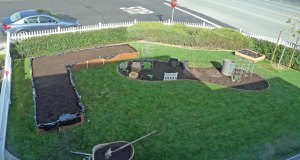
I’m cleaning things up around the garden for our final Dirt to Dinner lunch of the Spring session. A lot has changed around here since we started. Here’s what it looked like when all we had growing was the Spring Pea Trial vs. where the kids growing box and the rest of the front garden area are today.

Lots of Growing Changes!

Lots of Growing Changes!

We’ve added additional beds, trellis, arbors and teepee support structures, and, of course, lots of plants. We’ve let the lawn dry up and the mulch and straw take over to the point where I’m starting to wonder if I have 50 feet of defensible space around the house in case the suburb is consumed by wildfire. ;-)

Gourd_corsican_lgTomorrow we are going to put in several different varieties of gourds on an arbor we’ve constructed over the bench. It’s a tad late for gourds since they like such a long season, but we could still get lucky, and we could always try covering them with season extenders. Could be a good challenge for the new crew starting in September. One of the neighbors gets tomatoes until November, so I’m hopeful.

Eternal optimism is very helpful when it comes to experimenting with agriculture.

We’re also going to experiment with various ways of ripening green tomatoes, clean up around the garden a bit to see what we have to add to the compost bins, and we’ll probably tuck in some surprises for the folks who are coming back in the Fall.

Lunch is a Summer picnic theme so we are making tomato basil salad, potato salad, green beans, chopped green salad with veggies and some folks are also bringing a bit of potluck to spice things up. Should be a wonderful time to celebrate what we have accomplished and review the kids suggestions for what to do differently next year.
Food Independence

1 Comment
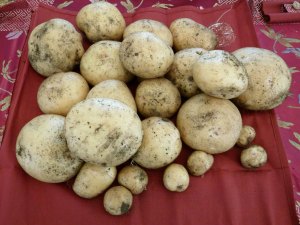
Return from 4 sq ft devoted to potatoes

Return from 4 sq ft devoted to potatoes

The Dirt to Dinner project is about creating a little bit of food independence in each of the kids who works with us. Making them aware of what it takes to grow the food they eat, showing them how they can do it, and helping them raise healthy food that goes directly from the ground onto their lunch plates. And, luckily for us, the whole process has been delicious.

Mashed Bounty

Mashed Bounty

Today we pulled some Yukon Gold-style potatoes out of the modest 4 sq ft patch where they had been growing and quickly boiled and mashed them. They hardly needed butter and were immediatly pronounced a success. The flesh of the potatoes is yellower than what I want for tomorrow’s red-white-and-blue potato salad, but it may have to do. Though I guess I could skin the red-skinned potatoes for the white, keep the skins on for the red, and, well, I still have my fingers crossed on the blues, but we haven’t raided any of them yet. Not one peek under all that dirt, compost and mulch. Though I have high hopes, we did plant thirty potato plants! There better be enough blue potatoes for one dish of potato salad tomorrow!

Tomato Season Finally Begins

Tomato Season Finally Begins

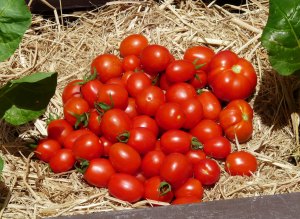
One thing I know we will have is tomatoes. They have started ripening in the warm weather and, so far, we have been eating the Principe Borghese drying tomatoes fresh. They are tough to resist. Especially with some of the blue flowering basil growing in the front bed and balsamic vinegar. These guys ended up in a salad bowl so fast they were still warm from the sun as we ate them. But just as soon as there are other tomatoes ripe, I really do plan to get out the drying recipes. I swear!

My bet is that the Costaluto Genovese will be the next to be ready. We’ve had one or two of them already. Some people call them ugly tomaotes because of the deep ridges they develop but they taste great.

Watching the Squash

2 Comments

Squash-ClockThere are no zucchini plants in the Dirt to Dinner garden, for reasons that will be obvious to you by August, if they aren’t already. ;-) Instead I’ve been trying to learn more about the squash varieties we do have going. For instance, did you know that the ‘pumpkin’ you buy canned to make into pumpkin pie is actually a squash that is most closely related to Butternut? I’m loving all the details available at Watch Your Garden Grow, from the University of Illinois Extension. It even includes recipes!

Spaghetti Trellis

Spaghetti Trellis

So far, the most vigorous grower we have out in the garden is the Spaghetti Squash which we are hoping to convince to grow up the trellis we have so generously provided just for this purpose. Unfortunately, the plants have designs on the wide open spaces in front of them and keep growing away from the trellis which backs up against theshade of the bushes that edge the garden. We could actually consider relocating the trellis, but there are still carrots and big white Icicle Radishes growing where it would need to go. Note for next year: Squash trellises need to be on the sunny side of the squash plants.

Net Lonving Squash?

Net Loving Squash?

At least the mystery squash seems happy to give it a try. Though, in my heart of hearts, I’m worried that this might actually be a cantaloupe plant of some kind. I’m not actually sure how to tell the difference. If it has big triangular leaves with spiny stems and sends out those little twisty tendrils that cling onto other plants and –hopefully–trellis netting, it could be anything from a Delicata to a cucumber as far as I can tell right now. I better go back to my website on growing squash to see how much more I can pick up.

Delicata Shade Crop

Delicata Shade Crop

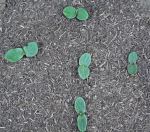
These guys I am pretty sure really are Delicata. They are a Compact Winter Squash from Renee’s Garden that gets great reviews for growing well and tasting a lot like sweet potatoes, which most of the kids are happy to eat. I took this picture just before I thinned them down to the recommended “2 strongest plants per hill.” I could have carefully pricked out the extra plants and moved them to a sunny spot so we could see exactly how much difference the sunlight would make, but it’s starting to feel like there’s an awful lot of squash growing around here. There are eight of the compact Winter squash plants left after thinning, half Delicata and half Early Butternut. There are at least twenty plants representing the dozen different varieties mixed into the Zucche in Miscuglio we got from Grow Italian with names like Tonda Padana, Serpente Di Sicilia and Berrettina Piacentina

Pre-Colimbus Natives

Pre-Columbus Natives

And, not to worry, it’s not *all* Winter squash. There are two Summer squash plants that I know of in the garden. They are Golden Scallopini Bush squash from Seeds of Change. It’s a rare native American cultivare that predates Columbus. And it makes small 3-6″ squash with a flying saucer shape that I hope will appeal to the kids.

Test Potatoes Are Up

2 Comments


Test Potato

Test Potato

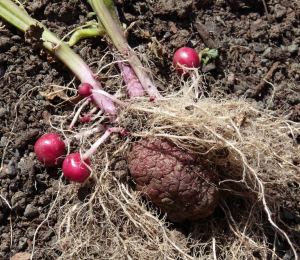
Growing potatoes is kind of mysterious, so we grew one test potato on it’s own so that we could pull it part-way through the season and all the kids (and the rest of us!) could see what was going on under there. We planted all the potatoes right around Saint Patrick’s Day, except for the Blues because their seed potatoes didn’t arrive from Seed Savers until later. 

Forming New Potatoes

Forming New Potatoes

It’s easy to see that the potatoes–and the roots–all form *above* the seed potato that you plant in the ground. You almost have to think about these guys upside down. It’s the soil that you put in on top of them that they care most about, not so much the soil that they are sitting on when they get planted. I was amazed to see how many potatoes were forming on this one plant that hadn’t even been hilled. 

Basket of Rattes

Basket of Rattes

Now I am curious to see how many potatoes we will be able to raise in the small spaces we have used. The La Ratte seed potatoes from Full Circle Farm are growing in an old trash basket that might hold five gallons, if we’re lucky. There are four plants in there and they have been hilled nearly to the top.

Big-BagI think I remember that the potato sacks we used each hold fifteen gallons, and they are nearly full of soil at this point as well. Each sack is planted with four or five potatoes, the same amount we used in the much smaller basket of La Rattes. So maybe we’ll find out the consequences of crowding when we compare the harvests, but it will be hard to interpret, since we used different varieties.

The real test of how many potatoes we can produce in garden this size will be the All Blue’s.

On Blue Hill

On Blue Hill

When I asked at the nursery the other day what they would recommend we use to supplement our own compost when we hill our 4′ x 8′ potato patch they started doing the math for how many cubic feet we would need and some eyebrows went up. “How many potatoes are you growing?!” was asked more than once.

But that’s OK. It’s only 32 plants. Kids love potatoes, right? And these potatoes will be nearly purple. That’s got some fun appeal, doesn’t it? Not to mention all the antioxidants from the phytochemicals that cause the color in the first place. 

I better go find out what you need to do to store potatoes for the winter…

Beans, Squash, Stakes and Sunflowers

Leave a comment

Great Sunflower Project

Great Sunflower Project

Yesterday was a busy day in the Dirt to Dinner garden.  A number of our pollinator flowers got moved into their permanent homes in the front garden area.  The vegetables will now be able to benefit from the attracting powers of Cosmos, nasturtiums, bee balm, blue basil and sunflowers.

And the Lemon Queen Sunflower seeds which recently arrived from The Great Sunflower Project are now planted. Yesterday the Scarlet Runner Beans and Sugar Pie Pumpkins that are part of our two test Three Sisters gardens were tucked into their mounds and are hopefully germinating right now in the heat. If heat is what they want, we certainly picked the perfect day to plant them. It was nearly 100 degrees yesterday and it’s at least 95 today.

Tomatoes at the Stake

Tomatoes at the Stake


The peas and the broccoli are unhappy, but the rest of the garden seems to be loving the heat. We’re layering in the mulch wherever we can, to help conserve moisture even though the local watering restrictions excempt food gardens–so far. We also added drip irrigation to the kids’ big growing bed this week, to help make even better use of the water the garden receives. And we are thinning and adding supports in the garden to make more space and also to allow the taller plants to help cool the plants below them who appreciate it on hot, sunny days. These tomatoes offer some much needed shade to lettuces, beets and carrots planted around them.