March Garden Tour

1 Comment

Today I created a new Voicethread tour of the current state of the Dirt to Dinner garden: http://dirttodinner.ed.voicethread.com/share/407685/

You can compare it with where we originally started here: http://dirttodinner.ed.voicethread.com/share/323777/

I love Voicethread and can’t wait to get the kids started making their own. I set up the whole class with accounts today and am looking forward to seeing what they will share. It will be a wonderful way to bring their home gardening projects into the Dirt to Dinner classroom.

Voicethread ideas:

  • Sharing information on the microclimate where students live
  • Comparing how various growing projects do in the garden vs. at individual students homes
  • Creating a chronicle of a growing project, the process of composting, development of a plant from a seed, etc.
  • How to do something from the project such as pot-up a tomato plant or make your own carrot tape
  • Show how you prepared a recipe from the project for your family 
  • Create your own!

Ahead of Schedule

Leave a comment
Lyngo Soil Delivery    Lyngo Soil Delivery

I can’t believe it, but all the soil is in the beds for the Dirt to Dinner project. When the semi originally dumped one cubic foot of Diestel compost and six cubic feet of Essential Soil mix onto the driveway, my husband had to have been thinking to himself, “Two weeks–minimum.” But it’s all in place and looks delicious. It’s like someone covered all the bare and ugly spots and all the new planting beds with dark chocolate frosting.
Lining Willow Raised Bed "Hurdles"

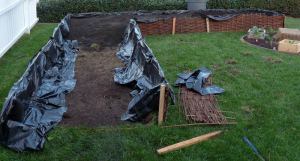
Lining Willow Raised Bed "Hurdles"

The new willow raised bed is sitting on top of the ground the kids removed the sod from this weekend. It’s fully constructed, filled with soil, topped with compost and ready for them to plant in. The kids did a great job preparing the spot where the bed sits. Then we straightened the willow “hurdles” and tapped them into the ground with a mallet. After the bed was shaped and squared, copper wires are attached around all the corners to further support the “L” shape the kids decided to build in. After that, the inside of the frame was lined with black plastic and the soil was added.

We have also been thinking about adding a vertical growing element and may install trellising along two sides of the bed before we are done. It would give the project a lot more growing space and be a good exercise in growth habits and the flexibility–or inflexibility–of spacing guidelines.
Willow Raised Bed Almost Done

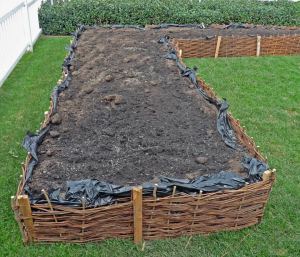
Willow Raised Bed Almost Done

Here’s the nearly finished willow raised bed, ordered as two 4′ x 12′ beds, then arranged in an “L” shape to add an additional 16 square feet of planting space that will be used by our instructor, Mackenzie, for her demonstration gardening space. Total growing area is 112 square feet, or 9.3 square feet per participating child, if anybody is counting. ;-)

We are built out two weeks before our earliest estimate and the weather feels ready to go too. We are also ahead of schedule in some of our growing and planting. The 85-year-old neighbor, who was raised on a farm in Iowa, assures me that it is safe to put out my tomatoes now, so I have gotten severl different varieites and am excited to see the German “Orange Strawberry” tomato plant my mother-in-law is sending over this weekend. I’m going to need a protected spot for that one.

P. Borghese in Flower

P. Borghese in Flower

I think I’m happy to report that we have our first tomato flowering. Though it might have actually been a stress response to being too crowded by the other tomato plants where it was pottted. Anyway, it’s in a good spot now growing with some Bok Choy on one side and Spinach on the other. I’m trying to find space for a dozen of the P. Borghese tomatoes to have lots of them for drying since the whole family *loves* sun-dried tomatoes. Of course, I have no idea how many tomatoes each plant will give, when they will give them, or how many we actually need for drying enough for the rest of the year. This is a year for learning what *not* to do next year!

Here’s the sum total of what I know about my dozen or more tomato plants right from the Victory Seed web site:

75 days, determinate — Italian heirloom variety very popular in Italy and California for splitting in half and sun drying. They maintain color and flavor well. The plants produce heavy yields of small, red plum-shaped fruits. The plants will benefit from support such as caging.

We plan to track how many pounds of tomatoes given by each plant, the height of the plants, the size of the cage needed for the plants, the amount of square feet required to grow the plants and anything else we might need to know to grow them well again next year if we like them.

Square Foot by Square Foot

Leave a comment

Square Foot Tomatoes and Chard

Square Foot Tomatoes and Chard

The Dirt to Dinner garden is starting to really take shape and I’m loving the time I am able to spend out there. One of the fun things we are doing this year is practicing some French Intensive gardening, or “Square Foot” gardening, as it’s often called. I have several beds divided up more or less in this way. Today I put in a two-level 2′ x 2′ bed with my drying tomatoes in the deeper sections and Swiss Chard in the two lower sections that will probably get shaded by the tomato plants, even when I cage them. I hope the Chard doesn’t mind too much. It should have lots of time to establish itself before then–if the crows don’t eat it!

Another bed is divided into three sections with a test bed of beans that I started ahead indoors, beans I started in place a month later, and beets. I lined the edges of this bed with carrots also, so it will be crowded as things mature and I will need to keep it fed. The bush beans won’t mind all being together and the beet tops hopefully won’t shade the carrots too much. We’ll have to see how this one works out.

Square Foot Beans and Beets

Square Foot Beans and Beets

I’m also trying a 3′ x 3′ with two tomato plants, again, and sections of spinach and chard. So that will make a nice comparison bed to the 2′ x 2′. I wish I had grown this type of tomato before. They are a determinate heirloom variety called Principe Borghese but I can’t get any concensus on how tall they like to grow or how bushy they will be. I’ll let you know how they turn out!

Mom, Can I Have More Kale?

Leave a comment
Massaged Kale Salad              

Massaged Kale Salad

Today in Dirt to Dinner the kids made an amazing Massaged Kale Salad with a medley of Roasted Root Vegetables. Delicious! And as you can see, beautifully presented. Can you imagine how satisfying it was for a bunch of parents to stand around and see the kids going for seconds of a salad made with raw kale right from the garden! Not to mention they were also eating roasted turnips, parsnips, potatoes, rutabagas, carrots and more. All in all a very satisfying meal to help consume. You can find a recipe for the salad (not exactly the way we made it–but close) on the “I Love Kale” blog at http://iheartkale.blogspot.com/2009/01/massaged-kale-salad-with-grated-root.html

Team Work

Team Work

And they had worked up quite an appetite finding garden bugs, playing an elaborate kind of tag that reinforces ideas about predator – prey relationships and food webs at work in a garden. And designing and digging the space for the Dirt to Dinner planting beds.

One thing we can already tell you after just two sessions of Dirt to Dinner is that when you have twelve plus kids on hand and lunch to prepare for 25, three hours goes mighty fast. Because there is so much to do, we are already guessing that the kids likely to get the most of the program will be the ones who are able to be here on Mondays for Open Garden hours when they can move at their own pace.

Dug Up Discovery

Dug Up Discovery

Just today while the group was together we had a scavenger hunt to see what kinds of insect life we could find in the garden, met the worms who will inhabit our worm farm, picked kale, celery and lemons and played the predator-prey game about cabbage, cabbage worms, moths and birds.

Then one group prepared and roasted the root vegetables and then planted potatoes outside in flexible bins and the other group prepared the Massaged Kale Salad and did a math and spatial awareness puzzle to try to figure out what shapes the pieces for the garden boxes could be arranged in to maximize the square feet for gardening while still allowing kids to reach all the plants that would be in the beds without putting their weight on the soil.

Mid-Dig

Mid-Dig

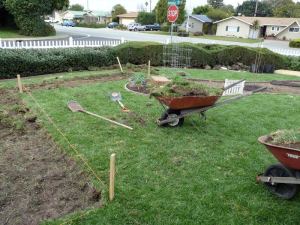
Want to try it? You can cut up sticks, straws, string, strips of paper, etc. into four 4″ lengths and eight 6″ lengths and let us know what shape configuration gives you the most square inches while still allowing easy access to the space inside the sticks. We know of two shapes that will give you 112 square inches. The largest configuration the Dirt to Dinner kids came up with today was a 112 square inch “L.” So that’s the shape that the kids measured and marked out and eventually framed with our 4′ and 6′ lengths of willow hurdles to make a 112′ garden bed.

Ready for the Dirt

Ready for the Dirt

Early Lessons from the Pea Trial

Leave a comment

Lessons from the Pea Trial–So Far

Pisello Nano Piccolo Provenzale

Pisello Nano Picolo Provenzale

#1. Early planting does not equal early eating. It’s not just 55-60 days, it’s the *right* 55-60 days. We thought an early start would give us peas sooner, but that hasn’t turned out to be the case. Peas that were supposed to be ready to start picking in 55-60 days are just now 6″ tall a week after the 60 day mark we were hoping for. The peas planted February 18th may or may not be ready for picking by mid-April. We’ll let you know!

#2. Peas planted early seem to get damaged by pests a lot more than peas planted later. Maybe because there’s not much else out there looking green and delicious in January and early February. Or maybe we just got smarter about the covers we used as the trial went on.

#3. Peas appear to sprout and grow better in February than they do in January. Weather will surely influence this. We’ll track it next year and compare. This year January was warm and sunny, if that weather had continued, maybe the peas would have been on the table by now.

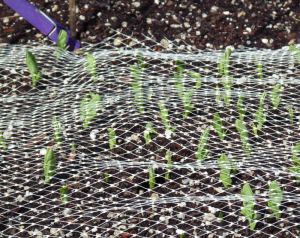
Pea Sprouts Protected by Plastic Netting

Pea Sprouts Protected by Plastic Netting

#4. Peas need to be grown under netting or cages in order to foil uninvited dinner guests. Upside down black plastic latticed plant carriers from the garden store worked well for the first few weeks, as did the onion bag netting we recycled. Neither of these methods was deep enough to allow for much growth and I would like to keep the peas protected longer, just in case. We lost a whole planting of snap peas in the back garden because something came along and snipped the tops off each of the vines. (Argh!!) We’ll keep the tall covers on these for the first several inches of growth and you can check out our Pea Trial page if you want know how our test of the burlap covered cages does.