Beans, Squash, Stakes and Sunflowers

Leave a comment

Great Sunflower Project

Great Sunflower Project

Yesterday was a busy day in the Dirt to Dinner garden.  A number of our pollinator flowers got moved into their permanent homes in the front garden area.  The vegetables will now be able to benefit from the attracting powers of Cosmos, nasturtiums, bee balm, blue basil and sunflowers.

And the Lemon Queen Sunflower seeds which recently arrived from The Great Sunflower Project are now planted. Yesterday the Scarlet Runner Beans and Sugar Pie Pumpkins that are part of our two test Three Sisters gardens were tucked into their mounds and are hopefully germinating right now in the heat. If heat is what they want, we certainly picked the perfect day to plant them. It was nearly 100 degrees yesterday and it’s at least 95 today.

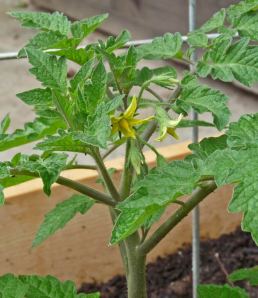
Tomatoes at the Stake

Tomatoes at the Stake


The peas and the broccoli are unhappy, but the rest of the garden seems to be loving the heat. We’re layering in the mulch wherever we can, to help conserve moisture even though the local watering restrictions excempt food gardens–so far. We also added drip irrigation to the kids’ big growing bed this week, to help make even better use of the water the garden receives. And we are thinning and adding supports in the garden to make more space and also to allow the taller plants to help cool the plants below them who appreciate it on hot, sunny days. These tomatoes offer some much needed shade to lettuces, beets and carrots planted around them.

From Grounds to Ground

1 Comment

Ground from Grounds

Ground from Grounds

I’ve been to a lot of Starbucks’ in the last couple weeks. I’m collecting coffe grounds for an experiment in one of the growing beds. Actually, I was going to compost the grounds along with some leftover sod the neighbor shared with us, and then add lots of compost to the growing bed, months from now or even next year when everything was ready. In the mean time, the dry and fragmented growing bed has some tomatoes and lots of winter squash varieites in it and they were going to need mulch and a lot of water to make it through the Summer.

Half-way through setting up the new compost bin, it struck me that maybe we could use the coffee grounds and the sod *as* the mulch while they were composting themselves into a new and improved growing medium for next year. Now, don’t try this at home yet. This may turn out to be like the time I had the great idea to butter the toast before I put it in the toaster oven hoping for a garlic bread kind of effect and the whole thing caught fire and had to be dropped out the second story window into the snow to save the rest of the apartment. But this seems, at the very least, much less likely to burst into flames if unsuccessful.

I gathered seven Starbucks-worth of coffee grounds. Which is an amazingly small amount at some stores. I’m sorry, but how could you possibly be selling coffee all day in a Starbucks and *not* have coffe grounds? I was turned away cold from store 5920 where they said they didn’t have to save their coffee grounds for customers. But most of the stores were happy to oblige and many of them even insisted on carrying heavy bags loaded with grounds out to my trunk. Thank you, Starbucks!

Caffeinated Tomatoes

Caffeinated Tomatoes

I had six or seven rolls of unwanted sod to go with the grounds. I spread out the grounds around the already planted tomatoes and squash mounds and raked them across the top of the soil we are hoping to improve. Then we covered the grounds with the unrolled sod, grass-side down, and watered the whole thing in. We plan to cover the area with another layer of coffee grounds and a mulch/compost from Kellogg’s called N’Rich. It will add some much needed variety to the soil with it’s bat guano, kelp, chicken manure and worm castings.

Then we’ll let the thing sit and the squash vines can crawl all over it and hopefully the tomatoes will grow in spite of what my grandmother always said about coffee causing stunting in the young. ;-) The idea is that the coffee layer will seep into the existing soil attracting worms who supposedly love coffee grounds. And maybe all that nitrogen will even warm things up enough that the sod layer will break down right there on the ground under the N’Rich and the squash will shade the whole thing and keep it from drying out while it’s magically converted into good growing soil.

We’ll put a shovel in it in the Fall and let you know what we’ve got. And if this year’s pumpkin pie keeps the kids from sleeping, we’ll all know why.

May Dirt to Dinner Update

Leave a comment
Sprouting and Growing    Sprouting and Growing

There’s no doubt that the garden is starting to fill out nicely. If I hadn’t noticed it myself, the evening parade of dog walkers would have been happy to remind me.

We continue to receive attention and even gifts from neighborhood well-wishers. We now have two new lavender plants, starts from lavender bushes up the road that attract several different types of bees. We have a new moisture meter, which is addicting to use and is a huge help in watering. The small horseradish we were given has turned into an enormous pot of lush leaves and roots. And the seed donation from Seeds of Change has arrived with many interesting varieties we may want to try.

Bauer Lumber in Mountain View has also been very generous with donations of scrap wood that has come in handy several times already and which will be used to complete the potato bed as the hills get higher.

Thanks everybody! It’s wonderful to have your support.

Easter Egg Radishes make delicious pickles

Easter Egg Radishes make delicious pickles

In the kitchen, I have finally perfected my radish pickling brine recipe and can’t wait for everyone to try it out the next time we meet. It’s a mix of mostly sea salt, apple cider vinegar and tamari and it tames the stronger radishes in a way I hope the kids will like. Oh, and did I mention that recipe also uses a pinch or two of suagar and a swirl of honey? That could be part of what’s helping smooth it out. Delicious!

The January planting of shelling peas is just about done producing and we are moving on to pick the February shell peas and the snap peas. I’m sure people walking past the other side of the fence think we are growing the world’s tallest Snap Peas. Little do they know the peas are started in raised beds that are three feet tall. I won’t tell if you won’t.
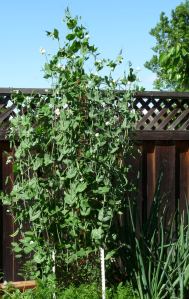
Eight Foot Tall Snap Peas

Eight Foot Tall Snap Peas

The broccoli is also still producing nice side shoots, but will flower if given half a chance. The Broccoli Raab the kids planted in their individual beds is also prone to flowering. I’m keeping the flowers trimmed to see if it will go back to making more broccoli or not.

Intensive Planting to the Max

Intensive Planting to the Max

Some of the individual planting beds are small jungles at this point. Remind me to go over plant spacing with the kids again. :-)

This one has carrots, radishes, beets and tomato plants–and that’s just in the first two square feet!
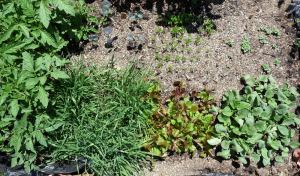
Square Foot Patchwork

Square Foot Patchwork

These will be a wonderful experiment since they are all planted differently with more or less attention to the spacing ‘suggestions’ we used at planting time. Here’s one bed that was planted with careful attention to the square foot measures that gives it a visual patchwork look that many of our visitors find appealing.

I wish I could keep the rest of the garden looking that nice and neat!


Circle of Pollinator Attractors

Circle of Pollinator Attractors

We have added a few more flowers to our pollinator collection, a blue basil, some coreopsis and others. And we have our first potato plant flower bud! I wonder what it will look like? I’m actually not sure at this point which sack of potatoes is which, so I’m not sure which kind of bud this will be. I hope Mackenzie remembers or we may not know until it’s time to pick the potatoes.

The blue potatoes sent up blue sprouts, which I would never have expected.  I didn’t even recognize them as sprouts when they first came up because they looked so dark against the soil and compost. Who knows? Maybe it will have blue flowers as well!
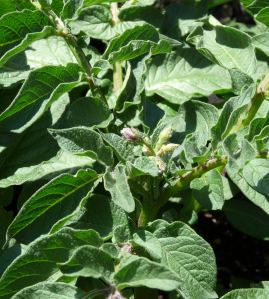
First Spud Bud

First Spud Bud

Testing the Light in the Garden

1 Comment

tilled-3sisters-bed1One of the experiments we are conducting in the Dirt to Dinner garden is a test of our ability to bring more light into a shady section up against one of the fences. It’s after 10:00 am and the sunlight still hasn’t gotten to this patch. It’ll be a little better in June and July, but less than ideal light is a fact of life for that patch of ground.
We divided the shady section into two roughly equal-size garden patches with a section of tomatoes dividing them. The right-hand section is our control, the left-hand section has white plastic attached to the fence to reflect light onto the plants during times when the sunlight is available in other parts of the garden, but doesn’t reach the plants in this spot.

The Corn is Sprouting

The Corn is Sprouting

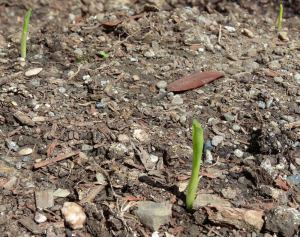
The kids made their Three Sisters corn mounds in both beds and planted the same corn variety in each bed. Yesterday, May 5th, the light bed had ten corn sprouts poking up out of the soil at the end of the day. The shadier control patch had none. Today, May 6th, the light test bed now has eleven sprouts, the shady side, just four.

I want to find a soil thermometer and see just how different the temperatures of the two sides are. It must be enough to influence germination. I can’t wait to see how the rest of the bean and squash planting goes.

Thoughts on Storing Seeds

Leave a comment

class-1_seedscatterThe piles of seeds for Dirt to Dinner have predictably gotten messy and disorganized. But last night I read a great idea for organizing seeds. When you plant some seeds from a packet, you take the remaining seeds and you store them filed away based on the month when you need to plant them next. If I am planting lettuce each month, I plant my May patch and slip the remaining seeds into the June section so that when June all-too-quickly rolls around, I know what I am trying to find room to plant next.
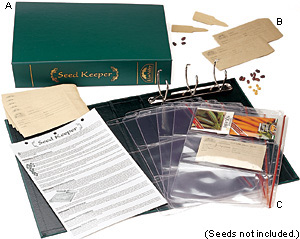
Lee Valley Seed Keeper Kit

Lee Valley Seed Keeper Kit

So now what I need is some way to sort and store the seeds in twelve sections, since we are either planting outside or starting seeds inside for Dirt to Dinner during every month of the year. Lee Valley has an elegant solution, as always.

But, since this is the year of “Make Due with What We Have” at our house (and many others, I’m sure!) I think I will try to find some similar binder pages and use my cool recycled Dirt to Dinner decoupage folder to hold them. I was also thinking it might be worth while to experiment with CD holder sleeves too. They wouldn’t have the cool zippers to hold the seeds in, but they are kicking around the house somewhere and they might be a good size for seed packets.

Seed Organization--for Now!

Seed Organization--for Now!

What I ended up with, for now, is a nine-section container with two months per section, a spot for things that are ready to be started outdoors, a spot for things that are ready to be started in-doors under the lights, and a section for things that can be planted here pretty much year round (and stuff that didn’t fit anywhere else.)

We’ll see if it keeps me organized. At least I can see what needs to get done next and when things should be planted. And if anyone reading this is looking for Mother’s Day ideas, the link to Lee Valley is http://www.leevalley.com ;-)